

Common Excavator Problems and How to Fix Them Before They Get Expensive
Let’s be honest for a second: there are very few things on a job site that will make your stomach drop faster than your main excavator suddenly dying in the middle of a massive dig. You know the exact feeling. The crew is waiting, dump trucks are lined up, the clock is ticking, and suddenly, your machine just gives up and create the most common excavator problems. Here at AmericanExcavator.org, we know firsthand that running heavy machinery is a massive financial commitment, and keeping that iron moving is the only way you actually make money.
When an excavator breaks down, you aren’t just writing a painfully large check for replacement parts and mechanic fees; you are bleeding cash through lost hours and blown project schedules. That’s why getting a solid grip on common excavator problems and how to fix them before they turn into full-blown disasters is the smartest thing any owner or operator can do.
From a tiny hydraulic drip that you keep ignoring to an engine that stutters on cold mornings, paying attention to the early warning signs is your best line of defense. We put together this guide to walk you through the real-world, everyday issues that plague diggers across the country. We’re going to show you what to look out for, how to handle it in the field, and how to keep your equipment out of the shop and in the dirt where it belongs.
Engine Starting Failures and Power Loss
There is nothing quite as frustrating as climbing into the cab at 6:00 AM with a full day of digging ahead of you, turning the key, and hearing absolutely nothing—or worse, a sad, slow crank that just won’t catch. Engine starting failures and sudden drops in power under load will bring your entire site to a grinding halt before the day even begins.
Usually, when your excavator refuses to fire up, the root of the nightmare is buried somewhere in the electrical connections or the fuel delivery system. A lot of operators make the mistake of ignoring occasional hard starts, thinking it’s just the cold weather or a one-off glitch. But if you brush off these early symptoms, you are basically asking for a burned-out starter motor or completely trashed fuel injectors down the line.
Fixing those will easily eat up your profits for the week. Instead of waiting for a total failure, you need to get proactive. Grab your multimeter, check your fuel lines, and trace the power. Taking half an hour to diagnose a sluggish start can literally save you thousands in mechanic call-out fees.
- Dead or dying batteries: This is the usual suspect. Batteries take a beating from the weather and constant vibration, and over time, they lose the raw cranking amps needed to turn over a massive diesel engine.
- Corroded or shaken-loose wiring: Heavy equipment vibrates violently all day long. This shakes battery terminal connections loose, and moisture causes them to corrode, cutting off the electricity right when you need it most.
- Trash in the fuel system: If dirt, rust, or water makes its way into your fuel tank, or if you’ve let your fuel filters get completely clogged up, your engine simply can’t breathe and burn the diesel it needs to run.
Hydraulic System Malfunctions and Fluid Leaks
If the engine is the heart of your machine, the hydraulic system is the muscle. It’s what gives your excavator the brute force to rip through hardpan and the surgical precision to lay pipe exactly on grade. When your hydraulics start acting up, you feel it immediately in the joysticks. The machine gets lazy, unresponsive, and sometimes downright dangerous to operate.
The scary thing about hydraulic failure is that it usually starts small—a tiny puddle under the boom overnight, or a slight whine from the pump when you lift a heavy load. But let me tell you, if you let a hydraulic pump run dry or pump contaminated oil through your expensive valve banks, you are looking at a repair bill that will make you want to sell the machine.
Understanding common excavator problems and how to fix them means keeping a paranoid eye on your hoses and fluid levels. Every single operator should be trained to wipe down cylinder rams, check for weeping seals, and listen for the dreaded pump cavitation noise during their morning walkaround.
- Running on low hydraulic oil: When you don’t have enough fluid in the tank, the system loses pressure, making the machine incredibly slow. Worse, it forces the main pump to suck air, which destroys the internal workings fast.
- Busted hoses and blown seals: High pressure, dry rotting from the sun, and constant rubbing against metal will eventually cause rubber hoses to burst and cylinder seals to give out, leaving a massive, expensive mess on the ground.
- Dirty, contaminated fluid: Water, sand, or metal shavings floating in your hydraulic oil essentially act like liquid sandpaper, completely shredding the incredibly tight tolerances inside your pumps and drive motors.
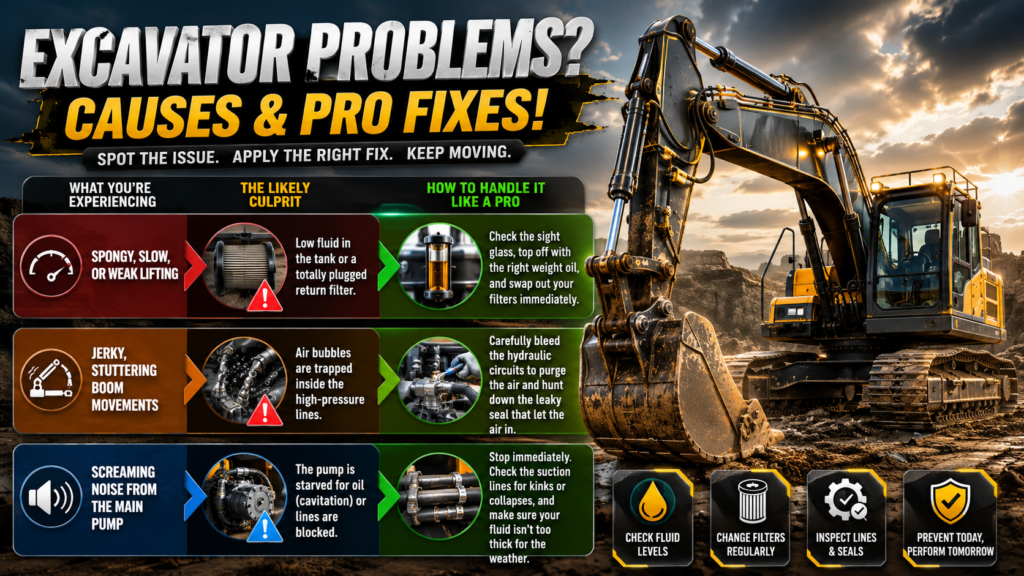
Table: Common Excavator Problems and How to Fix Them
| What You’re Experiencing | The Likely Culprit | How to Handle It Like a Pro |
| Spongy, slow, or weak lifting | Low fluid in the tank or a totally plugged return filter. | Check the sight glass, top off with the right weight oil, and swap out your filters immediately. |
| Jerky, stuttering boom movements | Air bubbles are trapped inside the high-pressure lines. | Carefully bleed the hydraulic circuits to purge the air and hunt down the leaky seal that let the air in. |
| Screaming noise from the main pump | The pump is starved for oil (cavitation) or lines are blocked. | Stop immediately. Check the suction lines for kinks or collapses, and make sure your fluid isn’t too thick for the weather. |
Undercarriage Damage and Improper Track Tension
Think about what the undercarriage of your excavator actually goes through. It has to support tons of swinging steel while grinding through mud, crushing rocks, and navigating abrasive sand all day long. It’s no surprise that undercarriage maintenance makes up a massive chunk of your machine’s lifetime running costs.
If you ignore the tracks and rollers, you are guaranteed to spend a fortune later. The absolute biggest mistake we see out in the field is guys running with the wrong track tension. If you pump too much grease in and run the tracks banjo-tight, you are putting insane stress on the idlers and drive sprockets, basically grinding them to dust.
On the flip side, if you let them run too loose, they’ll pop right off the machine the second you turn on a hillside, and they’ll wear out your track pins prematurely. You have to keep it clean, keep it tensioned correctly for the soil you are in, and swap out worn parts before they break the whole chain.
- Screwing up the track tension: Failing to adjust the tension based on whether you are working in sticky clay (which tightens tracks as it packs in) or clean rock will destroy your undercarriage faster than anything else.
- Ignoring packed mud and debris: If you don’t take a shovel to the undercarriage at the end of a muddy shift, that dirt freezes or dries into concrete overnight, locking up your rollers and tearing up the seals when you start moving again.
- Running parts past their wear life: Rollers, idlers, and sprockets are wear items. If you ride them until they are razor-thin, you risk snapping a track chain in the middle of nowhere, which is a nightmare to fix in the dirt.
Overheating Engines and Hydraulic Systems
Heat is the silent killer of heavy machinery. When you are pushing an excavator to its absolute limits during the dog days of summer, that machine generates an unbelievable amount of heat. If the cooling systems can’t dump that heat fast enough, things start melting, warping, and cracking. If you ever look down and see the temperature needle burying itself in the red, or if you smell that unmistakable scent of scorching oil, you have to throttle down and shut the machine off right then and there.
Do not try to finish the truck you are loading. Pushing an overheating machine for just a few extra minutes is a foolproof way to crack a cylinder head or fry an expensive hydraulic valve block. At AmericanExcavator.org, we always tell guys that keeping your machine cool is half the battle when it comes to preventing big repair bills. Take the time to blow out your radiators and keep your fluids fresh.
- Low coolant or broken-down oil: If your radiator is half-empty, the engine literally can’t cool itself. And if your hydraulic oil is burnt and old, it loses its ability to handle the extreme heat of the pressurized system.
- Plugged up radiators and coolers: Working in dusty environments or clearing brush will suck dirt and leaves right into the cooling fins, throwing a blanket over your radiator and blocking all the cooling airflow.
- Abusing the machine’s limits: Hanging a massive, oversized bucket on the stick or constantly trying to pry out stumps that are way too big forces the engine and hydraulics to work beyond their designed capacity, spiking temperatures rapidly.
Electrical and Wiring Troubles
Let’s face it, modern excavators are basically giant, heavy-duty computers that just happen to have a bucket attached to them. While all this new tech gives us amazing fuel economy and super smooth controls, it also means we have a whole lot of wires and sensors that can go wrong. Electrical issues are a massive headache because they are so unpredictable.
One minute everything is fine, and the next, your monitor is flashing error codes and you lose half your hydraulic functions. Sometimes it’s just a burnt smell in the cab, or a display screen that flickers every time you hit a bump. You cannot ignore electrical problems. A tiny short circuit can easily turn into a raging electrical fire that will burn a half-million-dollar machine to the ground in minutes. Keep your wiring harnesses tied up safely away from moving metal, and don’t let trash build up near electrical components.
- Blowing fuses constantly: Fuses are supposed to blow to protect the computer. If you keep blowing the same fuse, do not just put a bigger one in. You have a dangerous short circuit somewhere that needs to be chased down.
- Chewed or rubbed-through wires: Excavators shake, rattle, and roll. Wires inevitably rub against the metal frame until the insulation wears off, or field mice climb into the engine bay overnight and chew right through the harnesses.
- Dead sensors throwing bad codes: The little sensors that tell the computer how hot the oil is or where the boom is located take a beating. A little bit of moisture or a rock hitting a sensor will make the machine think it’s dying, forcing it into “limp mode.”
Final Drive Motor Issues and Failures
The final drives are the unsung heroes of your track system. They sit way down there in the mud, taking the hydraulic power from the pump and turning it into the brutal mechanical torque needed to push a 20-ton machine up a hill. When a final drive starts to give up the ghost, it’s not subtle.
You’ll notice the excavator wanting to steer off to one side on its own, or you’ll hear this horrible, grinding, popping noise coming from behind the sprocket. Because they live in the dirt and take the impact of every rock you drive over, they take a crazy amount of abuse. Keeping an eye on common excavator problems and how to fix them down in the final drives is crucial, because replacing one of these motors will easily cost you five figures. Check the gear oil level regularly, look for leaks around the inside of the track, and don’t treat your machine like a race car.
- Running dry on gear oil: The planetary gears inside the drive need thick, clean gear oil. If the seal leaks and the oil drains out, those metal gears will literally grind themselves into metal shavings in a matter of hours.
- Baking in mud: When you let heavy mud dry rock-hard around the final drive casing, you are basically insulating it. The heat from the motor can’t escape, and it cooks the internal rubber seals until they fail.
- Stripped gears and busted floating seals: Years of heavy travel eventually wear the teeth off the internal gears, and debris like old construction wire or rebar can easily wrap around the axle and slice the main floating seal wide open.
FAQs: Common Excavator Problems and How to Fix Them
What are the most common hydraulic problems in excavators?
Usually, you’re looking at things like a sudden drop in pressure, boom controls that feel laggy or spongy, jerky bucket movements, or flat-out fluid leaks. 90% of the time, these headaches trace right back to low fluid levels, a blown rubber hose, or dirt getting past the filters and trashing the oil.
Why is my excavator engine not starting?
If it won’t even crank, check your battery and the cable connections—they rattle loose all the time. If it cranks but won’t fire, you’re usually dealing with a fuel issue. Check for a plugged fuel filter, water in the water separator, or air that somehow got sucked into the fuel lines.
How often should I check the track tension on my excavator?
You should be putting your eyes on the track tension every single morning during your walkaround. If the track is sagging heavily off the bottom rollers, or if it looks completely tight like a guitar string, you need to grab your grease gun and adjust it before you start working.
What causes an excavator to overheat during operation?
It’s almost always an airflow or fluid problem. Check if your radiator fins are choked up with dust and leaves. If they’re clean, make sure your engine coolant and hydraulic oil are at the right levels and haven’t broken down from age. Also, make sure you aren’t just working the machine way too hard for the weather.
How can I fix hydraulic fluid leaks in my excavator?
First, you have to find it, which means washing the machine off so you can see where the fresh oil is coming from. If it’s a loose fitting, tighten it. If a hose has a crack in the rubber, pull it off and have a new one made. If a cylinder is weeping, you’ll likely need to pull it and repack it with a new seal kit.
Why are my excavator’s hydraulic movements slow or jerky?
When the machine acts jittery, it usually means there is air trapped inside the hydraulic lines. If it’s just really slow, you might be low on oil, causing the pump to suck air, or your hydraulic oil is so old and thick with sludge that it can’t flow properly through the valves.
What is the best way to prevent expensive excavator repairs?
Grease, grease, and more grease. Seriously, sticking to a strict daily maintenance routine is the only way. Walk around the machine every morning, grease every single pin, check your fluid sight glasses, kick the tracks, and never, ever put off changing your filters.

A trailer running at its weight limit continuously leads to accelerated tire wear and premature brake failure. Always choose a trailer rated at least 20% above your loaded machine weight.
Always calculate your TYPHON's wet weight — with fuel, hydraulic fluid, and a full tank — before purchasing a trailer. Dry weight figures from spec sheets are commonly 8–12% lower than the real transport load.
"The right trailer is not an accessory — it is the foundation of a safe, legal, and efficient job site operation for any TYPHON mini excavator owner."