

The Unspoken Secret to excavator technology for jobsite efficiency: How American Excavator’s Tech Drives Results
Walk onto almost any commercial jobsite at 6:30 in the morning, and you will see the exact same scene play out: diesel warming up, foremen squinting at crumpled blueprints on the tailgate, and grade-checkers pacing out trenches with wooden lath and marker pens. For decades, earthmoving has been viewed as a game won solely by brute force—put bigger iron in the dirt, push more yardage, and burn more fuel until the sun goes down. Thus, it is necessary for understanding excavator technology for jobsite efficiency.
But anyone running an excavation business right now knows that old-school formula is cracking under pressure. Fuel prices fluctuate wildly, skilled operators with twenty years of muscle memory are retiring faster than trade schools can replace them, and project schedules have zero margin for error.
The crews consistently finishing ahead of schedule and putting money in the bank aren’t running their guys into the ground; they have quietly figured out that modern excavator technology for jobsite efficiency is the single greatest competitive edge in construction today.
At American Excavator, that philosophy isn’t treated as an optional luxury package or marketing buzzword—it is built directly into how machinery operates, how attachments interface, and how fleets run day in and day out. When you pair heavy steel with intelligent mechanical and digital systems, you eliminate the endless cycles of over-digging, waiting on grade checkers, and burning through expensive parts, turning unpredictable jobsites into smooth, profitable operations.
The Evolution of Earthmoving: Moving Past Guesswork and Muscle
For generations, operating an excavator was an art form learned through years of making expensive mistakes in the cab. You felt the grade through the seat of your pants, listened to the engine bog down to gauge hydraulic load, and hoped your spotter on the ground was keeping a sharp eye on the surveyor’s grade stake.
If your operator miscalculated a slope by just two inches over a three-hundred-foot drainage ditch, you spent the entire next morning hauling in extra bedding gravel and running plate compactors just to fix the mistake. The integration of modern excavator technology for jobsite efficiency completely rewrites that outdated script by swapping out guesswork for raw, measurable consistency.
Smart sensors mounted along the boom, stick, and bucket relay real-time positioning directly to in-cab displays, turning even complex site plans into visual, real-time targets. By taking the physical and mental strain off the operator, machinery from American Excavator allows contractors to run tight tolerances right out of the gate, so the trench you cut before lunch matches the civil engineering plans down to the millimeter without relying on continuous manual grade checking.
- Onboard digital depth and slope assist eliminate repetitive manual staking, keeping ground personnel out of dangerous blind spots and open trenches.
- Smart hydraulic flow and auto-idle systems throttle the engine down during pauses, putting a dead stop to wasted fuel without sacrificing breakout force when digging restarts.
- Digital bucket tracking lets relatively green operators hit target depths quickly, leveling the playing field against long-standing industry labor shortages.
Precision and Power: How American Excavator Technology Maximizes Output
Raw horsepower without fine hydraulic control is just a recipe for broken utility lines, gouged trench walls, and shredded hydraulic hoses. When crews talk about output, they often brag about bucket capacity, but what actually determines project velocity is cycle time—how cleanly the bucket enters the ground, how effortlessly the hydraulics curl through hardpan, and how fast the machine swings and dumps without hydraulic stutter.
This dynamic is where specialized American Excavator technology sets a new standard on the ground. By pairing responsive pilot controls with high-output auxiliary hydraulics, these machines give operators surgical control over the bucket lip, whether they are shaving an embankment to a clean 2:1 slope or gently benching around a live gas main.
When you equip a machine with excavator technology for jobsite efficiency, the boom doesn’t fight the operator; it works with them through semi-autonomous depth limiters that physically prevent the cutting edge from dipping below the finished grade. That means you dig the profile once, load the dump trucks without wasted swing motions, and move immediately to the next station instead of wasting half your afternoon fixing sloped over-cuts.
- Proportional auxiliary hydraulic lines deliver fluid, progressive pressure adjustments rather than jarring on-off reactions, preserving machine stability under heavy load.
- Semi-automated grade protection prevents the cutting edge from penetrating past design elevation, saving thousands of dollars in wasted backfill materials.
- Ergonomic pilot joysticks with low-resistance valving drastically cut down on operator wrist fatigue, keeping production rates just as fast at 4:00 PM as they were at 7:00 AM.
Safety Without Sacrificing Speed: Smart Mini Excavator Tech on Active Sites
Ask any general superintendent what kills jobsite momentum fastest, and the answer is never weather or soil conditions—it is an OSHA recordable incident or a utility strike. Tight urban developments, residential backyard pool digs, and crowded road-widening jobs pack men, materials, and heavy equipment into high-stress spaces where one blind swing of a counterweight can bring an entire job to a dead halt.
Utilizing advanced mini excavator tech from American Excavator gives operators a second set of eyes where they need them most. Compact platforms like the TYPHON series incorporate zero-tail-swing architecture alongside digital travel alarms, electronic travel limiters, and panoramic visibility camera packages.
This practical layer of excavator technology for jobsite efficiency gives operators total spatial awareness, letting them pivot right up against property lines, concrete barriers, and commercial foundations without worrying about clipped fences or crushed utility boxes. When an operator knows the blind side of their counterweight is clear and their boom cannot physically drift into overhead lines, they swing faster, dig with confidence, and keep the job moving forward.
- Zero-tail-swing engineering combined with proximity sensors lets crews maneuver tight residential alleys without risking counterweight impacts against adjacent structures.
- Electronic boundary systems (E-fencing) allow operators to pre-set ceiling and swing limits, preventing accidental contact with live power lines and bridge decks.
- High-output LED work lights paired with wide-angle backup cameras ensure safe operation during early-morning utility cuts and late-night emergency repairs.
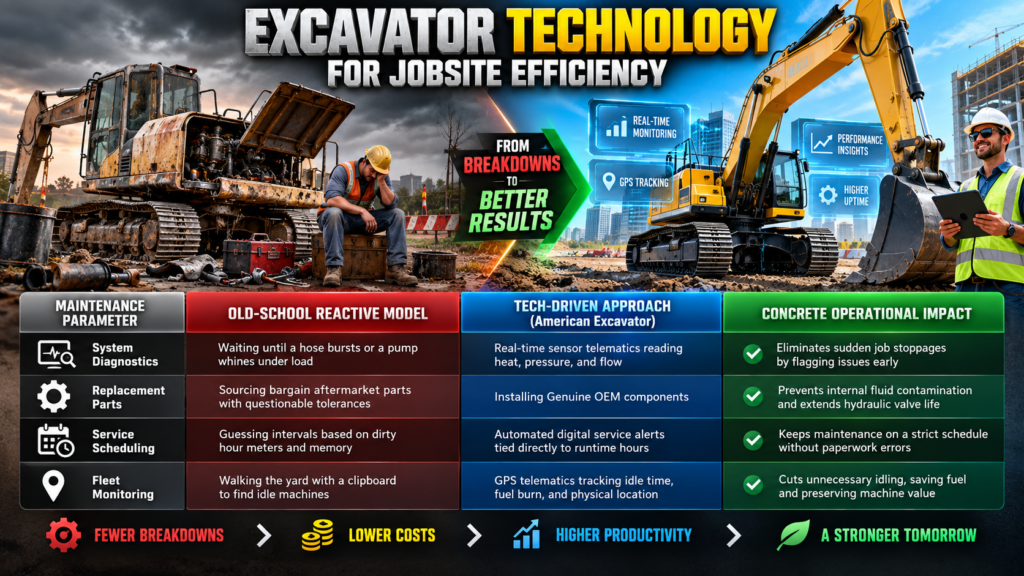
Crushing Downtime: Predictive Telematics and Genuine Iron
Every contractor has lived through the nightmare: an excavator blows a main hydraulic line or throws a seal in the middle of a major mass-excavation push, leaving three tandem axle dumps idling, an asphalt crew waiting on site, and money pouring out the exhaust pipes.
Downtime rarely happens out of nowhere; it builds up quietly through tiny oil leaks, spiking hydraulic temperatures, and skipped fifty-hour grease cycles that nobody logged in a greasy notebook. This is why forward-thinking contractors lean heavily on excavator efficiency benefits unlocked through modern telematics, combined with the rock-solid reliability of genuine factory components.
Real-time machine monitoring tracks hydraulic pressure drops, coolant heat, and engine loading around the clock, pinging fleet managers on their phones before an issue turns into a catastrophic failure.
Backing that data up with genuine OEM parts—rather than sketchy aftermarket components that never quite seat right in the valve block—protects the machine’s precision tolerances. Treating preventative maintenance as an automated, data-backed discipline rather than an afterthought is what keeps iron running week in and week out.
Table: Excavator technology for jobsite efficiency
| Maintenance Parameter | Old-School Reactive Model | Tech-Driven Approach (American Excavator) | Concrete Operational Impact |
| System Diagnostics | Waiting until a hose bursts or a pump whines under load | Real-time sensor telematics reading heat, pressure, and flow | Eliminates sudden job stoppages by flagging issues early |
| Replacement Parts | Sourcing bargain aftermarket parts with questionable tolerances | Installing Genuine American Excavator OEM components | Prevents internal fluid contamination and extends hydraulic valve life |
| Service Scheduling | Guessing intervals based on dirty hour meters and memory | Automated digital service alerts tied directly to runtime hours | Keeps maintenance on a strict schedule without paperwork errors |
| Fleet Monitoring | Walking the yard with a clipboard to find idle machines | GPS telematics tracking idle time, fuel burn, and physical location | Cuts unnecessary idling, saving fuel and preserving machine value |
- Genuine OEM seals and hydraulic pumps maintain designed operating pressures, preventing heat build-up that cooks hydraulic fluid and destroys packings.
- Automated maintenance alerts ensure oil, fuel, and pilot filters are swapped on actual run-time hours rather than rough guesswork.
- Diagnostic fault codes can be pulled remotely, meaning a service technician arrives on the site with the exact tools and replacement parts in hand on the first trip.
Telematics and Hard Numbers: The Engine Behind Modern Jobsite Productivity
Running an excavation outfit without hard data is like flying a plane blindfolded—you might feel the wind, but you have no idea where you are actually heading until you hit the ground. For years, business owners looked at their bank accounts at the end of the month to figure out if their bidding estimates were accurate. By tapping into modern telematics, you transform every piece of equipment into a data hub that tracks operational efficiency down to the minute.
Implementing excavator technology for jobsite efficiency through telematics reveals surprising realities: machines sitting idle for 40% of the working day, operators burning fuel in high-power modes while merely dressing a trench, or haul trucks queuing up too slowly at the loading bench.
Armed with this intelligence, project managers can reorganize their loading cycles, coach operators to use appropriate engine modes, and dramatically boost baseline jobsite productivity. When you know precisely what it costs to move a cubic yard of dirt on every specific machine in your fleet, you bid jobs tighter, win more contracts, and protect your profit margins.
- Accurate idle-time tracking exposes bottlenecks in dump truck cycles, showing dispatchers where to add or remove haulers to keep the excavator loading constantly.
- Integrated fuel consumption analytics reveal which operators are over-revving machines during light grading work, cutting site-wide diesel costs.
- Geofencing and machine tracking provide real-time anti-theft security and prevent unauthorized equipment use on weekends or after hours.
Attachment Versatility: Multiplying the Value of Every Machine Cycle
A bare excavator sitting on tracks is simply a hydraulic power unit waiting for an assignment; its true earning potential comes from the steel working on the end of the arm. In the past, swapping from a general-purpose digging bucket to a hydraulic breaker or an auger meant beating rusted pins out with a sledgehammer, wrestling oily hoses, and losing forty-five minutes of valuable digging time.
Today, smart mechanical design and rapid-change hydraulic couplers have turned versatile attachments into a core driver of excavator efficiency benefits. Modern excavators let operators drop a trenching bucket, grab a heavy-duty ripper to break through stubborn caliche or shale, and switch to a hydraulic compaction wheel in a matter of minutes—all without leaving the cab.
Pair that setup with a tiltrotator, and the machine turns into a surgical multi-tool that can dig around manholes, bevel pipe bedding, and backfill curbs from awkward angles without having to reposition the tracks. That level of flexibility is where excavator technology for jobsite efficiency directly saves money: you perform the work of three specialized machines with a single power unit, keeping your site clear, your overhead low, and your productivity high.
- Hydraulic quick-couplers allow operators to switch between buckets, rippers, and breakers in under two minutes without manual pin-hammering.
- Advanced tiltrotator attachments provide 360-degree continuous rotation and 45-degree tilt angles, letting operators sculpt tricky contours without shifting the tracks.
- Auxiliary hydraulic relief valves automatically match pre-set pressures for specific attachments, preventing blown seals in expensive hydraulic breakers and augers.
FAQs on Excavator Technology for Jobsite Efficiency
How does modern excavator tech actually improve daily jobsite efficiency?
Modern technology optimizes daily efficiency by cutting out guesswork and repetitive tasks. Through integrated 2D and 3D grade control, automated depth sensors, and responsive hydraulics, operators can reach target elevations on the first pass without waiting for manual grade checks. This drastically cuts fuel burn, prevents over-excavation, saves on bedding materials, and shortens project schedules.
Can tech-assisted controls help bridge the skilled operator shortage?
Yes. While tech cannot replace good work ethics or spatial awareness, semi-autonomous controls, in-cab digital visualizers, and depth-assist systems significantly flatten the learning curve. Newer operators can achieve accurate trench bottoms, smooth grades, and clean slopes weeks ahead of schedule, helping construction companies remain productive despite a shortage of veteran operators.
Why should contractors bother with genuine OEM parts instead of cheap aftermarket spares?
Precision hydraulic systems depend on tight machining tolerances, balanced pressures, and clean fluid paths. Cheap aftermarket components often feature slight dimension variations, lower-grade steel, and inferior filtration media. Using genuine OEM parts from American Excavator protects sensitive hydraulic pumps, preserves factory operating pressures, and prevents premature mechanical failures that halt work.
What is machine telematics, and how does it reduce operating costs?
Telematics is an integrated system that captures diagnostic, operational, and location data from onboard sensors and transmits it to your phone or computer. It reduces costs by showing exact fuel burn patterns, tracking engine idle time versus active dig time, warning of mechanical issues before parts break, and streamlining regular maintenance schedules.
Does advanced mini excavator tech make a difference on small residential jobs?
Mini excavators operating in tight backyards or close to foundations gain massive advantages from technology. Zero-tail-swing engineering, proportional auxiliary controls, and electronic swing limiters allow operators to work within inches of houses, utility lines, and fences without risking structural damage. This precision speeds up tight-quarter work that previously required manual shoveling.
How does automated depth and grade control prevent expensive jobsite rework?
Grade control systems use boom and stick angle sensors paired with bucket positioning to calculate exact depth relative to a benchmark. When the bucket reaches the programmed depth, the hydraulic system restricts further downward travel. This mechanical floor prevents operators from digging too deep, which eliminates the need to haul in, place, and compact expensive backfill gravel.
What are the best excavator attachments for speeding up cycle times?
Hydraulic quick-couplers are the biggest time-savers, letting operators swap tools in minutes without leaving the cab. Beyond couplers, tiltrotators allow buckets to articulate around obstacles without repositioning the undercarriage, while specialized rock rippers and hydraulic thumbs speed up material handling and demolition cycles substantially.