
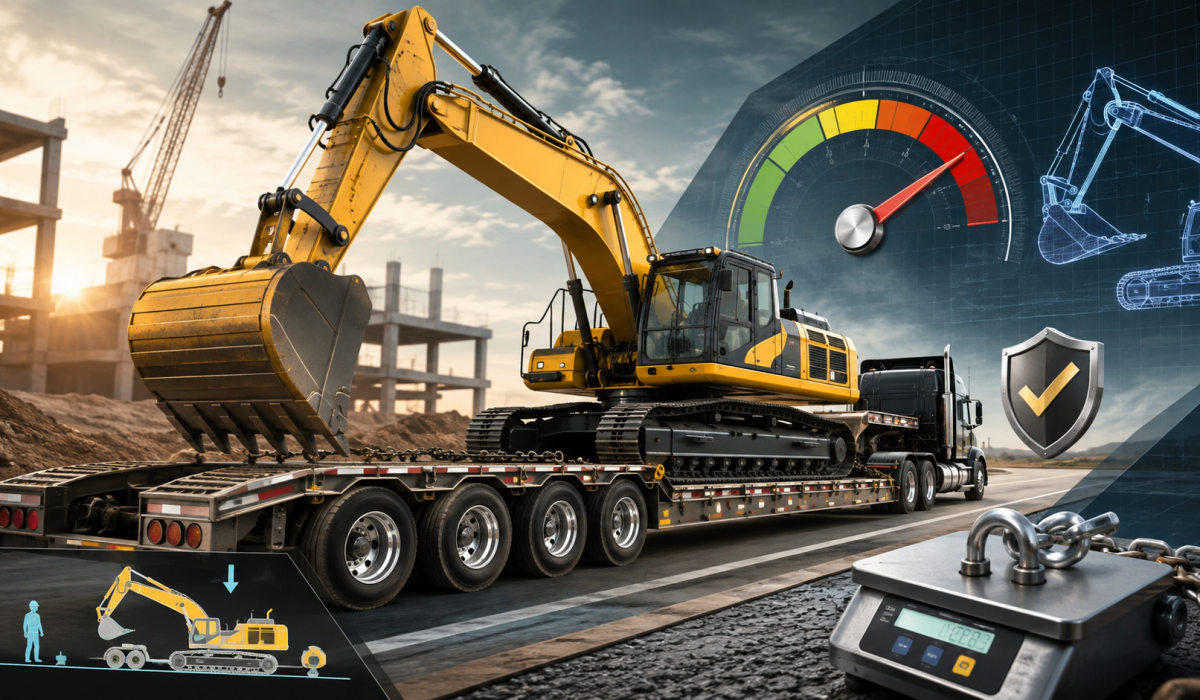
Excavator Weight Limits Explained: Transport & Job Site Safety
Let’s be real—when you are managing a construction project, knowing your iron inside and out is the only way to get the job done without damaging equipment or, worse, getting someone hurt. Among all the specs you need to memorize, excavator weight limits sit right at the top of the list. Whether you are breaking ground on a massive commercial facility or just digging a trench for a residential utility line, the physical weight of your machine dictates absolutely everything.
It changes how you plan your logistics, what kind of truck you need to rent, and how the tracks will interact with the dirt once you finally unload. Here at americanexcavator.org, we always remind contractors that the gross weight on that spec sheet isn’t just a suggestion; it’s a hard boundary that affects your machine’s performance and your crew’s safety.
Pushing a piece of heavy machinery past its engineered limits almost always ends in a blown hydraulic cylinder, a sunken track, or a massive headache at a highway weigh station. By respecting the boundaries set by the manufacturers, you can keep your fleet out of the repair shop and ensure your operators go home safe every single night.
- Protecting your bottom line: Knowing your exact excavator weight limits means you never waste fuel and money hauling a machine that is way too big for the job, or break a machine that is way too small.
- Keeping the crew safe: Staying well within the manufacturer’s weight constraints actively prevents terrifying rollover accidents, unstable loads, and sudden ground collapses.
- Avoiding massive fines: Knowing your equipment’s true weight stops you from dealing with expensive roadside tow fees, blown trailer tires, and hefty regulatory penalties.
Breaking Down Excavator Weight Classes
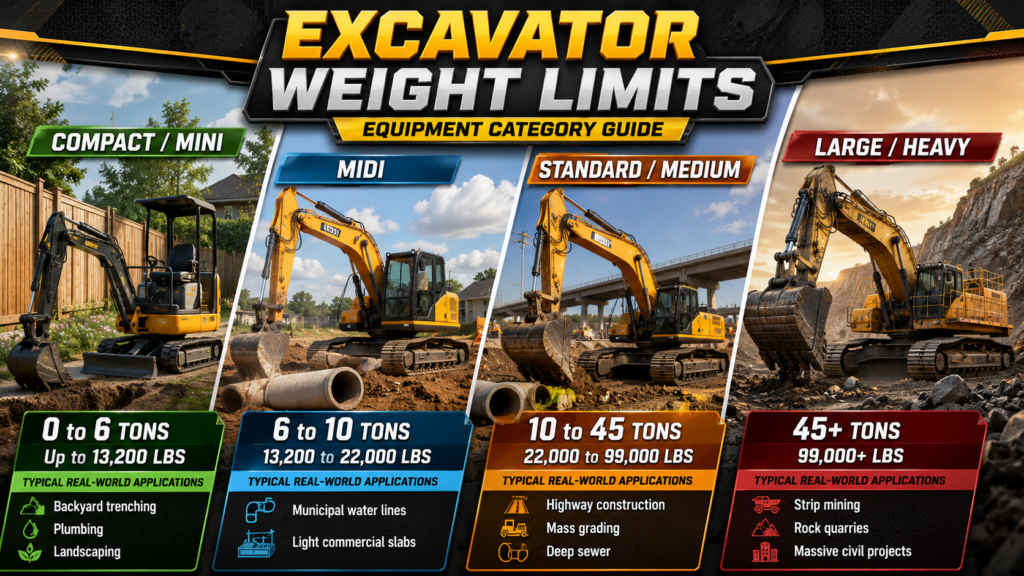
Before you can confidently plan out your logistics, you have to understand exactly where your machine fits into the broader market. The industry generally splits excavator weight limits into four main groups: compact (or mini), midi, standard, and large. Each of these categories is engineered for a very specific type of work, and their weight directly impacts their breakout force and lifting capacity.
Mini excavators usually clock in at under 6 metric tons, making them the absolute go-to choice for tight residential backyards, indoor demolition, and basic landscaping. Midi excavators step it up to around 10 tons, giving you a bit more muscle for utility work while still being fairly easy to load onto a standard tag-along trailer. Standard excavators are the heavy hitters you see on almost every major highway or commercial dirt crew.
Weighing anywhere from 10 to 45 tons, they offer the perfect mix of serious digging depth and raw power. Finally, if you are looking at anything over 45 tons, you are entering the large class. These massive machines are pretty much strictly reserved for high-volume quarrying, mining, and massive earthmoving campaigns where sheer scale is the only thing that matters.
Table: Excavator Weight Limits – Equipment Category
| Equipment Category | Operating Weight (Tons) | Operating Weight (Pounds) | Typical Real-World Applications |
| Compact / Mini | 0 to 6 Tons | Up to 13,200 lbs | Backyard trenching, plumbing, landscaping |
| Midi | 6 to 10 Tons | 13,200 to 22,000 lbs | Municipal water lines, light commercial slabs |
| Standard / Medium | 10 to 45 Tons | 22,000 to 99,000 lbs | Highway construction, mass grading, deep sewer |
| Large / Heavy | 45+ Tons | 99,000+ lbs | Strip mining, rock quarries, massive civil projects |
- Match the machine to the dirt: Choosing the right class is step one in making sure you don’t overwhelm the soil bearing capacity of your specific job site.
- Power and weight go hand-in-hand: An excavator’s physical mass directly acts as its counterweight, so a heavier class will naturally yield a significantly higher lifting capacity.
- Permit planning starts here: Pinpointing your exact weight class lets your logistics team book the right lowboy trailers and pull the right permits weeks before the move.
Surviving the Scales: DOT Regulations and Hauling
If you have ever had to haul a 40,000-pound piece of iron down an interstate highway, you already know that the authorities don’t mess around when it comes to road safety. Excavator weight limits dictate every single aspect of heavy equipment hauling, mostly because the federal government has very strict rules on how much stress public bridges and asphalt can take. Without any special paperwork, the absolute maximum gross vehicle weight (GVW) you can legally run down the highway is 80,000 pounds.
But it’s not just about the total number on the scale; it’s about how that weight is spread out. DOT weight limits strictly cap single axles at 20,000 pounds and tandem axle groups at 34,000 pounds. Once you load a standard or large excavator onto a heavy-duty lowboy, you are almost always going to blow right past those standard limits.
That is when you have to start dealing with the headache of oversized and overweight permits. Planning these moves requires a lot of patience, as you have to route your trucks around low bridges, weight-restricted county roads, and sometimes even coordinate with police escorts to stay on the right side of the law.
- The 80K rule: Standard commercial hauling hits a hard ceiling at 80,000 pounds GVW, meaning anything heavier triggers a completely different set of legal rules.
- Axles matter most: You can be under the total weight limit but still get a massive ticket if your trailer load isn’t balanced to meet specific single and tandem axle restrictions.
- Permits are non-negotiable: Running an overweight excavator load without the proper state permits is a fast track to getting your truck impounded on the side of the highway.
Nailing the Loading Process and Securing the Iron
Getting an excavator from the equipment yard to the dirt requires a lot more than just driving it up a set of steel ramps. A successful excavator transport operation starts with doing the math on your truck and trailer to ensure their payload capacity actually matches the gross weight of the machine. And this is where a lot of guys make a critical mistake: they forget to account for the extras.
When you are calculating your total load, you have to add in the weight of the hydraulic thumb, the severe-duty bucket, the quick coupler, and even the fuel in the tank. Once you are confident the trailer can handle the load, loading the machine requires dead-level ground and a spotter who actually knows what they are doing.
After the machine is parked perfectly over the trailer axles to balance the weight, securing it is a science of its own. Federal law requires specific tie-down methods using heavy-duty transport chains and binders that are stamped and rated for the load they are holding. A heavy standard excavator is naturally going to require more tie-down points and thicker chains than a small backyard mini-ex.
- Check the data plates: Always cross-reference the trailer’s maximum Gross Vehicle Weight Rating (GVWR) against the excavator’s actual operating weight before you even drop the ramps.
- Chain it down right: Use DOT-approved, properly graded chains at the exact tie-down points welded onto the machine’s undercarriage to stop the load from shifting if you have to slam on the brakes.
- Don’t forget the attachments: A hydraulic breaker or an extra grading bucket chained to the deck adds thousands of pounds that count against your total legal hauling weight.
Job Site Safety and Keeping the Tracks on Solid Ground
Once you actually get the machine unloaded, your focus has to shift immediately to job site safety. The sheer, concentrated weight of an excavator creates an incredible amount of ground bearing pressure. If you track a 50,000-pound machine into a swampy, uncompacted area without thinking ahead, it is going to sink up to the belly pan before you can even swing the boom. Site foremen need to constantly evaluate the soil conditions to make sure the ground can actually support the machine’s footprint.
Furthermore, you have to respect the load charts bolted inside the cab window. Those charts tell you exactly how much weight the machine can safely lift at different boom extensions based on its built-in counterweight. If you try to pick up a trench box or a massive concrete storm pipe that exceeds those specific excavator weight limits, the machine’s center of gravity shifts entirely. When that happens, the machine gets tippy, and you risk a violent rollover that could destroy the equipment and seriously injure the operator and ground crew.
- Read the dirt: Always do a walk-around of the site to check for soft spots, hidden voids, or uncompacted trenches before tracking heavy iron across the property.
- Live by the load chart: Never guess how much a concrete structure weighs; always check the engineered lifting chart in the cab to maintain your center of gravity.
- Mat it out: If the ground is dangerously soft, use heavy timber crane mats to spread the excavator’s immense weight over a wider surface area to prevent sinking.
The Brutal Reality of Ignoring the Limits
If you decide to play fast and loose with equipment capacities, it is only a matter of time before it catches up with you in the worst way possible. Ignoring excavator weight limits hits contractors from two sides: mechanical breakdowns and legal nightmares. From a logistics standpoint, trying to sneak an overweight load past a DOT checkpoint usually results in crippling fines that wipe out the profit margin for the entire job. Worse, overloading an underrated trailer can snap an axle or blow out tires at highway speeds, causing a catastrophic wreck.
On the dirt side of things, constantly pushing a machine past its engineered lifting capacity destroys the equipment from the inside out. You will start blowing expensive hydraulic cylinder seals, burning up the main pump, and you might even discover terrifying stress cracks in the boom steel. At the end of the day, blatantly ignoring the rules of heavy machinery weight shows a reckless disregard for the people working around you, opening your company up to massive liability.
- Goodbye profit margins: Getting popped for overweight hauling usually results in thousands of dollars in immediate fines and a permanent stain on your company’s federal safety record.
- Shredding your hydraulics: Pushing the machine to lift more than it was designed to handle boils hydraulic fluid and blows expensive seals, causing massive downtime.
- Lawsuits waiting to happen: Accidents caused by overloaded, unstable equipment give insurance companies a reason to drop your coverage and leave you exposed to devastating legal action.
FAQs on Excavator Weight Limits
What is the standard weight of an excavator?
There really isn’t just one “standard” weight because it depends entirely on the class. However, the machines you see on typical commercial jobs usually fall into the standard class, weighing anywhere from 22,000 to 99,000 pounds (10 to 45 metric tons). Mini excavators sit way down under 13,000 pounds, while massive mining rigs can easily push past 100,000 pounds.
How do excavator weight limits impact transportation?
The weight of your machine completely dictates the truck, trailer, and route you have to take. If the truck, trailer, and excavator combine to weigh more than 80,000 pounds, standard transport is out the window. You will have to file for state-specific oversize/overweight permits, run multi-axle lowboys, and carefully avoid bridges that can’t handle the massive load.
What are the DOT weight limits for hauling heavy equipment?
The Department of Transportation strictly caps standard commercial loads at 80,000 pounds gross vehicle weight to protect the highway infrastructure. On top of that, they limit the weight on single axles to 20,000 pounds and tandem axles to 34,000 pounds to make sure the weight is safely distributed across the trailer deck.
How much weight can a mini excavator safely lift?
It entirely depends on the size of the mini and where the boom is positioned. A popular 3.5-ton machine can usually lift between 1,500 and 3,000 pounds when the load is tucked in close. But remember, the further you stretch that boom away from the tracks, the less weight you can safely hold without tipping forward.
Do I need a CDL to transport a mini excavator?
You might actually be able to get away without one, provided you do the math. If the combined weight rating of your heavy-duty pickup truck and your flatbed trailer stays strictly under 26,001 pounds, a Commercial Driver’s License isn’t usually required by the feds. Just be sure to double-check your local state laws before hitting the road.
How does ground pressure affect job site safety?
Ground pressure is basically how hard the machine is pushing down on the dirt beneath its tracks. If a heavy machine exerts too much pressure on soft, muddy ground, it will sink unevenly. This throws off the excavator’s center of gravity and creates a massive, immediate risk of the machine rolling over on its side.
What happens if you overload a flatbed trailer with an excavator?
Putting an oversized machine on an underrated t ag trailer is asking for a disaster. You will likely bend the steel frame of the trailer, blow out the tires from the excess heat and friction, and completely overwhelm the tow vehicle’s braking system, making it nearly impossible to stop quickly in highway traffic.