

Don’t Get Stuck in the Mud: The Excavator Resale Value Argument for American Excavator Machines
Ask any seasoned excavation contractor about their biggest purchase mistake, and nine out of ten won’t tell you about an engine blowing up on an interstate job. They’ll tell you about that one time they thought they were being clever by buying a dirt-cheap, off-brand mini excavator from an online clearinghouse which can be easily completed by American excavator resale value.
On paper, it looked like a slam dunk—they saved twenty grand right out of the gate, the financing was easy, and the machine dug dirt just fine for the first four hundred hours. Then the pins started wobbling in the boom foot, the hydraulic oil began running hot enough to fry bacon, and when they finally decided to dump the headache three years later, local dealers wouldn’t even offer trade-in scrap value for it.
That initial discount evaporated into thin air, dragged down by heavy depreciation and parts that nobody on this continent could track down. That is why smart fleet owners don’t look at iron through the narrow lens of purchase price alone.
Instead, they run the numbers on American excavator resale value, treating the machine as a working capital asset where long-term durability and domestic parts support turn an everyday workhorse into serious cash equity down the road.
What Actually Dictates American Excavator Resale Value on the Secondary Market
Walk through an equipment yard before a regional consignment auction, and you will see bidders doing the exact same dance: grabbing the bucket teeth with work gloves to shake the dipper stick, squinting through flashlights at the slew ring gear, and crawling underneath the carriage to check the bottom rollers for flat spots.
Buyers in the used equipment arena are inherently skeptical because a single cracked boom casting or burned-out travel motor can wipe out an entire season’s profit on a site development project.
When you go to sell a rig backed by established domestic support—like the machines distributed through American Excavator out of Commerce, California—you are selling certainty in a market full of gambles. Buyers know the steel was welded to tight structural specs, the hydraulic pump pressures match published shop manuals, and the chassis wasn’t built out of low-grade recycled iron.
That direct confidence keeps the floor price high, shielding your initial investment from the free fall depreciation that wipes out unbranded foreign equipment.
- Structural Integrity Over Time: Heavy-gauge American-spec steel plates and robotic-welded seams resist metal fatigue, meaning the boom and dipper arms don’t develop hairline structural fractures after thousands of hours of trenching through rocky cliche.
- Domestic Supply Chain Reliability: A secondary buyer knows they can call an American distributor and get factory replacement seals, cylinder rebuild kits, and hydraulic valves delivered to their door in two days, avoiding costly job site shutdowns.
- Broad Market Appeal: Resale markets thrive on familiarity; standard machine footprints like compact 1-to-3-ton models easily match up with standard tandem-axle utility trailers, widening your pool of prospective buyers to include local plumbers, landscapers, and residential utility contractors.
The Parts Strategy: Why Genuine Spares Protect Your Machinery Equity
There is an old, tired myth floating around field mechanics that says an O-ring is just an O-ring and a hydraulic filter is just a can full of paper. Try telling that to a variable-displacement piston pump when a five-dollar knockoff filter collapses under high pressure and sends microscopic brass filings through your entire valve manifold.
Keeping your equipment running on genuine OM spares isn’t just about avoiding roadside downtime; it’s an active, ongoing investment in your ultimate American excavator resale value.
Whether you’re running compact earth movers like our popular TYPHON series or heavier utility excavators, authentic components ensure the engine, cooling pack, and hydraulics operate within their engineered thermal limits.
When a prospective buyer inspects your machine and sees pristine factory-stamped filters, clean OM hoses without mismatched aftermarket adapters, and a dry belly pan, you immediately take away their leverage to negotiate your price down.
- Factory Tolerance Protection: Genuine hydraulic filters, directional control valves, and relief cartridges maintain exact system pressures, keeping hydraulic fluid free of debris that scores cylinder walls and degrades expensive swing motors.
- The Buyer’s Inspection Advantage: When buyers see stamped OM parts across the engine bay and track drives, it signals that the owner never cut corners on operational maintenance, instantly commanding higher offers.
- Longer Component Cycles: Genuine heat-treated bucket pins, hardened bushings, and track sprockets wear down evenly and slowly, preventing the loose, sloppy stick slop that immediately scares away experienced operators.
Evaluating Depreciation Curves: Premium Build Quality vs. Disposable Iron
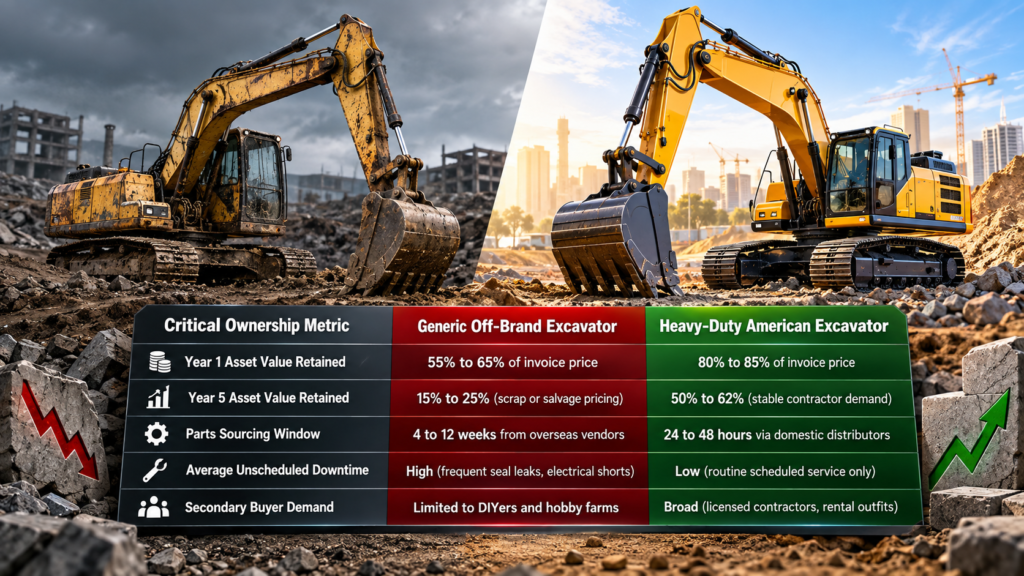
If you sit down with a pencil and trace out the depreciation curves of construction equipment over a five-year horizon, the financial reality of cheap machinery hits like a bucket of cold water. Low-tier imported excavators suffer from what equipment appraisers call a “front-loaded cliff”—dropping nearly half their value within twelve to eighteen months simply because the secondary market has zero appetite for machines that have no dealer network.
By contrast, investing in an American excavator allows you to ride a much flatter, predictable depreciation curve. Yes, every machine takes a hit when it transitions from new to used status, but well-built iron with domestic backing stabilizes quickly. You get five solid years of billable job site hours, take advantage of IRS Section 179 tax deductions on the front end, and still walk away with a sizable lump sum when you liquidate the asset to upgrade your fleet.
Table: American excavator resale value
| Critical Ownership Metric | Generic Off-Brand Excavator | Heavy-Duty American Excavator |
| Year 1 Asset Value Retained | 55% to 65% of invoice price | 80% to 85% of invoice price |
| Year 5 Asset Value Retained | 15% to 25% (scrap or salvage pricing) | 50% to 62% (stable contractor demand) |
| Parts Sourcing Window | 4 to 12 weeks from overseas vendors | 24 to 48 hours via domestic distributors |
| Average Unscheduled Downtime | High (frequent seal leaks, electrical shorts) | Low (routine scheduled service only) |
| Secondary Buyer Demand | Limited to DIYers and hobby farms | Broad (licensed contractors, rental outfits) |
- Total Cost of Ownership Calculation: Factoring upfront purchase price against maintenance costs, fuel burn, downtime losses, and final sale proceeds proves that premium iron consistently delivers a lower cost per billable operating hour.
- Protection Against Equipment Abandonment: When obscure import brands vanish or abandon model lines, owners are left with “orphan iron” that cannot be fixed; domestic suppliers maintain active, ongoing parts availability across model years.
- Strong Collateral Value for Lenders: Commercial equipment lenders and banks offer far better financing and lease terms on established machinery brands because they know the equipment holds sufficient equity to cover the loan note in a pinch.
Job site Rituals: Daily Operator Habits That Lock In Residual Worth
You can buy the best-engineered machine on the market, but if your operators ignore the grease gun and run the machine bone-dry through sandy loam, your equity will wash away in a season.
Protecting your American excavator resale value boils down to setting non-negotiable daily habits on the job site. A ten-minute walk-around at the start of every shift pays for itself ten times over when trade-in day comes around. Greasing all boom, stick, and bucket pivot points pushes out dirt and water before it can grind into the bushings.
Keeping track tension adjusted to spec prevents excessive wear on idler wheels and track drive sprockets. Keeping a logbook in the cab where the operator jots down hours, oil changes, and fluid top-offs creates an undeniable paper trail that turns an otherwise ordinary sale into a verified, top-tier listing.
- Daily Lubrication Routine: Pumping fresh grease through every zerk fitting until clean grease pushes out the old purging dirt keeps pin tolerances tight and prevents expensive line-boring repairs down the road.
- Track and Undercarriage Hygiene: Scraping packed clay, roots, and frozen mud out of the track frames at the end of every work shift prevents excessive strain on the drive motors and keeps bottom rollers turning freely.
- Fluid and Filter Verification: Checking engine oil, hydraulic sight glasses, and coolant levels before turning the key ensures minor leaks are spotted and patched long before they cause catastrophic component failure.
Prepping the Machine: How to Cash Out at the High End of the Market
When the time finally comes to refresh your yard and put your excavator on the secondary market, how you present the iron makes a massive difference in the final check you collect. Equipment buyers buy with their eyes before they ever read the spec sheet.
If you drag a mud-caked machine straight off a demolition site and throw it on an auction lot, you are inviting low ball bids from opportunistic flippers. Spending a weekend detailing the machine—pressure washing the frame, decreasing the slew ring cavity, blowing out the cab air filters, and touching up scratched counterweights—can easily swing your final sale price by thousands of dollars.
Furthermore, bundling the machine as a job-ready package with functional, high-utility attachments like trenching buckets, hydraulic breakers, and augers turns your listing into a turnkey solution for contractors who need to put equipment to work the following Monday.
- Complete Mechanical and Cosmetic Detailing: A spotless engine bay, crystal-clear cab glass, intact operator seat, and freshly pressure-washed undercarriage immediately communicate to buyers that the machine was treated with care.
- Addressing Minor Leaks and Hardware: Spending a couple hundred bucks to replace weepy O-rings, blown hydraulic quick-disconnects, and worn bucket teeth removes easy targets that buyers use to chip away at your price.
- Bundling Work Attachments: Packaging your machine with a complete set of tools—including grading buckets, rippers, or hydraulic hammers—creates high perceived value and allows you to capture a much higher total transaction price.
FAQs on Excavator Resale Value and Equipment Longevity
What is the typical depreciation rate on a newly purchased excavator?
A commercial excavator usually drops 15% to 20% of its initial value during the first year of operation, primarily reflecting the shift from brand-new to used status. For high-quality machines with proven parts networks, the annual depreciation rate slows down to a steady 8% to 12% per year through years two through five. Cheaper, unbranded imports often lose 35% to 50% in year one and continue dropping steeply because secondary buyers avoid machinery with unpredictable parts support.
At what operating hour threshold does an excavator lose significant value?
In the compact and mini excavator segment, the 3,500 to 4,500-hour mark is where buyers begin scrutinizing equipment closely for undercarriage wear, pump efficiency, and engine blow-by. However, hours are secondary to documented care. A well-maintained excavator with 5,000 hours and a complete, verifiable binder of fluid samples and OM filter changes will regularly command a higher sale price than a neglected machine showing only 2,500 hours with wobbly pins and leaking valves.
Does domestic brand backing really improve my excavator’s trade-in value?
Yes, dramatically. When buyers evaluate used machinery, their single biggest fear is downtime caused by missing or discontinued parts. An established supplier like American Excavator provides direct domestic access to replacement hydraulic pumps, travel motors, seal kits, and attachments. That reliable parts pipeline removes immense risk for the next owner, which translates directly into higher bidding, quicker sales, and far better residual value retention.
Are compact and mini excavators easier to resell than full-sized machines?
Compact machines—especially those under four metric tons—enjoy the highest liquidity and fastest turnover in the used equipment market. Mini excavators can be hauled on standard equipment trailers behind conventional pickup trucks without requiring commercial transport permits or oversize load escorts. This opens your listing to an enormous buyer pool that includes pool builders, landscape contractors, plumbers, fence installers, and private landowners.
How much do included attachments increase the overall resale package price?
Bundling versatile attachments like hydraulic thumbs, auger drives, tiltrotators, and different bucket widths typically yields a 60% to 75% return on the attachment’s initial cost. Contractors prefer turnkey packages because it saves them the hassle of tracking down compatible mounting brackets and hydraulic hose hookups, making your machine significantly more attractive than bare-boom competitors.
What is the ideal time of year to list a used excavator for sale?
Late winter through early spring—specifically February through April—is historically the peak selling season for per-owned excavation equipment. This is when contractors are finalizing their spring and summer job bids, spending newly approved capital budgets, and looking for immediate additions to their fleets to hit the ground running as soon as the frost clears.
American excavator resale value