

5 Reasons Why Property Owners Get Early Excavation Estimates
The construction and land development project is a monumental undertaking that needs meticulous planning, a thorough understanding of the terrain, and a strong financial strategy. Whether you are breaking ground for a new commercial facility, preparing a residential lot or installing essential underground utilities, the foundation of your project’s success literally begins in the dirt. by understand the initial excavation estimates will help to analyze the expenditure.
One of the most important steps in this preliminary stage is to get accurate excavation estimates. Sadly, many property owners don’t even begin to research the costs of earthmoving and site prep until the final blueprints are drawn up and construction is ready to start. The longer this Critical Step is deferred, the greater the chance of expensive budget overruns and schedule delays.
Importance of Early Excavation Estimates
At American Excavator, we have seen firsthand how planning can make or break a development, so we continue to advocate for early cost forecasting. Obtaining detailed excavation estimates during the early design or pre-construction phase gives stakeholders the financial and logistical clarity to make intelligent, well-informed decisions.
It is not only best practice to know the true extent of earthwork prior to final design, it is an absolute necessity for project feasibility. Excavation is notoriously one of the riskiest phases of any construction project, because the ground beneath our feet is full of unknowns.
Hidden rock formations, unstable soil conditions, and high water tables can completely derail a project if not taken into account early on. By asking for estimates at the outset, property owners are essentially buying an insurance policy against the unpredictable nature of work underground.
Such foresight allows developers, architects and contractors to work together, changing designs to match the realities of the landscape, rather than trying to make the landscape fit a pre-conceived plan. In this definitive guide, we’ll examine the key benefits of early estimation and explore the five indisputable reasons property owners seek excavation estimates early to safeguard their assets and streamline their construction timelines.
Top 5 Reasons Why Property Owners Get Early Excavation Estimates
1. Proper Budgeting to Avoid Unexpected Financial Burdens
Getting good excavation estimates early in the life of the project is the key to developing a good, reliable construction budget. Earthmoving and site preparation can easily soak up a large part of the initial budget for a project, and if you get these costs wrong it can have disastrous knock-on effects for the rest of the build.
Property owners who bring in professional excavating contractors early in the process are able to get detailed quantity takeoffs, which is a detailed analysis of the exact amount of soil, rock, or debris that needs to be cut (removed) or filled (added) in order to get to the desired grade.
This level of granularity removes the fuzzy, broad stroke guessing that often leads to huge budget overruns when the heavy machinery finally gets to the site. Realistic excavation estimates early in the process give developers the confidence to approach lenders and investors with the knowledge that the financial framework for the project is based on solid, empirical data and not wishful thinking.
Also, early excavation estimates allow property owners to budget for sufficient contingency funds. There are always surprises on construction projects but if there is a solid baseline for the work on site some of the money in the contingency can be used smartly.
Without this early intervention, owners often find themselves scrambling to raise more money midway through the excavation phase, a situation that can stall progress altogether and damage relationships with financial institutions.
- Accurate Quantity Takeoffs: Early excavation estimates mean accurate cut and fill volume calculations. You pay only for the amount of earth moved and no earth is wasted because too much fill dirt was ordered.
- Improved Financing Approval: Lenders and investors look for a high level of financial certainty. The detailed excavation estimates show that your budget has been well researched and will greatly increase your chance of obtaining early-stage funding.
- Strategic Contingency Allocation: Knowing the baseline costs of standard site preparation, financial planners can earmark specific, mathematically defensible contingency percentages for worst-case scenarios, rather than picking numbers out of thin air.
2. Recognition of Concealed Site Difficulties and Subsurface Hazards
The surface of a property is seldom the entire story and what is below the topsoil can dramatically alter the course of a construction project. Requesting excavation estimates early often includes preliminary site visits and topographical assessments by experienced earthwork professionals.
During these evaluations, experts can spot potential hidden subsurface red flags such as dense rock formations, subterranean water issues, or highly expansive clay soils that would otherwise remain concealed until excavation officially commences. Once the total project budget is set, it’s a nightmare for any property owner to find out that your site needs a lot of rock blasting or complicated dewatering systems.
By bringing estimators onto site early, these hidden challenges can be identified when there is still plenty of time to strategise, adapt and adjust the financial forecasts accordingly.
Pinpointing these geological and environmental challenges as early as possible not only safeguards the budget, but also the physical integrity of the future structure. In case the survey phase reveals poor soil conditions, foundation designs can be altered by structural engineers and architects to suit the actual earth conditions.
Here at American Excavator we pride ourselves in understanding every nuance of a site in the estimation process so that our clients are never blindsided by the ground they are building on.
- Detection of Rock and Water: Expert estimators can predict the chances of encountering bedrock or high water tables, allowing teams to add specialized equipment such as trench boxes, rock breakers or high-capacity pumps long before they get underway.
- Soil Composition Analysis: Performing soil stability assessments during the initial estimate phase allows engineers to plan for any necessary soil stabilization techniques, thus averting foundation settlement or structural failure later on.
- Proactive Problem Solving: Early identification of site limitations allows the project team to move from a reactive position to a proactive position, providing the runway to design specialized engineering solutions without interrupting active construction.
3. Simplifying Project Scheduling & Machinery Logistics
Time is money in construction and the pace of the whole project is set in the excavation phase. At the same time, early estimates of excavation by property owners are laying the groundwork for an extremely efficient construction schedule. Earthmoving is a cacophony of heavy machinery; bulldozers, excavators, articulated haul trucks and compactors.
This equipment is in high demand, and booking requires a significant lead time. The work is determined by an early estimate of the exact size and scope of the work, so that contractors can book the exact machinery that is needed for the specific timeframe that is needed.
Without planning, property owners will suffer extended delays, as the heavy equipment or skilled operators required will be busy elsewhere on other job sites.
Excavation is also very sensitive to seasonal changes and weather patterns. Moving thousands of cubic yards of earth in the heavy rainy season or dead of winter can double the time and cost of the job. Early excavation estimates help project managers schedule the site work within the best possible weather windows.
This makes for an easy transition between the excavation crew and the next trades on the job, whether they’re utility installers or concrete foundation teams, and keeps the project moving forward without expensive downtime.
- Optimal Equipment Allocation: Early estimates of the scope of work ensure that the right size and type of heavy machinery are booked in advance, preventing delays caused by unavailability of equipment.
- Strategic Weather Scheduling: Knowing precisely how long the excavation phase will take allows project managers to schedule the earthwork when the weather is most favorable and helps avoid the enormous delays caused by mud, frost or heavy rains.
- Flawless Subcontractor Coordination: A clear excavation schedule allows follow-on trades such as plumbers running underground pipes or concrete workers pouring foundations to be scheduled to the minute, avoiding job site traffic jams and costly downtime.
4. Facilitating Value Engineering and Smart Design Changes
One of the most powerful, yet often overlooked benefits of asking for excavation estimates early is the opportunity for value engineering. In the schematic or design development stages of an architecture project they are very malleable.
If an early estimate of the excavation shows that a particular design element, such as a deep basement or a huge retaining wall, will be prohibitively expensive in earthmoving costs, the design team can change course.
Architects and property owners can work in concert with existing topography by changing the building footprint, changing the finished floor elevation, or revising the grading plan. This way the project can achieve its aesthetic and functional goals by working together without blowing the whole budget on unnecessary dirt removal.
For example, a competent estimator may notice that a grading plan requires 5,000 cubic yards of dirt to be exported off-site at a premium price. As part of value engineering, they could suggest raising the overall elevation of the site a tad so the dirt excavated could be reused as fill elsewhere on the property.
This tactic is called balancing the site and can save tens of thousands of dollars on excavation estimates. These cost-saving design interventions can only be made if the estimating process takes place before the final blueprints are stamped and approved.
- Balance Cut and Fill: Early estimates let engineers change the elevation of the site so that dirt dug from high spots can be used to fill low spots, greatly reducing the huge costs of moving dirt to and from the site.
- Alternative Foundation Solutions: If initial site assessments suggest that a traditional deep foundation would be excessively expensive due to rock, architects have the option to switch to alternative designs such as slab-on-grade or pier foundations to bypass the impediment.
- Optimized Footprint Placement: In a large property, owners can map out the varying costs of excavation in different zones and physically shift the placement of buildings or parking lots to where the earth is easiest and cheapest to move.
5. Navigating Permitting, Compliance and Environmental Regulations
The administrative side of building is often as hard to figure out as the actual physical work. Excavation and land clearing are highly regulated activities, and must meet strict local, state and federal standards for environmental protection, stormwater management and zoning. It can be a slow and arduous process to get the permits you need to move tons of earth.
Excavation estimates are a great way for property owners to get a head start on this administrative marathon. Professional excavation estimators consider the costs and needs for sediment control, erosion prevention and proper topsoil management and provide the documentation necessary to satisfy local regulatory boards.
Also, working with excavation professionals from the beginning means the project is compliant from day one. Failing to properly calculate environmental protections such as silt fencing, retention ponds or proper disposal of contaminated soil can lead to devastating fines, stop-work orders and public relations disasters.
An initial estimate is a detailed road map to compliance, ensuring all environmental fees and regulatory requirements are included in the budget and schedule so the property owner can proceed with complete peace of mind.
- Quicker Permit Approvals: Detailed excavation estimates contain the exact volume and environmental control plans that local municipalities require before issuing grading and earthmoving permits.
- Erosion and Sediment Control Planning: Preliminary cost estimates and strategies for essential environmental protection measures such as silt fences and temporary seeding are outlined, ensuring complete adherence to clean water acts and avoiding expensive fines from government agencies.
- Safe Handling of Hazardous Materials: Early estimates allow for appropriate budgeting and legal scheduling of specialized environmental remediation and disposal when initial site assessments indicate the potential for contaminated soil or hazardous debris.
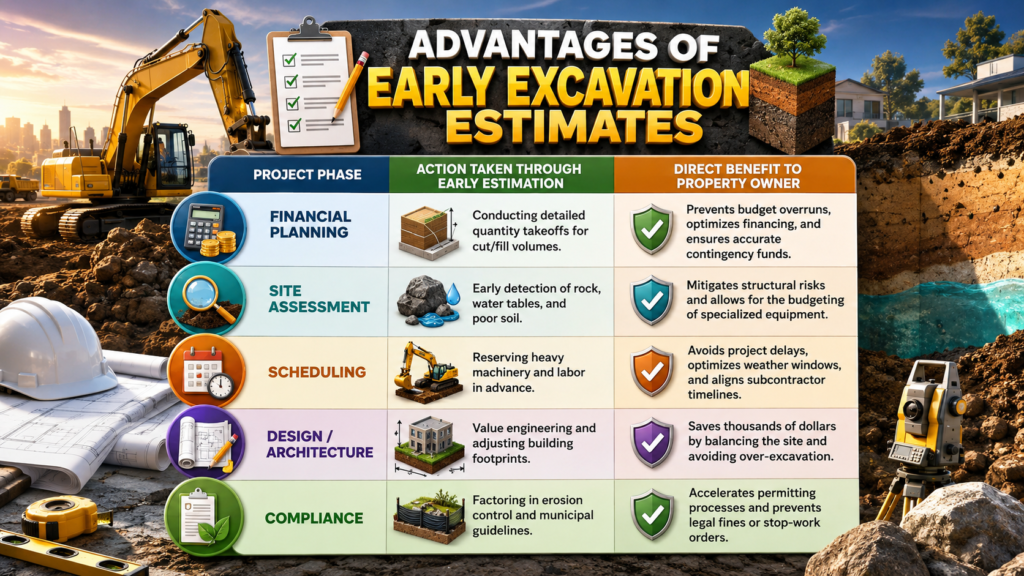
Summary: Advantages of Early Excavation Estimates
| Project Phase | Action Taken Through Early Estimation | Direct Benefit to Property Owner |
| Financial Planning | Conducting detailed quantity takeoffs for cut/fill volumes. | Prevents budget overruns, optimizes financing, and ensures accurate contingency funds. |
| Site Assessment | Early detection of rock, water tables, and poor soil. | Mitigates structural risks and allows for the budgeting of specialized equipment. |
| Scheduling | Reserving heavy machinery and labor in advance. | Avoids project delays, optimizes weather windows, and aligns subcontractor timelines. |
| Design / Architecture | Value engineering and adjusting building footprints. | Saves thousands of dollars by balancing the site and avoiding over-excavation. |
| Compliance | Factoring in erosion control and municipal guidelines. | Accelerates permitting processes and prevents legal fines or stop-work orders. |
FAQs About Excavation Estimates
Why is a good estimate for excavation important?
The financial basis of the whole construction project is excavation, so an accurate estimate of the excavation is very important. It provides exact costs for labor, equipment and moving materials so property owners can avoid budget overruns, get reliable financing and not face unexpected financial surprises once the digging starts.
How do you figure the cost of excavation?
The excavation costs are determined by a ” quantity takeoff ” . This measures the volume of dirt to be moved (cut and fill). This information is then considered by estimators, along with current rates for heavy equipment operation, labor hours, soil transportation, tipping fees, and site-specific conditions such as rock removal or water pumping.
What is a take off for excavation quantities?
An excavation quantity takeoff is a highly detailed digital or manual calculation of the precise cubic yardage of soil, rock and organic material that needs to be removed from, or added to, a job site to accomplish what the architect proposed as a final grade.
How do site conditions affect your excavation estimates?
Site conditions make a vast difference on costs. If you have dense bedrock, steep slopes, high groundwater or contaminated soils, your excavation estimates will skyrocket because you’ll need specialized heavy equipment, more labor hours and specific environmental remediation protocols.
Why should you hire a professional for your excavation estimate?
Professionals use advanced software (like 3D terrain modeling), historical cost databases and field experience to factor in variables that amateurs miss, like soil swell/shrinkage factors and hidden subsurface risks, so your budget is totally realistic and mathematically sound.
What happens if I don’t do a pre-construction excavation estimate?
If you skip this step, you’ll often pay dearly for it, both financially and logistically. Unexpected ground conditions could exhaust your funding midway through the project; you could experience significant delays waiting for specialized equipment; or you might be issued stop-work orders by local municipalities because of poor environmental planning.
How long does it take to get an estimate on an excavation?
Timeline depends on complexity and size of the project A basic residential estimate might only take a few days, but a big commercial development with topographical surveys, soil testing, and detailed 3D modeling could take a couple of weeks to prepare accurately.