
Long Reach Excavators What They Are and When You Need Extra Distance
When heavy-duty construction, mining or waterway management professionals have projects just out of reach for standard equipment to safely get to the work zone. That’s where Long Reach Excavators come in, reinventing what is possible on difficult project sites. The distinctive long boom and stick provide these vehicles unsurpassed access to deep trenches, high demolition sites and hard to reach dredging locations.
Ever wondered how construction crews can empty huge reservoirs or tear down high-rise structures without compromising stability? Long Reach Excavators have the answer, with incredible capabilities that make it all feasible. These strong earthmovers with operating ranges that may extend from 40 to more than 100 feet are critical investments for difficult projects.
A Guide to the Anatomy of Long Reach Excavators
Long reach excavators are designed specifically for jobs that demand both long distances and solid stability. In structure they are similar to conventional crawler excavators, comprising an undercarriage, rotatable house and the necessary boom-stick-bucket combination.
The main characteristic of long reach excavators however is that the boom and the arm are much longer and this requires special engineering to ensure that the machine remains balanced and does not tip over.
Manufacturers accomplish this fine balance by raising the counterweight at the back of the machine and expanding the undercarriage footprint. The hydraulics on these machines are also specially adjusted to provide steady power over a considerably longer distance, so that the attachment, whether it a bucket, grapple or crusher, will perform at its peak even when completely extended.
- Extended Boom and Arm: The main structural distinction enables the machine to stretch its reach out to 100 feet or more in order to excavate deep or far away.
- Better Counterweights: Needed to balance the center of gravity and avoid toppling when the arm is extended completely with a heavy load.
- Heavy-duty Hydraulic Systems: Built for long-distance delivery of hydraulic fluid without pressure drop to provide accurate control of attachments.
The Main Difference: Standard vs. Long Reach Excavators
Knowing whether to go for Long Reach Excavators instead of normal models is important for efficiency and cost control on projects. Standard excavators are used for the majority of common earthmoving, trenching and material handling activities.
They are highly adaptable. They shine in situations when mobility and breakout power are valued more than sheer reach. Conversely long reach excavators trade some breakout force, the raw digging force at the bucket, for their longer reach. This makes them unsuitable for very tight and rocky terrain where a strong digging force is required near the machine.
But when the project calls for accuracy from a distance, such as contouring slopes, cleaning canals or securely taking down a structure from a perimeter, Long Reach Excavators are the only realistic solution. A poor choice might result in serious delays in operations, wasted fuel or a compromised task site safety.
- Breakout Force Limitations: Regular excavators have more digging power, but long reach excavators sacrifice some of that power for distance.
- Operating Footprint: Standard versions are more maneuverable in confined urban areas, whereas Long Reach Excavators need a bigger operating footprint.
- Target Applications: The bread and butter of standard excavators are simple digging and hauling, while long-reach variations rule the roost for canal management, deep trenching and destruction.
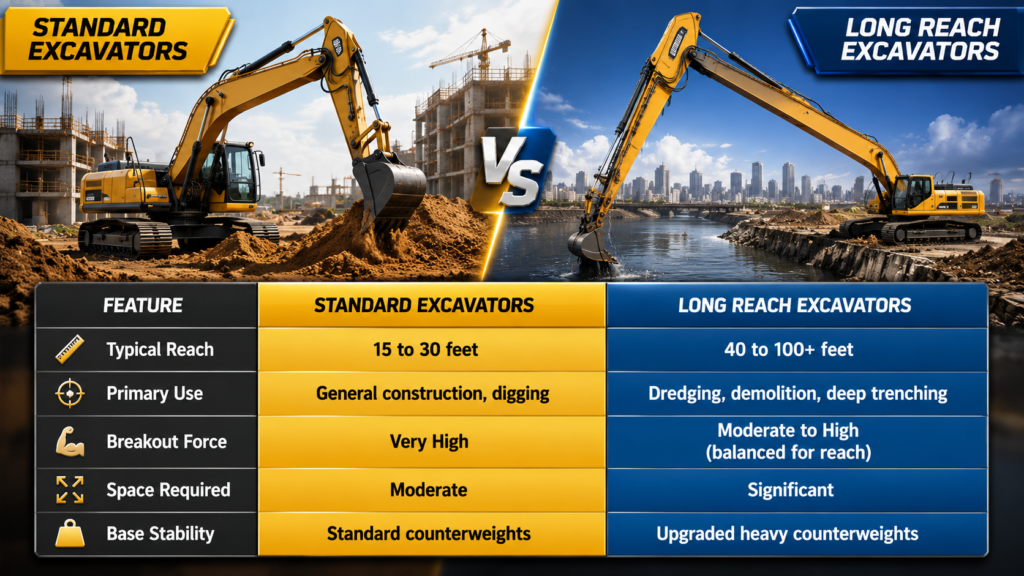
Table: Feature Standard Excavators Vs Long Reach Excavators
| Feature | Standard Excavators | Long Reach Excavators |
| Typical Reach | 15 to 30 feet | 40 to 100+ feet |
| Primary Use | General construction, digging | Dredging, demolition, deep trenching |
| Breakout Force | Very High | Moderate to High (balanced for reach) |
| Space Required | Moderate | Significant |
| Base Stability | Standard counterweights | Upgraded heavy counterweights |
Core Applications and Industries for Added Reach
The distinctive geometry of long reach excavators makes them a must-have in many specialized sectors. In waterway management and maritime construction these machines are often used for dredging rivers, removing silt from canals and fortifying shorelines.
The long arm keeps the heavy equipment on solid, dry ground while the bucket conducts the job underwater, so there is almost no chance of sinking or water damage. Long reach excavators are also utilized in the demolition industry for safe dismantling of multi-storey constructions.
They extend high into a structure and let operators to tear down walls and clean trash from a safe distance far beyond the fall zone. They are also crucial for deep excavation work such as mining, foundation digging and quarrying, when normal equipment would not be able to reach the requisite depth.
- Waterway Maintenance: Capability to clean rivers, canals and reservoirs from the beach without the necessity of aquatic pontoon installations.
- High-Reach Demolition: Demolition of towering buildings and structures from a safe distance around the perimeter, keeping operators away from falling debris.
- Deep Trenching and Mining: Reaching deep soil layers and retrieving materials in large-scale civil engineering and strip mining operations.
Major Advantages and Operational Benefits
Long Reach Excavators are a good investment and may be rented too. There are several operational advantages to using this kind of equipment that can save you time and money. One of the biggest benefits is the massive decrease in the requirement to move the machine.
The long boom gives the operator a large working radius to dig a large volume of material from one stationary position. This speeds up the process and cuts track wear and tear, and fuel consumption, dramatically. Today’s hydraulic systems are so precise that an operator may even execute sensitive duties like as sloping and grading from a distance with great accuracy.
The safety advantages are as clear. The potential of catastrophic accidents is dramatically reduced by keeping the heavy undercarriage away from unstable edges, steep slopes or dangerous demolition sites.
- Improved Productivity: The extended operating range enables the operator to move more material without having to repeatedly drive and adjust the machine.
- Improved Operator Safety: Protects the operator and the machine from collapsing edges, deep water and falling buildings.
- Less Ground Disturbance: Less driving equals less harm to the surrounding ecosystem. This is particularly good for fragile eco-zones.
Critical Factors in Long-Reach Excavator Selection
Browsing equipment on a site like americanexcavator.org may be overwhelming, and selecting the correct long-reach excavator depends on a careful evaluation of your individual project objectives.
The first and most apparent measure is the needed reach, which means you need to determine the greatest horizontal and vertical distance your project requires, and pick a boom length that comfortably surpasses that requirement. But reach is not the only variable.
You also have to consider the operating weight and stability of the machine. Is the undercarriage wide enough to support the extended load without tipping? Attachment compatibility Another key aspect is attachment compatibility, with various jobs requiring unique instruments such as dredging buckets, hydraulic shears or tiltrotators.
To run your machine successfully, the correct hydraulic flow to power these attachments is a non-negotiable need.
- Reach and Depth Requirements: Accurately determining the maximum vertical and horizontal distances necessary for the given project location.
- Machine Stability & Weight: Lift Charts analysis and confirmation of operational weight can support the extended boom securely.
- Hydraulic Attachment Compatibility: Ensure that the excavator can provide the necessary flow and pressure for attachments like crushers or specialty buckets.
Safety and Care Procedures for Equipment with Long Reach
The operation of long-boom excavators is by its very nature complicated and requires careful safety and maintenance procedures. The long arm has a large lever effect therefore even tiny errors in estimating the weight of a load or the pace of the swing might cause instability of the machine.
Operators need particular training to grasp lift charts, load restrictions and the weird feeling of working an attachment 60 to 100 feet distant. Daily maintenance inspections are also more important for big equipment than they are for your average excavator.
The pins, bushings and hydraulic cylinders on the extended boom are under a lot of stress and must be greased and inspected stringently. If you neglect these preventive maintenance actions, it could lead to catastrophic hydraulic failures or structural fractures, which might cause enormous project delays and major safety dangers.
- Strict Load Limit Compliance: Operators must follow manufacturer load charts to avoid tipping when the boom is completely extended.
- Regular Daily Checks: Daily checks on structural joints, hydraulic hoses, and track tension to discover wear before it leads to a breakdown.
- Operator Training Specific to Equipment: Make sure the operator in the cab knows how the stability and swing characteristics differ with an extended boom.
FAQs: Long Reach Excavators
How far does a long reach excavator reach?
The actual reach of Long Reach Excavators varies a lot by the actual make, model and customized boom-stick arrangement used for the machine. Excavators of the specialized type have a working range that averages between 40 and 100 feet, or about 12 to 30 meters. Some of the biggest bespoke versions are over 100 ft. in reach for extremely specialized applications such as extreme high-rise demolition or deep sea dredging. Total reach will tell you just what kind of tasks the machine can take on. It is the most important parameter to examine before rental or purchase.
- Standard Long-Reach Range: The most popular variants comfortably cover distances of 40 to 100 feet.
- Extreme Reach – Custom: Demolition models may be designed to reach much over 100 feet.
- Boom and Stick Combo: The overall reach is always a mix of the particular boom length and the stick length linked to it.
What are Long Reach Excavators best suited for?
Long reach excavators are used in applications where traditional earthmoving equipment cannot reach due to their extended capabilities. They are mostly used for water management, such as dredging rivers, cleaning canals and maintaining reservoirs. “ They are also very common in the demolition industry for safely bringing down tall structures from a distance. You’ll also find them in deep civil engineering tasks, such as excavating deep foundational trenches or cutting steep slopes.
- Dredging and Waterways: Clearing silt and debris out of bodies of water while parked safely on dry ground.
- Safe demolition: Demolishing multi-story structures without the machine being in the line of falling debris.
- Complex Sloping: Grading and contouring steep embankments where ordinary excavators would be in danger of rolling over
Do long reach excavators have less power while digging?
Yes, under general physics and engineering rules, long reach excavators do compromise some raw digging strength for their extended distance capabilities. The long boom is a big lever therefore the hydraulic breakout force at the bucket is usually less than a regular excavator of the same base weight. Therefore, they are not recommended for ripping heavily compacted, rocky or virgin hardpan soil. These are best employed in loose soil, mud, silt and pre-loosened demolition rubble.
- Reduced Breakout Force: The extended arm automatically lessens the raw prying strength at the bucket tip.
- Apply Physics: The further the bucket is from the base, the less focused digging force the machine can apply.
- Preferred Material Types: Better for softer materials such as mud, sand, silt and loose debris, not solid rock.
How to carry a long reach excavator?
The bulk and unusual proportions of Long Reach Excavators make transportation a matter of meticulous logistical preparation. The boom and stick are so lengthy that they typically cannot be folded securely enough to fit on a conventional lowboy trailer without breaking highway height or length regulations. In many cases the boom and arm have to be taken off the main house completely and transported on a separate trailer. Because the machine has to be reassembled at the site, it requires extra lifting equipment, making transportation a substantial part of project timetables and finances.
- Oversize Load licenses: These equipment nearly invariably need special wide or long-load highway licenses to be transported.
- Disassembly Requirements: The boom and stick often must be removed for safe transit and shipped on secondary trailers.
- Assembly on Site: When the excavator arrives, it normally has to be re-assembled by cranes and expert technicians.
How a long reach excavator may employ conventional attachments?
Long Reach Excavators use the same hydraulic systems as ordinary machines, but you can’t just take a regular implement and bolt it onto a long boom. The weight of the attachment is a huge worry; if you put a bucket or crusher that is too heavy 80 feet away from the centre of gravity of the machine, the excavator will tilt forward straight away. Long reach excavator attachments must be precisely weighed and volume-rated for the machine’s lift chart. Special lightweight ditching buckets or special demolition shears are often needed to ensure operating stability.
- Weight Limits: Attachments need to be lighter than regular tools so the machine does not become unbalanced.
- Hydraulic Flow Matching: The attachment must be a perfect match to the hydraulic pressure that may go down the extended boom.
- Specialized Tooling: Long-reach models come with their own line of lightweight dredging buckets and smaller grapples.
Are Long Reach Excavators difficult to operate?
Operating a long reach excavator is a much more demanding skill than operating a conventional excavator and demands an extra dose of patience and greater spatial awareness. The operator’s cab is typically up to 100 feet away from the bucket, which makes it difficult to visually assess the depth, angle and material density.
Furthermore, the long arm magnifies every movement made by the joysticks; a small, jerky motion in the cab results in a huge, potentially dangerous swing at the bucket. There is a distinctive bounce, sway and leverage dynamic to the extended boom that requires specific training for operators.
- Amplified movements. Small movements of the joystick create sweeping motions at the end of the extended arm.
- Visual Limitations: Operators find it very difficult to get a good view of the bucket whether it is under water or 80 feet distant.
- Specialized Certification: Requires special training to operate properly with emphasis on stability, load charts and smooth hydraulic control.
Renting or Buying a Long-Reach Excavator?
The choice to rent or purchase relies a lot on your individual tasks, how often you do them and for how long. If you are a specialist dredging or demolition firm that employs Long Reach Excavators on a regular basis, then buying the equipment is a solid long-term investment that creates equity.
But since these equipment are so specialized and tend to lie idle during normal earthmoving stages, it’s often considerably more economical for regular contractors to hire them. Renting removes the huge upfront capital expenditure, the complicated transport and storage logistics and assures that you always have a machine right-sized for the particular work you need to do.
- Project Frequency: Only buy it if you are going to use the machine for specific activities on an almost regular basis.
- cash Considerations: Renting means you don’t have to tie up huge amounts of cash in one equipment that may not be used a whole lot.
- Maintenance and Storage: Contractors are spared the hassle of storing, moving and maintaining a huge piece of equipment.