
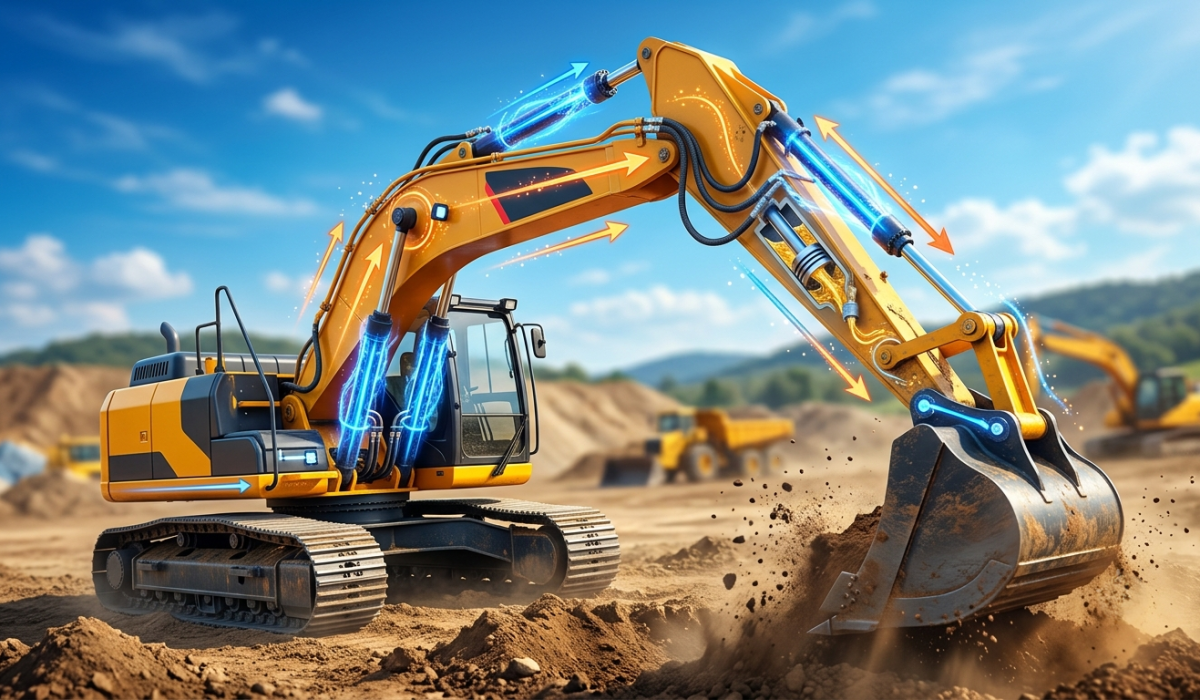
Understanding Excavator Dynamics and Hydraulic Arm Cylinders
Hydraulic excavators’ tremendous strength and accurate judgment make the modern construction world rely on them indispensably. These amazing machines house a specialized hydraulic system, a closed-loop one. Such a system is able to convert the power of the pressurized oil working hydraulics into mechanical motion through the actuators. The actuators are the main source of motions and are commonly referred to as hydraulic arm cylinders of the arm or front-attachment actuators.
They are simultaneously performing the task of controlling the structural behaviour, carrying the loads, and manipulating the specialized attachments.
Types of Hydraulic Arm Cylinders & Their Applications in Excavators
The front-attachment mechanism of an excavator is essentially a very efficient kinematic chain with several degrees of freedom. Usually, this chain consists of three significant components: the boom, the arm (sometimes called the stick or dipper), and the bucket.
The movement of each part is powered by a separate set of double-acting hydraulic cylinders. The hydraulic arm cylinder mainly controls the action of the middle arm segment. It is this cylinder which produces the essential digging force, crowd pressure, and material handling capacity needed for heavy-duty earthmoving.
To choose, maintain and differentiate between various types of hydraulic arm cylinders result in maximizing machinery availability, minimizing thermal degradation and enhancing overall operating efficiency.
Critical Structural Features of Arm Cylinders
- Heavy-Wall Cylinder Tubes: Made from high tensile, cold drawn carbon steel or the finest alloy pipe, these tubes are designed to endure high internal pressures during forceful digging.
- Induction-Hardened Piston Rods: Produced from the top quality steel, ground to a fine finish, induction-hardened, and chrome-plated for protection against abrasive wear, micro-cracking, and impact.
- High-Integrity Sealing Configurations: Fitted with exquisite polyurethane wiper seals, special buffer rings, and multi-lip rod seals designed to seal off high pressure fluids while preventing the ingress of dust and dirt.
Top Types of Hydraulic Arm Cylinders
1. Double-Acting Hydraulic Arm Cylinders
The most common design used in modern earthmoving equipment is that of the double-acting hydraulic cylinders. On the other hand, single-acting cylinders which expose themselves to gravity or external springs for retraction, double-acting cylinders apply fluid pressure for piston rod motion in both directions actively. This is a safer design that enables fine controls of both strokes extension and retraction.
Besides, the mechanical design offers two different fluid ports: a base-end port (cap end) and a rod-end port (head end). The entry of the pressurized oil into the cap end results in the application of the force on the entire piston surface area. This is the way the arm’s pulling motion inside (also called “crowd” or “stick-in” stroke) is being generated.
On the other hand, when fluid is supplied to the head-end port of the cylinder, the piston will be operated in the opposite direction to extend the arm outermost. A continuous, cyclical operation of the digging tool requires this feature as it is the only way to achieve forceful output during the entire cycle of the machine operation.
Main Areas of Industry in Which Double-Acting Hydraulic Cylinders are Being Used:
- Trenching at great depths and foundation excavation: Continuous downward force supply with efficient tool retraction with the double-acting arm cylinder allows deep trench cuts even with hard subsoil conditions.
- Handling heavy materials with precision: The use of balanced, excellent hydraulic arm control gives the operators the freedom to also accurately locate heavy structural elements, concrete barrier elements, and utility pipes.
- Bulk earthmoving activity: Quick and aggressive force delivery is possible with the double-acting cylinders to cut through the dense embankments of soil ensuring the rapid cycles when loading high-capacity haul trucks.
2. Multi-Chamber and Digital Hydraulic Arm Cylinders
With the industry focusing more and more on fuel economy and low carbon emissions, multi-chamber advanced hydraulic cylinders and digital ones are becoming popular as well. Ordinarily, standard cylinders have two working chambers, and when variable structural loads are being managed, that can result in a quite high loss of energy due to throttling.
Multi-chamber designs are different in this aspect as they feature three or four distinct internal pressurized areas. Through the wise management of system pressure using these different surface areas, the excavator can simply modulate its force output and thus avoid the use of excessive oil throttling.
These very advanced components are usually installed with high-speed digital on/off valve manifolds. A digital valve which is switched on and off in milliseconds replaces the traditional proportional valve that would ordinarily be used to regulate speed by restricting the flow.
Advantages of Multi-Chamber Designs in Operations
- Cut down on fuel consumption: Main control valve flow-throttling energy losses are reduced by up to 15% to 25%, which results in lower fuel consumption during typical digging cycles.
- Fit for energy recuperation: Work well with hydraulic accumulators that allow the capture and storage of excess kinetic energy during the arm deceleration, in other words, power recycling for the subsequent strokes.
- Better thermal management: Leads to less heat being generated inside the hydraulic circuit which, in turn, helps to improve the life span of system fluids, hoses, and internal sealing components.
3. Telescopic Hydraulic Arm Cylinders
Telescopic cylinders, or multi-stage actuators, have a number of nested tubular segments referred to as sleeves or stages. When fluid pressure gets into the cylinder at the base, each individual length of the sleeve gets extended one after another with the largest diameter sleeve coming first and the smallest smallest diameter last. A very long operational stroke has been delivered even from a very compact length in the retracted position due to this design.
While one-piece cylinder rods are the first choice for performing high-force breakout task because of their stiffness, telescopic arm cylinders are used for the specific type of excavation which requires extended reach.
Preventing buckling or bending of the expanding outer sleeves when the cylinders operate at full extension is one of the main reasons why these cylinders are structurally very well balanced across each stage.
Instances When Telescopic Arm Components are Being Utilized:
- Excavating deep shafts: Modified excavators equipped with telescopic cylinders are capable of digging vertical shafts, utility pits, and underground transit tunnels way beyond the reach of the standard booms.
- Demolition at high reach: Long-reach demolition rigs are able to take apart the upper floors of concrete and steel structures safely while still keeping the machine platform at a safe distance with the help of telescopic cylinders.
- Long reach environmental dredging: Machines working along riverbanks, industrial waterways, and retention ponds that have been equipped with telescopic cylinders are able to extend their reach for cleaning operations.
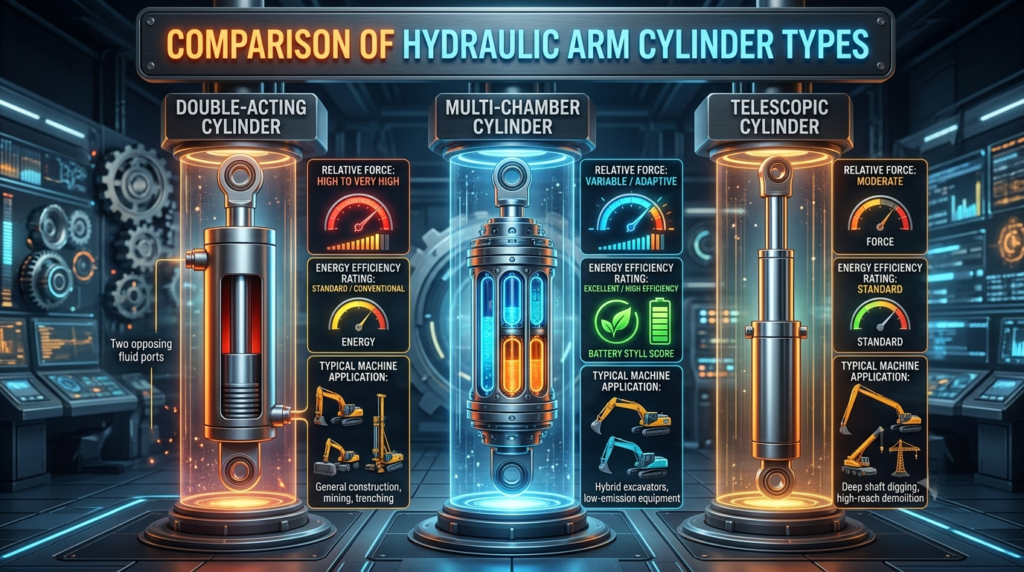
Table: Comparison of Hydraulic Arm Cylinder Types
| Cylinder Type | Primary Structural Feature | Relative Force Output | Energy Efficiency Rating | Typical Machine Application |
| Double-Acting Cylinder | Two opposing fluid ports | High to Very High | Standard / Conventional | General construction, mining, trenching |
| Multi-Chamber Cylinder | 3 to 4 independent internal chambers | Variable / Adaptive | Excellent / High Efficiency | Hybrid excavators, low-emission equipment |
| Telescopic Cylinder | Multi-stage nested sleeves | Moderate | Standard | Deep shaft digging, high-reach demolition |
Technical Maintenance Practices for Heavy-Duty Arm Cylinders
In order to maintain an excavator at maximum operational efficiency, it is a must to have a proactive maintenance strategy. Since the hydraulic arm cylinder is always exposed to abrasive rock dust, high work pressures, as well as weather changes, it is considered very high maintenance.
If you overlook some very early signs of damages, you can get resultant fluid contamination, cross-piston scratches, and most likely an unscheduled downtime of the machine.
Key Maintenance and Care Procedures:
- Ensure Wiper Seals Are Checked Daily: Check the exterior rods seal area to make sure there is no oil coating or dust entrapment, which can introduce abrasive contamination inside the fluid loop.
- Examine the Rod Closely: The chrome finishing of the rod can become damaged by fine scratches, score lines or impact dents. Any such damage should be detected and repaired before it is too late.
- Conduct Regular Fluid Checks: A proper maintenance programme includes oil sampling to detect the presence of metallic particles and the amount of moisture.
FAQs – Hydraulic Arm Cylinder
What are the 3 main hydraulic cylinders on an excavator?
Basically, it is the set of three double-acting hydraulic cylinders that are the main drivers of the front-attachment mechanism of an excavator: boom cylinders, arm stick cylinders, and bucket cylinders. The boom cylinders are responsible for elevating and lowering the entire arm structure. The arm cylinder facilitates the digging force by controlling the inward and outward swing of the stick segment. Finally, the bucket cylinder is the one that operates the bucket attachment to scoop, curl, and dump materials.
What is the difference between a boom cylinder and an arm cylinder?
While the boom cylinder is lifted by the upper structure of the machine, which rotates all the time and it is also the one that actually carries the entire front attachment assembly, the arm cylinder, which is the hydraulic arm cylinder, gets installed on top of the boom and is directly connected to the stick segment. It is the arm cylinder that provides the crowd force which is the back and forth movement which essentially allows the tool to break into the ground.
Why is my excavator arm cylinder losing power or drifting?
Inadequate performance or uncontrolled movement of the structure can be traced to internal leakage past the piston seals or a faulty control valve. Seals which have worn out allow high-pressure fluid to escape to the low-pressure side of the chamber, thereby making it impossible for the cylinder to maintain its position under load. You can check for this by carrying out a cylinder drift test and looking at the oil for particles.
How do double-acting hydraulic arm cylinders work in heavy equipment?
Double-acting cylinders force the piston rod to extend and retract actively using pressurized fluid. Upon command, the machine’s main control valve directs high-pressure oil to one of the cylinder ports (either the cap-end port or the head-end port) while at the same time allowing the returning oil from the opposite chamber to flow back to the reservoir. This arrangement enables the arm to be moved up and down smoothly and accurately.
Can a scored excavator hydraulic piston rod be repaired?
Minor surface scratches can often be removed by polishing with very fine abrasive stones. Similarly, small localized nicks can be handled by electroplating techniques such as selective localized electroplating. On the other hand, if the rod has deep gouges or is bent due to impact, these are cases where unavoidable replacement or full re-chroming will be necessary. Using a damaged rod means that the new head seals will be torn to pieces very quickly and lead to a persistent leak of fluid.
What causes premature failure in hydraulic arm cylinders?
Common causes of early failure include contamination of the hydraulic fluid, excessive structural side-loading, and pressure spikes beyond normal limits. Particulate matter in the oil can score the polished cylinder walls and damage internal seals. Side-loading, which happens when the arm is subjected to twisting forces during lateral operations, causes uneven wear on both the internal wear bands and the cylinder head glands.
How do I choose the right replacement arm cylinder for my excavator?
If you want to get a replacement cylinder, you will be required to make the exact specification match with the original equipment manufacturer (OEM). This means the internal bore diameter, the rod diameter, the total stroke length, and the pin-to-pin retracted length should be among the key factors considered.