

What are popular jobs for professional excavating contractors
A big new commercial development, bespoke house construction, or extensive utility infrastructure project is quite a milestone. However, your buildings won’t be able to rise above the horizon until you have laid a perfectly designed, structurally sound foundation underground. If a large site preparation for a property owner is new to you, you might feel a bit confused by the logistics involved. Hiring top excavating contractors guarantees that your piece of land will be turned into proper structurally sound layout that adheres to all engineering specifications needed for building durability.
Professional land development is a very carefully computed and very precise job that requires a lot of skill with the machinery used, compliance with local laws, and thorough knowledge of geology. It is wise to plan ahead of time what will be happening on the site till the finishing of final grading, so you don’t get stressed over changes and your schedule remains unchanged.
This guide tells you in detail what goes on during a high-quality excavating contractors jobs, including the types of equipment used, the work steps, and the industry standards followed by leading excavation contractors.
Phase-Wise popular jobs for professional excavating contractors
Phase 1: Pre-Excavation Site Assessment and Legal Permitting
Everything starts with the assessment phase before any excavation work is done. This phase is twofold: it protects the legal standing of your construction project while also ensuring that downstream ecosystems or architectural structures are not harmed in any way. The best excavating contractors will pinpoint this time of discovery and planning as the most critical moment, lasting until every legal point has been checked.
During the assessment phase, surveyors and engineers take a very detailed look at the topographical contours of your land as well as the soil densities. In addition, they make decisions as to where to set up logistical staging, plan access points while minimizing ground compaction, and decide on which types and classes of machinery to use for maximum production.
- Underground Utility Mapping: These steps include a site visit by excavators and technicians to listen for impacts if a bright colored stretch of line is a utility line, etc. Flagging is where the utility lines are covered in geotextile fabric and then colored flags are used to mark the locations with painting of the curb next to the paint marked areas.
- Zoning and Municipal Permissions: Project managers continue the process of securing all necessary regional clearing permits, official grading documents, and critical local environmental variances. Step one is to get approval from the zoning board and then approval from the local council to get the license. Needed items for the application are the plans, how you are going to do the work, and how you are going to get it done in the shortest time possible.
- Geological Profile Analysis: This test determines where cracks, fissures, faults, and potential sources of subsidence, etc., may exist in the foundations of the buildings to be constructed.
Phase 2: Site Clearing and Heavy Equipment Mobilization
The current crew of men and equipment at the disposal of the project will be used as completely as possible. So, a number of man-hours will be scheduled for them. To phase in increments based on the size of the crew and how much time is available, the amount of manpower will be limited.
Equipment like cranes, excavators, bulldozers, and graders all have to be moved to the work site with minimal disruption to the traffic flow or causing damage to the pavement. To determine the best and safest way of conducting the work with the minimal effect on the traffic and local public, the team will be ready with a plan, or it will be drawn up on site when necessary.
So, as to avoid disruption and how to deal with it when it is not possible to avoid it are to be considered as part of the tasks assigned to the contractor. Equipment transport and deployment must be managed with strict safety measures, particularly when operating near high-traffic commercial zones or quiet residential districts.
Excavating contractors map out secure transportation logistics to ensure that the massive machinery can be dropped off safely without blocking traffic or damaging nearby public pavement.
- Surface Obstacle Removal: Site clearance operations include the removing of all vegetation such as trees, etc., as well as the clearing of any other obstructions like rocks, boulders, old concrete slabs, foundations, etc. etc., all within the proposed building boundary.
- Industrial Fleet Arrival: Delivery of the equipment is usually being accompanied by the arrival of the truck driver who bring the personnel to set the equipment up, and then return. Once the driver drops the equipment the driver will then move to the staging area. A mix of tight access equipment including mini-excavators, skid steers, and compact wheel loaders along with heavier production tools like full-size excavators, backhoes, and track loaders will be the delivery lot.
- Erosion Control Implementation: During the heavily rainy season, the main causes of water pollution in urban areas are the sediments and stormwater. Hence, a lot of cities consider silt barriers, straw wattles, and run-off trenches as the best practices for erosion control as these can prevent the sediments from getting washed into the nearby waterways. They will get into the system through drains or directly will enter the water bodies causing pollution and thereby very harmful to the aquatic life.
Phase 3: Survey Layout and Stakeout Precision
Before any work begins, very careful marking of the outlines of the actual plan with wooden stakes must be done. It is extremely important that the lines set with wooden stakes are the correct width of the hole to be dug, very accurate to the plan, as well as being absolutely perpendicular to the adjacent lines.
Should a mistake be made here and the holes are dug out of position, it will be the source of the loss and cost of time and money of the most precious resources we all have. It is, therefore, better to spend a little extra time and money to make sure that the staking and setting out of the holes is done correctly and be very thorough and careful while the holes are being dug.
Therefore, the “stakeout” procedure involves the marking of existing features on the site, the location of future construction, and the placing of markers at points where the digging work is to be done.
- Boundary Line Establishment: Surveyors use bright-colored wooden pegs and resilient string lines to mark the exact corners, property limits, and reference lines.
- Laser Benchmark Calibration: Operators use sophisticated laser levels or GPS receivers connected to satellites to set exact depths, slopes to aim at, and benchmark elevations into the machine operations.
- Designation of Haul Routes: The team identifies and decides on exclusive routes, through which the heavy dump trucks will ferry materials to and from without causing at any time the compaction of soils outside the work areas.
Phase 4: Main Structural Excavation and Soil Management
This is the central phase where the bulk of the earthmoving takes place, turning the jobsite into an active zone of swinging booms, rhythmic digging, and shifting soil. Top-tier excavating contractors emphasize controlled, systematic material removal over reckless speed to protect the integrity of the trench walls and keep everyone on site completely safe.
As the depth increases, the operation shifts dynamically based on what is uncovered beneath the surface. Experienced operators adjust their tactics and swap out standard buckets for heavy-duty hydraulic hammers if they hit unexpected layers of solid bedrock or deep glacial stones.
- Controlled Layered Extraction: Operators shave earth away in deliberate, parallel passes rather than digging random deep pits, keeping the surrounding soil stable and safe from sudden cave-ins.
- OSHA-Compliant Shoring Setup: For deep foundation pockets and utility trenches, crews install steel trench boxes or hydraulic shoring jacks to ensure worker safety below ground level.
- Spoil Pile Allocation: Excavated material is either neatly stockpiled far from the edge of the pit for future backfilling or loaded onto heavy dump trucks for off-site disposal.
Machinery Deployment Guide – professional excavating contractors
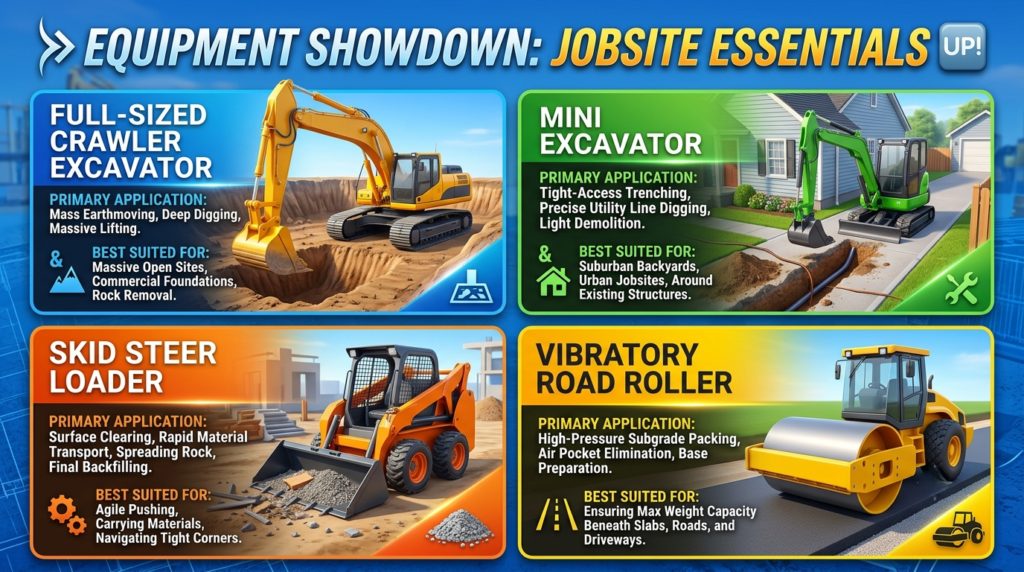
Achieving a highly successful earthmoving outcome requires selecting the perfect machine configurations for your site’s spatial limits and geological challenges. Professional excavating contractors rely on a precise selection of machinery to ensure optimal results:
| Equipment Category | Primary Application on the Jobsite | Best Suited For |
| Full-Sized Crawler Excavators | Mass earthmoving, heavy deep digging, and lifting massive structural objects. | Massive open sites, commercial foundations, and rock removal. |
| Mini Excavators | Tight-access trenching, precise utility line digging, and light demolition. | Suburban backyards, urban jobsites, and working around existing structures. |
| Skid Steer Loaders | Surface clearing, rapid material transport, spreading rock, and final backfilling. | Agile pushing, carrying materials, and navigating tight corners. |
| Vibratory Road Rollers | High-pressure subgrade packing, air pocket elimination, and base preparation. | Ensuring maximum weight capacity beneath slabs, roads, and driveways. |
Phase 5: Structural Backfilling, Grading, and Compaction
After the site is dug to the desired depths and trench lines, exactly according to the engineering drawings, the focus of the work changes from aggressive soil removal to precise site finishing.
The final work will be the grading and compaction that convert a messy hole in the ground into a smooth, clean, and thoroughly compacted structural bench capable of receiving masons, plumbers, and concrete trucks.
Improper soil compaction may cause the ground next to the new foundation to settle in a different manner. Over a period of time it may result in cracked walls, water leaks and uneven floors.
The top excavation contractors employ professional soil compaction testing equipment and perform high-impact compaction to achieve the specific engineering densities required.
- Rough and Fine Grading: Crews use grading blades and skid steers to shape the final topography, creating a precise slope that naturally channels rainwater away from your structures.
- Layered Lift Backfilling: Loose dirt is returned into trenches and foundation gaps in shallow, controlled layers (called lifts) rather than filling the entire hole all at once.
- High-Impact Compaction Testing: Every single layer of backfill is packed down mechanically to meet specific engineering density standards before the next layer is added.
Frequently Asked Questions (FAQs) – Excavating Contractors Jobs
How long does a standard project take when handled by professional excavating contractors?
A typical residential dig, like an average basement foundation or swimming pool, takes 3 to 5 days. Larger commercial jobs or sites with heavy subsurface rock formations can take several weeks of steady work.
Can heavy excavation work continue during rainy or freezing winter weather?
Light rain is perfectly fine, but heavy downpours turn soil into unsafe mud, stopping the project for safety. Freezing temperatures harden the dirt, requiring heavy machinery to use specialized teeth to break the frost layer.
How do excavating contractors avoid hitting hidden underground utilities?
Crews call local 811 hotlines to get public underground utility lines mapped out and marked with high-visibility paint. In high-risk zones, operators use hand tools or low-impact vacuum trucks to safely expose lines without damage.
What is the difference between rough grading and fine grading?
Rough grading uses heavy machinery to shape the general layout, slopes, and main elevations of your land. Fine grading is the meticulous final step that smooths the top layer of dirt, preparing it perfectly for landscaping or concrete.
What happens to all the extra soil that is dug up during construction?
Clean dirt is often kept on-site to use later for structural backfilling, balancing out slopes, or landscaping. Any leftover excess material is loaded onto haulers and taken to local reclamation sites or other construction projects.
Why do excavating contractors use compact mini excavators on residential jobs?
Mini excavators have a small footprint and a tight tail- swing design, allowing them to pass through standard yard gates easily. They deliver exceptional digging power while protecting your lawn and surrounding structures from damage.
How close to an existing house foundation can a heavy machine safely dig?
Crews can dig right up next to an existing wall, but it requires strict engineering oversight and structural shoring. Operators use specialized compact machines to eliminate heavy vibrations that could crack older concrete foundations.