
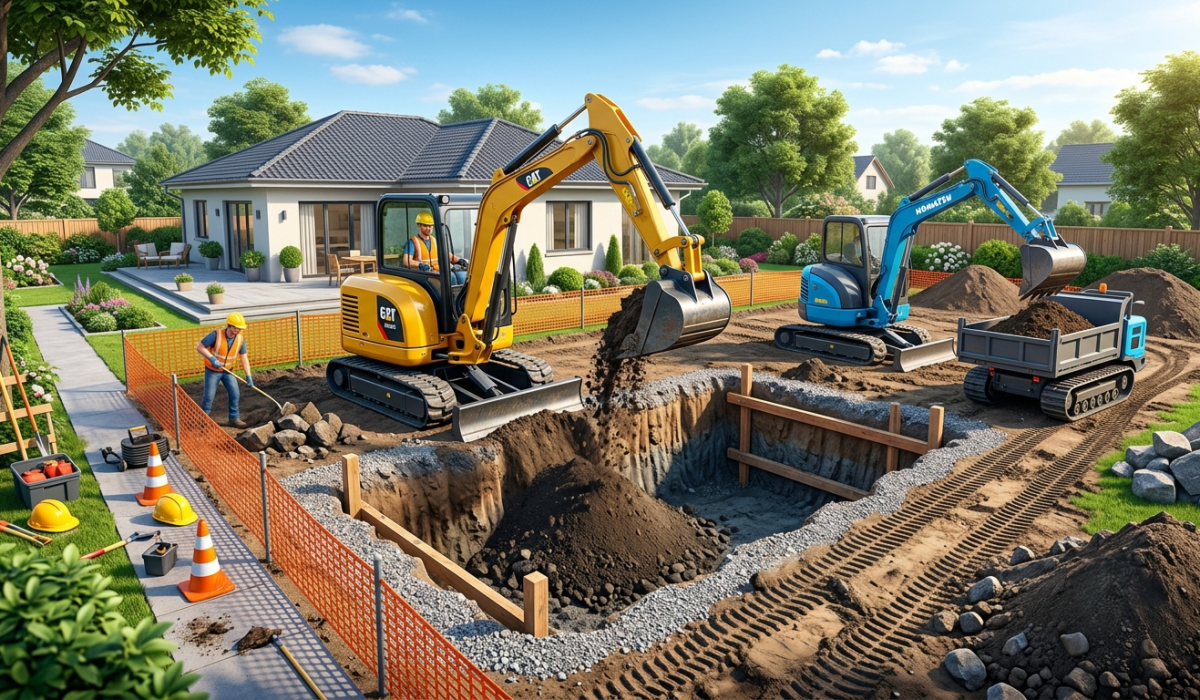
In-depth Guide to Swimming Pool Excavation: Steps, Timeline, and Safety Tips with Mini Excavator
Converting a backyard into a beautiful and luxurious swimming pool is something many homeowners aspire to do. However, the journey from dirt to sparkling water involves a very complex and accurate engineering stage: the subterranean swimming pool excavation. Employing a mini excavator in such a vital procedure has drastically altered the home construction sector.
These highly adaptable, small-sized machines enable today’s builders to maneuvre around narrow property borders and make elaborate backyard designs without damaging the surrounding buildings.
Proper excavation demands a careful mix of technical skills, thoughtful safety precautions, and stepwise implementation. Homeowners and supervisors of the project should be well aware of the process from beginning to end.
Choosing the right machinery for earthmoving will be the primary factor that influences directly the pace, accuracy, and the quality of your backyard remodeling project. Though big commercial track hoes can move huge volumes of soil in a matter of minutes, they will not fit in at all inside typical residential neighbourhoods.
Their massive weight leads to great soil compaction damages, breaks underground public utilities, and entirely destroys decorative concrete driveways. On the other hand, small construction equipment generally have a low ground pressure footprint, very smooth hydraulic controls, and an excellent turning radius.
Hence, those operators can efficiently work in very limited spaces, go around mature plants, and make perfectly vertical pool walls without any extra excavation.
Phase-Wise Swimming Pool Excavation using Mini Excavator
Phase 1: Pre-Excavation Planning and Property Site Preparation
Several essential administrative, logistical, and preparatory actions must be completely fulfilled beforehand before the physical digging work begins. Without the proper structural planning, breaking ground in a residential backyard can lead to severe financial liabilities, violations of the law, or even fatal incidents of hitting utility lines.
- Obtaining required permits: Before the start of the construction, local government needs approved engineering construction permits, structural blueprints, and zoning assessments.
- Utility line locating: It is the responsibility of the property owners to call local utility marking services (like the 811) and get the underground electric, gas, fiber-optic, and water lines marked.
- Clearing access in the backyard: In order to make way for the machine, contractors have to remove boundary fences, overhanging tree branches, and decorative patios.
- Setting up reference lines: Using ground paint, stakes, and laser levels, the exact perimeter of the pool, steps arrangements, and deep-end transitions are laid out.
- Performing soil composition test: Conducting a geological analysis at the site reveals the presence of clay, loose sand, or shallow bedrock conditions that call for special digging attachments.
| Pre-Excavation Checklist Item | Responsible Party | Expected Completion Timeframe |
| Municipal Zoning & Building Permits | Property Owner / Contractor | 2 to 6 Weeks |
| 811 Underground Utility Marking | Local Utility Technicians | 48 to 72 Hours |
| Perimeter Stakes & Laser Guide Setup | Excavation Lead Operator | 2 to 4 Hours |
Phase 2: Choosing and Outfitting the Ideal Mini Excavator
Compact digging machines do not run on the same set of standards. Selecting the right operating parameters is the key to avoid structural flaws and mechanical failures. The mini excavators in the 3.5 to 6 metric tons are powerful yet nimble enough to handle the requirements of residential pools.
- Confirming dig depth: It is essential to check if the machine’s arm can be extended enough to reach the deepest point of the pool floor plus approximately a foot for the gravel base.
- Choosing tracks: As a rule for residential yards, enthusiasts and professionals pick rubber tracks, so they don’t damage asphalt walkways, brick pavers, and lawns.
- Deciding on the buckets: Working with buckets alternates between the use of grading buckets that are wide and smooth-edged for cleaning up floors and toothed buckets that excel at breaking compacted soil.
- Hydraulic thumb addition: A hydraulic thumb allows the operator to grab and remove large boulders, old concrete, or tree stumps.
- Tail-swing feature: Machines with zero tail-swing are the best when working in real tight spaces as the counterweight remains within the track width during a turn.
Phase 3: The Step-by-Step Pool Excavation Process
The digging process of the pool goes through step-by-step execution once the preparations are done and the machine is ready. During this step, the proven teamwork of an expert operator and a helpful ground spotter is necessary to realize the exact measurements of the blueprint.
- Topsoil removal: The operator removes and stocks separately the soil with impurities like grass, roots, and sod.
- Marking the perimeter: The first cuts are made along the line that was painted, creating a bench where the pool’s coping level and height will be decided.
- Deep-end excavation: The machine is first directed to the maximum depth and at the same time the soil slope is gradually managed.
- Floor slope shaping: The operator skillfully manipulates the controls to create the slope of the floor that leads from the shallow area to the deep diving well.
- Vertical walls trimming: The vertical soil walls are gently shaved so that they retain their strength and do not collaps before the steel framing is set.
Phase 4: Earthwork Logistics and Soil Disposal Management
Excavating a swimming pool results in the generation of a very large quantity of loose soil that has been dug out and consequently increased in volume. Taking care of this displaced dirt in an effective manner is the key to maintaining an organised, safe, and on-schedule work site.
- Determining soil change in volume: Consult soil point-density tables which reveal that compacted earth becomes loose and increases by 20% to 30% in volume when dug out of the ground.
- Ordering Dump Trucks: Have the trucks ready to set up a continuous cycle without causing traffic jams or delays.
- Retaining dirt on-site: If the landscaping plan involves grading or creating terraces, separate clean topsoil from deep clay for subsequent use.
- Stop run-off water pollution: Surround silt fences and straw wattle with dirt piles to prevent the sediment from getting into the storm drains during the rain.
- Get off-site disposal sites: Make sure to book certified dump clean-fill locations beforehand to avoid costly delays or illegal dumping fines.
Phase 5: Crucial Safety Protocols and Cave-In Prevention
Excavation is one of the most dangerous activities in residential construction. Therefore, it is very important to follow the safety standards imposed by the authorities strictly. Besides protecting the operator and ground workers, such efforts also save the property from heavy damages.
- Shoring exposed earth walls: Temporary wood or aluminium shoring panels will be a need if you are digging in loose, sandy soils.
- Safe distance for machines: Don’t let the tracks of the heavy construction equipment come close to the edge of the open excavation, as this can cause sudden rupture of the wall.
- Use a ground spotter: The spotter watching the site back-up hand signals to the operator and simultaneously is conscientiously looking for any hidden pipes or structural shifts, and the like.
- Control of exclusion zone: Keep family members, pets, and non-essential employees completely out of the active machine swinging radius.
- Weather monitoring: Once a rainy weather condition is predicted, a work suspension and water pumping should be considered to be ready.
Phase 6: Timeline Expectations and Weather Delay Factors
As a rule, a pool excavation in a residential area does not occur within a few hours; rather, a reasonable period has to be allotted to factor in various elements such as soil conditions, equipment transport, and weather breaks. Homeowners who grasp this timeline can handle their expectations and plan accordingly.
- Typical excavation periods: The excavation work of a normal residential pool will require 2 to 4 consecutive working days under absolutely perfect conditions with a highly talented operator.
- Encountering unexpected problems: Discovering large boulders, high water levels, or abandoned septic tanks will easily add to the project duration.
- Dealing with rainfall: Strong storms turn the work site into a mud pit, stopping the work until it becomes feasible enough for supporting equipment.
- Delivery and pick-up of equipment: Remember at least half a day for dropping off, fueling, inspection, and picking up of the rented equipment.
- Excavation hand-off: Set aside time immediately after the clone for laying the gravel base and manually shaping steps prior to the arrival of the steel crews.
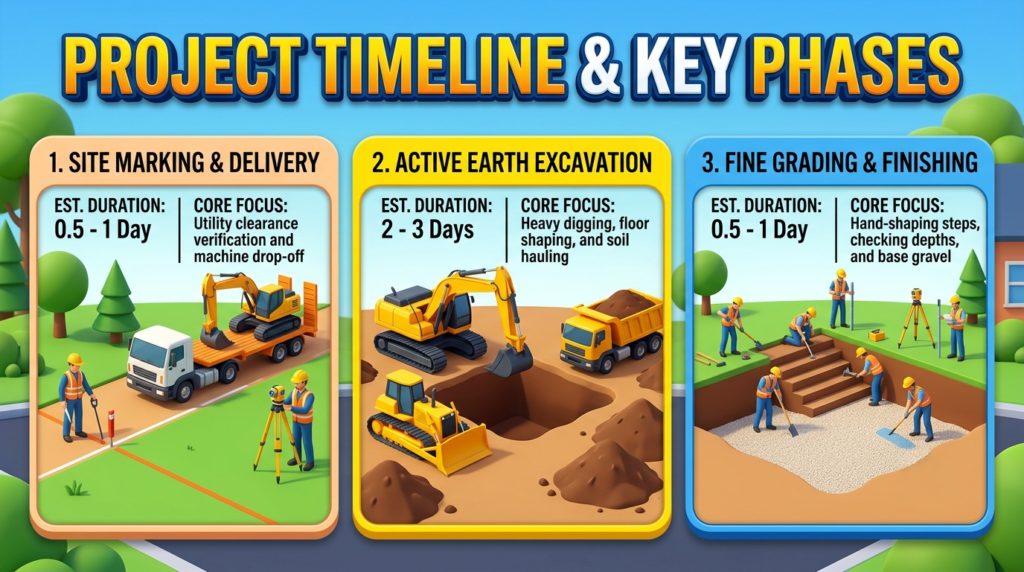
| Project Phase | Estimated Duration | Core Focus Area |
| Site Marking & Delivery | 0.5 – 1 Day | Utility clearance verification and machine drop-off |
| Active Earth Excavation | 2 – 3 Days | Heavy digging, floor shaping, and soil hauling |
| Fine Grading & Finishing | 0.5 – 1 Day | Hand-shaping steps, checking depths, and base gravel |
Phase 7: Post-Excavation Inspections and Hand-off Procedures
The last part of the excavation process serves as a connection point between the raw earthwork and the pool structural framework. A smooth transition guarantees the pool shell is ready for plumbing installations and reinforcement tying-ins.
- Layout verification: With the help of laser levels, the project manager checks that the concentrations of floor slopes and bench cut-outs are accordance with pool blueprints.
- Subgrade soil compaction: In order to duckle the heavy pool shell from settling unevenly over the years, the floor soil has to be mechanically compressed.
- Gravel spread: Crushed stone in a 2-to-4-inch layer is systematically distributed over the pool floor to allow proper drainage and serve as the foundation.
- De-watering line installation: When water seeps into the excavation bottom, a pressure relief or sump pump pipe is used.
- Photographic record keeping: Detailed records through photos of the open excavation provide clear grounds for underground conditions.
FAQs – Swimming Pool Excavation using Mini Excavator
How long does it typically take to excavate a residential swimming pool?
On average, the excavation of a residential pool with a mini excavator will take 2 to 4 days to complete. Factors such as landscaping accessibility, soil conditions, and weather affect the schedule.
Can a mini excavator dig deep enough for a standard inground pool?
With a size of 3.5 to 6 tons, mini excavators normally have a dig depth of 12 to 15 feet. Therefore they will be able to do the work in deep-end pools.
What size mini excavator is best for tight backyard pool builds?
3.5-ton to 5-ton zero tail-swing mini excavator will be your best choice if you are doing a backyard pool build on a tight site. It is sufficiently powerful and will spin safely within its track footprint.
How do I protect my lawn and patio from heavy excavation tracks?
A contractor will always try to use a rubber-tracked mini excavator and cover the ground with large plywood or special composite mats so as not to crack concrete and create ruts in the lawn.
What should I do if the excavator hits rock during the pool dig?
If the excavator comes across solid rock during the pool excavation, it is time for bucket-to-hydraulic breaker or jackhammer to be exchanged. This will break the rock layer but the time and cost of equipment will be increased.
Do I need a permit just for digging out a pool in my yard?
Yes, the structural engineering and excavation permits are a must from the local building department before you dig. If you decide to do it without a permit, you can face expensive fines from the city and possibly have your construction project stopped.
How close can a mini excavator safely dig next to a house foundation?
Generally, excavations should be kept outside the 45-degree angle of influence from the foundation footings of your house to ensure safety. If you need to dig closer, custom shoring or underpinning by a structural engineer is required.