
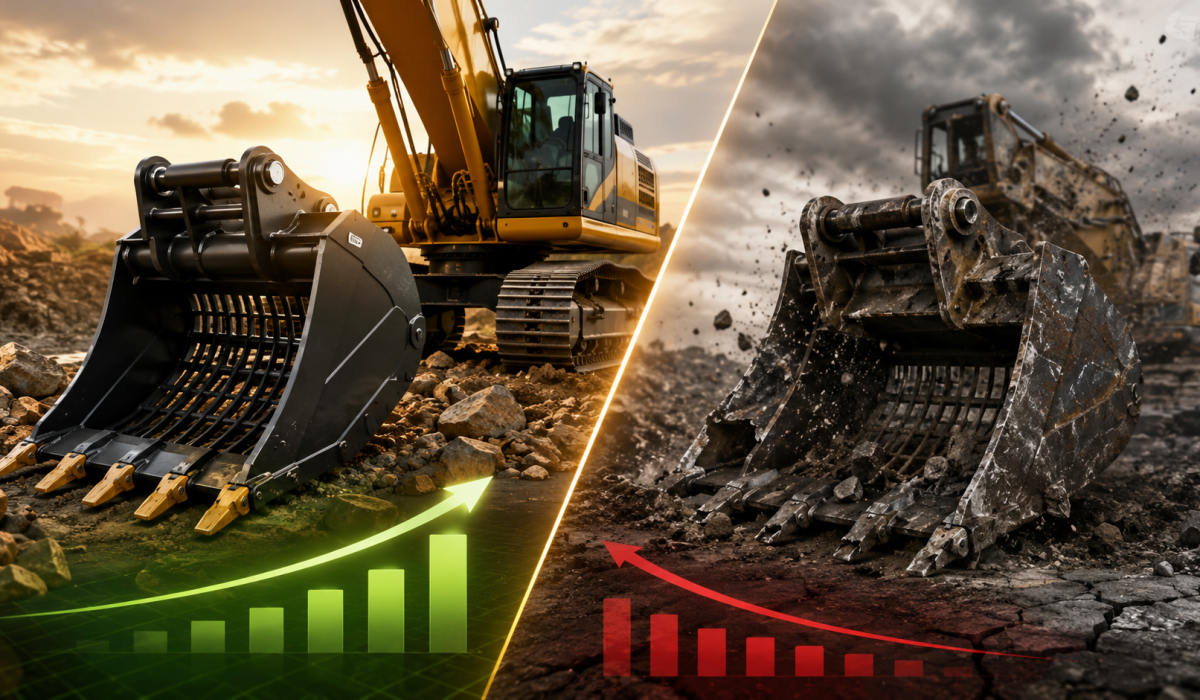
The “Good Enough” Fallacy: How Settling for Premium Excavator Attachments Affects Your Productivity!
In construction, mining and heavy earthmoving, where the stakes are high, the equipment you bring to the table is the lifeblood of your business which can be achieved by choosing the premium excavator attachments instead of cheap ones.
But the “good enough” myth still haunts fleet managers and independent operators alike, a prevalent and damaging attitude. That’s the fallacy that if you’ve invested in a high-horsepower, state-of-the-art base carrier, then the tool at the end of the stick is just a commodity where you can safely cut expenses.
Thinking you are being financially wise by compromising on lesser attachments for the sake of budget is no badge of financial wisdom. It’s a straight sabotage to your machine’s potential and your company’s profitability. A base excavator is merely a hydraulic power delivery system.
The attachment is where the real work is done, where steel meets ground and where the money is eventually earned or lost. When you cut corners at this crucial juncture, you hamstring your production and allow a cascade of hidden expenses that will soon dwarf any initial savings.
Why “Good Enough” Is So Appealing in Heavy Machinery Premium Excavator Attachments
The urge to cut shortcuts on attachments is founded on a basic misunderstanding of operational economics. When equipment purchasers look at a spreadsheet they perceive the excavator itself as a towering capital expense and instantly start looking for ways to stem the cash drain.
A bargain bucket, a white label hydraulic breaker or a generic grapple suddenly seem quite enticing. The changes in appearance on a showroom floor or a web catalog may seem minor — steel is steel, after all. But such a surface assessment entirely misses the metallurgy, engineering geometry and hydraulic efficiency that separates premium excavator attachments from their cheap knockoffs.
Complacency arises in when operators think that if an inferior tool survives its first week on a moderate soil job, it’s OK for the long haul. The illusion of security is broken the instant the machine hits hard rock or extremely abrasive materials or a tight timetable that calls for constant vigorous cycle. Settling is artificially limiting the output of a machine that is capable of so much more.
- Budgetary illusions: The first significant unplanned downtime event almost often negates the initial savings of an inexpensive attachment.
- False parity: Assuming all attachments are made similarly misses important variances in wear-resistant steel plating and precision weld quality.
- The complacency trap: Using inadequate instruments creates a culture of mediocrity on the work site, where operators accept poor cycle rates as the norm rather than striving for optimum efficiency.
The Hidden Costs of Settling for Substandard Equipment
But you put a low tier tool on a high tier machine and you create an instant operational bottleneck. Inferior attachments are defined by poor geometric design, which directly affects how well they penetrate the ground or handle material.
If the breakout angle of the bucket is improper, the hydraulic system of the excavator is working a lot more to get the same result. This persistent, high strain does not occur in a vacuum; it instantly translates into rising fuel consumption and faster wear on the carrier’s pins, bushings and hydraulic pumps.
And inexpensive attachments do not use high-quality, abrasion-resistant steel (AR400 or AR500) like good excavator attachments. This results in a fast deterioration of the structural integrity of the instrument. Teeth shatter, cutting edges distort, hydraulic seals rupture, and all too often.
Every time your operator needs to stop the machine to change a broken tooth or fix a hydraulic leak on a sub-par breaker your project drains money in idle labor and missed daily objectives.
- High maintenance costs: Low-cost attachments need to be welded often, reinforced and parts replaced, increasing your maintenance overhead.
- Increased fuel consumption: Inefficient digging geometry and dull cutting blades of poorly designed tools need the carrier machine to consume more diesel to overcome.
- Operator tiredness and safety risk: The tools’ erratic behavior and frequent malfunctions are a source of great annoyance for the operators, increasing weariness and the danger of accidents on the work site.
Premium Excavator Attachments: Changing the Job Site
Investing in premium excavator attachments is not a frivolous luxury. It is a smart move to make the most of your capital equipment. The premium tools that industry experts advocate and provide at americanexcavator.org are meticulously crafted and detailed.
The mechanics are tuned to send the maximum breakout force of your particular excavator model straight into the material without energy loss. When a premium hydraulic breaker is used, for instance, the internal dampening mechanisms serve to shield the carrying machine from deadly shockwaves, yet continue to deliver devastating, consistent blows to the rock.
Similarly, a premium grading bucket incorporates stiff torsion bars and wear strips that keep a flawless edge for thousands of hours of usage so your operator can complete grades in one pass instead of three. The degree of synchronization between the carrier and the attachment drastically reduces project schedules, enabling your organization to bid more aggressively and execute more contracts in one season.
- Superior material retention: High quality buckets are intended to enhance fill factors and limit material leakage during the swing cycle, moving more dirt per hour.
- Improved Hydraulic Synchronization: Quality attachments are designed to work with the flow and pressure ratings of your machine, ensuring that it never overheats or loses power.
- Extended service life: Using unique wear plates and heavy-duty pivot points, these tools will last years longer than the cheap counterparts, not just months.
“Budget vs. Premium Excavator Attachments: The Cost Comparison”
One really can’t understand the argument against the “good enough” fallacy without abandoning the narrow view of the original purchase price and adopting the measure of Total Cost of Ownership (TCO).
A inexpensive attachment could save you forty percent the first day, but it costs you in hidden costs over the life cycle. Where a budget attachment is unsuccessful, the cost is not only the cost of the replacement part but also the pay of the idle crew, the rental cost of a temporary substitute machine and the possible contractual penalties for missing a project milestone.
Premium excavator attachments are an insurance policy against these catastrophic financial breaches. They guarantee up-time. Standardize your fleet with excellent hardware from trusted vendors like americanexcavator.org and you’ll guarantee predictable performance and stabilize your predictions.
Table: Premium Excavator Attachments Features
| Feature / Metric | Budget / Inferior Attachments | Premium Excavator Attachments |
| Material Quality | Mild steel, prone to rapid wear and deformation | AR400/AR500 wear-resistant steel, structural integrity |
| Hydraulic Efficiency | Generic fittings, high risk of leaks and pressure drops | Precision-machined components, optimal flow utilization |
| Downtime Risk | High; frequent stops for repairs and structural welding | Low; engineered for continuous, heavy-duty cycles |
| Long-Term ROI | Negative; replacement costs exceed initial savings | Highly Positive; maximizes machine output and longevity |
- Initial purchase price vs. lifespan cost: The initial premium you pay for excellent tools is rapidly negated by the substantial decrease in emergency repairs and replacement cycles.
- Resale/ scrap value: Premium tools have a substantial residual value on the secondary market, but budget tools are often sold for scrap metal weight.
- Warranty and manufacturer support: Quality attachments have good warranties and prompt dealer assistance, which helps reduce the cost effect of any rare manufacturing problems.
The Real-World Effects of Equipment Complacency
Imagine a mid-sized civil contracting business that has been assigned to a trenching and utility installation project with a quick turnaround in a congested metropolitan area with unpredictable, rocky soil.
The procurement team goes for a bargain-brand hydraulic hammer and a low-cost trenching bucket to optimize their profit. In the first 72 hours the bucket teeth break on a concealed bed of granite and the hydraulic hammer experiences a catastrophic failure of the seal owing to poor manufacturing tolerances.
The whole work site comes to a standstill. The excavator sits idle, the pipe laying team is paid to stand about and the project manager spends frantic hours attempting to obtain new parts that are not easily accessible locally. But when the machine is up and running again, those first “savings” are long gone, replaced by thousands of dollars in missed production and a customer relationship that can never be repaired.
On their equipment with top-of-the-line excavator attachments, the rock would have been methodically treated, the trench excavated neatly, the job delivered ahead of time. Complacency silently eats away at construction margins.
- Project deadlines missed: Equipment failure has a domino effect, delaying dependent trades and extending the total project completion date.
- Reputation: Customers may forget a few bucks on a bucket, but they remember the delays and explanations; unreliable contractors don’t get repeat work.
- Contractual penalties: Many contemporary commercial and municipal contracts include hefty liquidated damages for missing milestones, converting a little failure into a significant financial punishment.
FAQs about Premium excavator attachments
What attachments do you put on a tiny excavator?
Mini excavators are quite adaptable. They can handle a lot of premium excavator attachments. The most prevalent include heavy-duty digging buckets, grading buckets, hydraulic thumbs, augers for drilling post holes, hydraulic breakers for mild demolition, and brush cutters for land clearing. The trick is to make sure the attachment is a match for the machine’s operational weight and hydraulic flow.
Do premium excavator attachments fit all excavators?
No, they are not generally interchangeable as-is. Attachments should match the pin diameter, pin center-to-center distance and dipper stick ear width of the carrier machine. Although you may install a premium hydraulic fast coupler that will produce a standard connection point, so you can simply switch out many attachments manufactured to that coupler’s standard, thereby substantially decreasing changeover time.
What is the best tool for an excavator?
But the most important change is often regarded as the hydraulic thumb, since it’s a versatile addition. A hydraulic thumb coupled with a premium heavy-duty bucket quickly converts a basic digging machine into a powerful material handler, enabling operators to pick up, sort and arrange irregular items like rocks, logs and demolition waste with complete accuracy.
What to look for before purchasing an attachment?
Before you buy it’s important to check the precise characteristics of your excavator. This involves testing the maximum lifting capability of the machine, the auxiliary hydraulic flow rate (GPM) and hydraulic operating pressure. If you install an accessory that requires more flow than your machine can offer, you will get slow, inefficient performance and risk overheating.
Are hydraulic attachments difficult to maintain?
Yes, hydraulic attachments like breakers, tiltrotators and grapples have more demanding maintenance requirements than static buckets. Premium excavator attachments should be visually inspected daily for hydraulic hoses and fittings, greased at all pivot points (often several times a day in heavy operation) and worn components and seals replaced at the manufacturer’s suggested intervals.
How to Match a Hydraulic Hammer to Your Excavator
A hammer match is based on the weight class of the carrier and the hydraulic power of the carrier. Should the hammer be too tiny it will not penetrate the hard rock and will merely rebound, ruining the instrument. If it is too big, the additional weight and shock can cause serious damage to the excavator’s boom and stick. Always consult your equipment dealer or the experts at americanexcavator.org to ensure perfectly matched kinematics.
Are refurbished premium attachments a good option?
Refurbished premium excavator attachments can offer excellent value, provided they have been meticulously inspected and rebuilt by certified technicians. A properly refurbished premium tool—featuring overhauled cylinders and newly plated AR500 steel—will almost always outperform and outlast a brand-new budget attachment. Always ask for documented service history and assurances of structural integrity.
Conclusion – Premium Excavator Attachments
The construction and excavation sector allows no tolerance for mediocrity. Every cubic yard of soil moved, every trench excavated, and every building dismantled demands full mechanical dependability. The “good enough” fallacy is a harmful delusion that mislead company leaders into risking long-term sustainability for short-term perceived savings on a ledger.
Settling for substandard attachments cripples your production, artificially restricts the capabilities of your costly carrier equipment, and exposes your organization to severe, unexpected downtime. By realizing that the attachment is the genuine tip of the spear, and making the uncompromising decision to invest in superior excavator attachments, you defend your project timeframes, protect your operators, and ensure your profit margins.
Do not allow complacency define your success; equip your equipment with the quality they deserve and demand the performance your organization needs to grow.