How to Know an Excavation Company is Right for Your Job
When you’re starting a new construction project — whether it’s laying the intricate foundation of a sprawling residential home, installing complex underground utility systems, or preparing a massive commercial site for future development can be succeeded with the perfect excavation company— the very first phase determines the pace, safety, and success of the entire effort.
Selecting the correct excavation company is not just ticking off a box on your project management to-do list, but it’s a major investment in the structural integrity and long-term survival of your property. If the initial earthwork is not done well, each subsequent step in construction, from pouring the concrete foundation to framing the walls and installing the roof, will be plagued by underlying instability and unanticipated, costly issues.
Finding the appropriate excavation company takes you much beyond the easy online search, and you have to go deep into a contractor’s operating standards, safety procedures, and historical performance record.
At American Excavator, we genuinely believe that when our clients are educated and informed, they are empowered. And to that end, we want you to know just what basic characteristics differentiate a bad dirt moving contractor from a good one, so your property is well prepared for the future.
Evaluating Experience and Project Fit
Experience is always the best instructor and this is never more true or important than in the heavy dirt-moving and earthwork industries. When you are engaged in looking for the proper excavating business you need to thoroughly review their particular experience with projects that are an ideal match for the scope, size and particular intricacies of your own future task.
A contractor might have years of experience efficiently digging out small residential swimming pools or shallow drainage ditches, but that doesn’t mean he’s qualified to handle the complexity of a commercial-scale grading project, deep sewer line trenching, or building a large retaining wall.
Study their portfolio in depth. Probe with specific questions about the kind of soil they’re used to working with, the particular geographical and environmental obstacles they’ve managed to overcome in the past, and their intimate knowledge of local zoning laws and regulations.
A good excavating business will take pride in showing a broad, full portfolio and will be upfront about what they can do, their particular talents, and what they can’t do. They will also take time to familiarize themselves with your concept, traveling to the site in person to analyze the terrain, drainage needs and any subsurface obstructions before they even sketch a formal plan.
- Carefully review contractor’s portfolio to confirm they have successfully accomplished projects very comparable to your exact needs, lately.
- Ask for a minimum of three genuine references from former customers to get an up-close and personal feel of their happiness, communication style, and length of the project.
- Ask specifically about the company’s firsthand expertise with the particular soil compositions in your area, whether it’s heavy moisture-retaining clay, loose shifting sand or exceptionally thick bedrock.
Safety Certification, Insurance, And Licensing
Professional excavation is a business of inherent hazard. With large pieces of tremendously heavy gear, deep plunging trenches that are always subject to unexpected collapse, and a concealed, sophisticated labyrinth of highly pressured subterranean utility lines, there is a great deal that may go wrong. Legal license, complete insurance cover and documented safety qualifications are all non-negotiable and need to be stringent to be able to recognize the proper excavating firm.
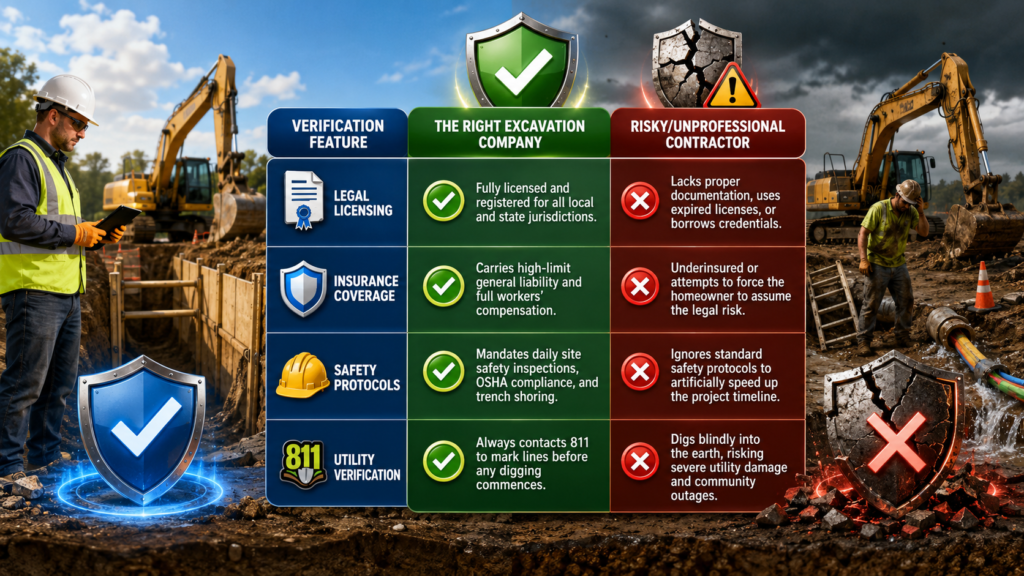
Table: Excavation company Verification Features
| Verification Feature | The Right Excavation Company | Risky/Unprofessional Contractor |
| Legal Licensing | Fully licensed and registered for all local and state jurisdictions. | Lacks proper documentation, uses expired licenses, or borrows credentials. |
| Insurance Coverage | Carries high-limit general liability and full workers’ compensation. | Underinsured or attempts to force the homeowner to assume the legal risk. |
| Safety Protocols | Mandates daily site safety inspections, OSHA compliance, and trench shoring. | Ignores standard safety protocols to artificially speed up the project timeline. |
| Utility Verification | Always contacts 811 to mark lines before any digging commences. | Digs blindly into the earth, risking severe utility damage and community outages. |
A real expert and respectable contractor will have all the proper state and local municipal licenses needed to do difficult earthwork legally and ethically in your particular area. In addition to that, they must have solid general liability insurance and full workers’ compensation insurance.
This important insurance matrix protects you, the property owner, from devastating and life-altering financial liabilities in the highly unfortunate event that a worker is severely injured on your property or a neighboring residential structure is accidentally damaged in the aggressive digging process.
Don’t just take a contractor’s word of it; a premium excavation company will be happy and able to offer you with physical or electronic copies of their current insurance certificates and proper license credentials. Here at American Excavator we are always on the highest level of safety and legality, so you can rest assured knowing you’re in good hands from the first shovel to the final product.
Insurance Coverage High-limit general liability and complete workers’ compensation. Underinsured, or try to compel the homeowner to take the legal risk.
Safety Procedures Daily site safety inspections, OSHA compliance and trench shoring required. Ignores normal safety procedures to artificially accelerate the project schedule.
Utility Verification Always call 811 to designate lines before any digging starts. Blindly digs into the soil risking serious utility damage and community blackouts.
- Always ask for and check confirmation of their current, active general liability and workers’ compensation insurance policies in hard copy or electronic format.
- Confirm with local authorities the contractor’s possession of the specific municipal and state permits necessary legally for large commercial or residential earthmoving.
- Get the company’s detailed explanation of the particular safety procedures they use every day and how they work to strictly adhere to OSHA requirements on the live job site.
Equipment Quality and Technological Capabilities Analysis
In today’s fast-paced construction environment, the overall quality and condition of a contractor’s heavy equipment fleet is a clear and unmistakable indicator of the company’s overall dedication to efficiency, precise execution and unwavering dependability. Just look at the visual condition and technical integration of a fleet and you can very quickly discover the suitable excavating firm.
Old, rusty and badly maintained equipment is especially prone to catastrophic malfunctions on a regular basis, which means nothing but painful project delays, huge blown budgets and enormous aggravation for everybody concerned. In contrast, a forward-thinking firm that invests extensively in state-of-the-art excavators, strong bulldozers, nimble skid steers and durable backhoes indicates a deep, long-term commitment to better and timely outcomes.
With the development of current technology, such as very precise GPS-guided grading systems and automated laser leveling instruments, equipment operators may now attain accuracy down to the millimeter, reducing the need for expensive and time-consuming human rework.
The right excavation company will not only have this cutting-edge advanced machinery but also will adhere to a stringent, manufacturer-recommended preventative maintenance schedule to guarantee that every single piece of equipment is running at absolute peak performance the moment it shows up on your property.
- Carefully examine the age, brand and overall visual condition of the heavy equipment the contractor proposes to use on your property.
- Ask whether the firm employs fancy technology that helps them work faster and with more accuracy, including automatic grading systems using GPS or laser leveling.
- Ask about their typical preventive maintenance routines and how they effectively work through unforeseen equipment problems during an active project.
Assessing Communication, Transparency and Professionalism
One of the most vital, but often ignored, parts of selecting an earthwork contractor is to thoroughly examine their ability to communicate effectively, honestly and with a high level of absolute professionalism throughout the course of the difficult job. A good excavation company knows that the foundation of a successful, stress-free relationship between customer and contractor is clear, consistent and proactive communication.
Even during the first introduction phone contact, pay particular attention to how quickly they reply to your initial inquiry, how clearly and calmly they answer your complicated concerns, and how they value your important time.
A truly reliable contractor will provide you with a very detailed written timeline with key project milestones, and will keep you informed of their daily progress, particularly if highly unforeseen challenges suddenly develop, such as hitting hidden subterranean bedrock or experiencing severe, disruptive weather.
The ideal excavating firm is defined by absolute openness in their daily operations and in their overall billing methods. They will never leave you wondering about the present condition of your pricey project, or the justification behind a sudden major operational move.
- Take note of how promptly, courteously, and clearly the contractor replies to your first phone calls, text messages and email questions.
- Make sure the organization is fully committed to a very comprehensive, legally binding written project timetable with clear, realistic goals.
- Look for a contractor that is forward-thinking about possible problems down the road, and who has practical, cost-conscious solutions to provide — not just excuses.
Comparing Quotes and Figuring Out the Real Cost
And when it eventually comes time to sit down and analyze the filed project bids, the natural human impulse is nearly always to first go towards the lowest figure listed on the page. But going for the cheapest alternative available is an infamous, very risky trap that almost always leads in decidedly sub-par craftsmanship, a torrent of hidden expenses at the end and very stressful legal battles.
A good excavation company will always provide you a very complete, itemized price that clearly lists the separate expenses for human labor, heavy equipment use, transporting of bulk materials, environmental disposal fees, and any required municipal permits.
If one bid is ridiculously and drastically lower than others, then it is very likely the unethical contractor is taking dangerous safety shortcuts, underpaying their uncertified staff, not having proper liability insurance, or purposely skipping over critical phases of the work needed and then going to aggressively bill you for later.
If you want to do an apples to apples comparison you need to get at least 3 full quotations from highly rated respected contractors in your local region. The correct excavating firm will gladly back up their price structure and clearly explain where every dollar of your money is going to show the tremendous value, longevity and structural integrity they provide to your property.
- Request a detailed written estimate that isolates personnel, heavy equipment, raw supplies and debris removal into separate and distinct line items.
- Exercise a healthy level of skepticism about any first bids that are much below the general market average since they almost invariably mask huge future upcharges and fees.
- Make sure the final signed contract specifically states the total cost for getting all essential local construction and zoning licenses.
Customer Reviews & Testimonials Portfolio of Past Work
In today’s highly-connected, heavily-scrutinized digital world, a construction company’s whole reputation is practically 100% visible and accessible for your full evaluation at the push of a button. Before you sign any binding contracts or pay any deposit, take the time to do a deep, complete review of the potential contractor’s whole internet presence.
A good excavating business will have a large, largely favorable set of reviews that can be verified on many highly-trusted sites like Google, Yelp, the Better Business Bureau and industry-specific directories. Pay very close attention to the company’s official response to this very rare negative feedback.
An extremely professional, empathetic and polite response to a client dispute can tell you a lot about their conflict resolution skills and their constant dedication to ultimate customer satisfaction. Request to examine a tangible or digital portfolio of prior completed work. It should include substantially detailed before and after images. You will have tremendous, unparalleled trust in their daily operating standards, via verifiable visible proof of their heavy grading and trenching skills.
The correct firm in the excavation company will always be very pleased to put their past work on the line and will be more than happy to provide you the names of previous local customers who will be more than happy to recommend their integrity, timeliness on a daily basis and their long lasting quality of earthwork.
- Read through several online customer evaluations on a variety of third-party platforms to find indisputable, persistent trends about the company’s timeliness and quality of work.
- See for yourself the quality of their grading, clearing and trenching work by looking at high definition before and after photos of their past earthwork projects.
- Pay very careful attention to precisely how the top management team reacts publicly to any poor reviews or public consumer concerns online.
FAQs – Excavation company Services
What questions do I ask an excavating contractor?
ALWAYS ask them point blank about their real, verifiable experience on jobs just like yours. ALWAYS ask for immediate proof of current licenses and liability insurance. ALWAYS ask very specific questions about the age, brand and maintenance schedules of their heavy equipment. ALWAYS ask for a very detailed explanation of their on-site safety policies on a daily basis.
How much does it cost to engage the appropriate for the excavation company?
The total cost of the project might vary greatly depending on the actual size of the project, the concealed subsurface soil conditions and the exact geographic location of the property. But for simple domestic excavation, most normal homeowners pay between $1,500 and $5,000. Massive, complicated commercial grading operations may easily and rapidly go into the tens of thousands of dollars.
What is the difference between trenching and excavating?
Excavating is a very wide umbrella industry phrase that applies to any and all processes of forcibly moving soil, thick rock, or other ground materials using large heavy equipment. Trenching, in contrast, is a very precise, limited kind of excavation in which the hole made into the ground is significantly deeper than it is broad and is often used especially for the purpose of safely installing underground pipes or utility lines.
Do excavating businesses need permits?
The correct excavating firm will almost always take care of the whole arduous permission procedure totally on your behalf. They are intimately, professionally versed with intricate local zoning rules and severe municipal standards. But this important administrative task has to be specifically and properly incorporated into your final written contract.
What kind of insurance does an excavating firm need?
At an absolute, non-negotiable minimum, any earthwork contractor who is highly legitimate and professional must legally carry comprehensive general liability insurance to fully cover any accidental property damage, and they must carry robust workers’ compensation insurance to fully cover any physical injuries sustained by their hardworking crew while actively operating on your property.
How can I check an excavating contractor’s license?
Verifying that a prospective contractor has an active operating license is very easy and quick. All you need to do is ask for the exact license number and check that specific number against your state or local municipal government’s official online contractor licensing board website or public database.
What if the excavation company damages a utility line?
If a negligent contractor unintentionally strikes an active utility line because they negligently neglected to call 811 to have the underground wires correctly marked prior to digging, they are often held totally accountable, both legally and financially, for the large repair expenses. This is the precise case when it is extremely necessary to choose a properly insured, highly careful, well-reviewed specialist for your financial protection.

A trailer running at its weight limit continuously leads to accelerated tire wear and premature brake failure. Always choose a trailer rated at least 20% above your loaded machine weight.
Always calculate your TYPHON's wet weight — with fuel, hydraulic fluid, and a full tank — before purchasing a trailer. Dry weight figures from spec sheets are commonly 8–12% lower than the real transport load.
"The right trailer is not an accessory — it is the foundation of a safe, legal, and efficient job site operation for any TYPHON mini excavator owner."