
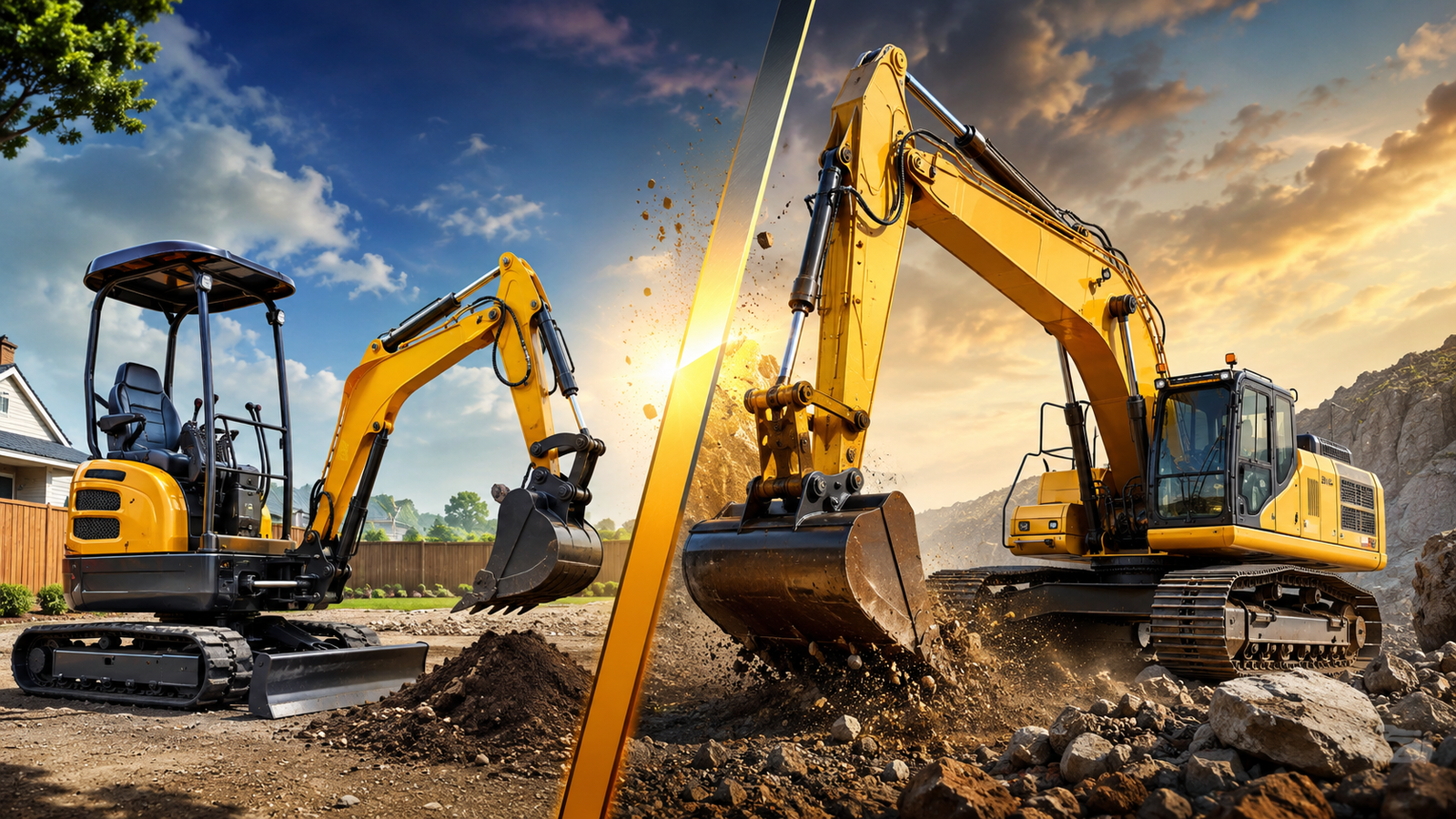
Mini Excavator vs. Full-Size Excavator: What Do You Need?
Whenever it comes to taking on construction, landscaping or mining projects, the most important choice you will make is choosing the best heavy gear. The age old issue of a Mini Excavator vs. Full-Size Excavator frequently has project managers and property owners assessing the advantages and drawbacks of power, size and mobility.
Both devices have different objectives and work well in different contexts so it is important to understand what each can do before making a purchase or rental choice. American Excavator is your go to source for all things earthmoving, dedicated to helping people and companies find the correct equipment to do the job efficiently and productively.
This ultimate guide covers the features, restrictions, and best uses for tiny and full-size excavators so you can choose the right excavator for your project.
Mini Excavator vs. Full-Size Excavator: What to know?
The complexity of equipment size is more than just a matter of measuring the physical dimensions of the machine. That means taking a comprehensive look at hydraulic flow, breakout force, transportation logistics and long term maintenance expenses.
From vast commercial projects to confined private backyards, work sites have gotten more diversified than ever, driving an unprecedented need for both nimble compactness and raw power. Assess your site conditions, needed depths of digging and time limits to optimize your fleet and save thousands of dollars in operational expenses.
Join us as we take a look at some of the key differences that set these two earthmoving titans apart and help you pick whether one belongs on your next jobsite.
Introduction to Mini Excavators
Mini excavators (sometimes called compact excavators) are usually in the 1 to 10 ton range (2,500 to 22,000 pounds). These machines have been more popular over the last decade, in large part due to the growing demand for adaptable construction equipment in crowded urban and residential locations.
Modern micro excavators have a smaller footprint yet provide a surprising amount of hydraulic power, enabling them to conduct precise work without the hefty footprint that ruins completed landscapes or paved surfaces. They are meant to be precise, accessible and to cause little disturbance to the site.
The biggest benefit of a compact excavator is its simplicity in terms of logistics. For most machines under 10,000 pounds, you may tow them behind a heavy-duty pickup truck on a regular equipment trailer, so you don’t require commercial carrying licenses and semi trucks.
Many types also include retractable undercarriages to enable them to pass through standard 39-inch gates, and zero-tail swing designs that keep the back of the cab from hitting adjacent buildings when turning. A compact excavator is the best friend you could have for inside demolition, digging a trench for home utilities or even backyard restorations.
- Excellent Maneuverability: Zero tail swing and small frames enable these machines to work in tight quarters and residential backyards without collateral property damage.
- Cost-Effective Operations: These machines use less gasoline than their bigger counterparts and often have reduced maintenance and shipping expenses. These machines are very budget-conscious for short-term operations.
- Lower Ground Pressure: Lightweight and non-marking rubber tracks allow for operating on finished surfaces, lawns and fragile terrains without damage.
- Ease of Transportability: Smaller units may be moved with a conventional heavy-duty truck and trailer, greatly reducing the problems and expenses of commercial haulage.
The Unparalleled Strength of Full-Size Excavators
Standard excavators, or full-size excavators, are known for their massive raw power and structural stability. These heavy-duty machines, ranging from 13 to over 40 tons, are the uncontested monarchs of commercial construction, deep foundation digging and large-scale earthmoving activities.
The normal excavators have high-horsepower engines from 100 HP to over 500 HP and do the tough work that tiny machines literally cannot touch. When you’re working in deep frozen ground, heavy clay, solid rock or large scale land clearing projects, a full size excavator has the breakout power to keep the job on schedule.
The design of a full-size excavator is based on greatest reach, dumping height and lifting capability. These machines are large. They take up a lot of area in an operating room with widths of typically 8 to 10.5 feet and large tail swings.
They don’t have the delicate touch of a tiny digger but can cycle through huge amounts of material aghttps://americanexcavator.org/2025/03/18/how-to-save-time-and-money-with-a-mini-excavator/gressively making them the most cost-effective option for long-term, high-volume projects. From demolishing a multi-story commercial building to filling fleets of dump trucks at a mining site, the standard excavator’s high hydraulic flow and heavy-duty steel tracks provide unmatched productivity and stability in difficult, underdeveloped terrain.
- Best Breakout Force: Heavy-duty hydraulic systems and high horsepower engines push through resistant materials such as bedrock, clay that is tightly packed and concrete structures.
- Better Depth and Reach for Digging: Great for deep trenching jobs, big foundation excavations, and putting dirt onto high-sided dump trucks quickly.
- Huge-Duty Stability: This unit offers a strong, steady base to lift huge items and execute high-impact destruction with its enormous weight and broad steel track stance.
- High-Volume Productivity: The big buckets and quick cycle durations of the equipment dramatically minimize the hours it takes to move large volumes of soil.
Major Differences: Size, Range, and Performance
The most noticeable distinctions between a Mini Excavator and a Full-Size Excavator are their physical dimensions and the performance characteristics that result from these measurements. Mini excavators are designed for surgical accuracy in tiny locations, and they generally dig down 5 to 15 feet.
A typical excavator, however, trades urban maneuverability for sheer brute might, able to dig deeper than 25 feet and with a horizontal reach that enables operators to transport massive volumes of soil without continually moving the vehicle.
There are some requirements of your project that are important considerations to make an educated selection. If you’re working on a large commercial project with plenty of room, the continual repositioning needed by a compact excavator will be a major negative on your timetable.
But to put a 20-ton conventional excavator in a close residential area would create logistical headaches, the possibility of property damage and high transporting costs.
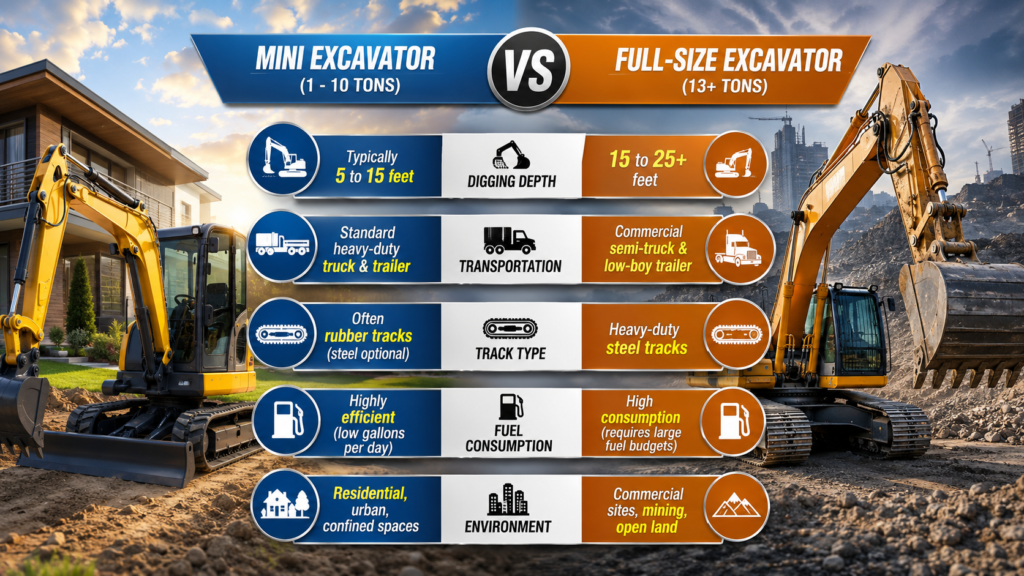
| Feature | Mini Excavator (1 – 10 Tons) | Full-Size Excavator (13+ Tons) |
| Digging Depth | Typically 5 to 15 feet | 15 to 25+ feet |
| Transportation | Standard heavy-duty truck & trailer | Commercial semi-truck & low-boy trailer |
| Track Type | Often rubber tracks (steel optional) | Heavy-duty steel tracks |
| Fuel Consumption | Highly efficient (low gallons per day) | High consumption (requires large fuel budgets) |
| Ideal Environment | Residential, urban, confined spaces | Commercial sites, mining, open land |
- Operational Footprint: Personnel entrances and gates may provide access to little excavators, whereas full-size excavators need large, clear access ways to reach a work site.
- Hydraulic Flow: Bigger excavators have the hydraulic power to drive large industrial attachments, while smaller ones can only operate ordinary augers, tiny breakers and grading buckets.
- Cycle Times: Full-size machines move tenfold more material each scoop, which greatly accelerates deadlines on high-volume earthmoving projects.
- Surfaces: Standard excavators will dig deep ruts in soft ground and ruin pavement. Mini excavators with rubber treads glide over sensitive surfaces with little effect.
Cost Estimation and Project Budgeting
Budget factors are significant in the Mini Excavator vs. Full-Size Excavator argument. It is important to go beyond the original rental or purchase price and determine the Total Cost of Ownership (TCO) or the whole rental overhead. Hiring mini excavators on a daily, weekly or monthly basis is much cheaper.
They are very fuel-efficient; a tiny model may get a whole workday out of less than 15 liters of diesel. They also are very cheap for independent contractors and property owners. Smaller undercarriages and lower fluid volumes mean fewer maintenance expenses.
But for colossal projects, even full-size excavators with their scary initial price might be the budget-friendlier choice. A regular excavator hire comes with hefty daily costs, costly commercial delivery fees and huge fuel expenses.
But if a compact excavator takes two weeks to accomplish a large-scale trenching task that a regular excavator can finish in three days, the savings in man-hours and total project time will more than compensate for the higher equipment expenses. Always match the machine’s output rate to your unique schedule to reach the real economic sweet spot.
- Logistical Expenses: When planning for a full-size excavator, you have to include in the expense of commercial low-boy trailers and CDL drivers, but pulling a compact excavator is almost free if you have a big vehicle.
- Fuel Consumption Rates: High horsepower equals high fuel consumption; regular excavators need to be tightly budgeted for gasoline to minimize unforeseen project cost overruns.
- Labor efficiency: The big rental charge against lengthy, slow hours on a smaller digger typically is mitigated by paying the operator for fewer days on a high producing huge equipment.
- Maintenance Overhead: Servicing huge hydraulic systems and replacing heavy-duty steel tracks on typical excavators calls for a far bigger maintenance expense.
Maintenance Problems and Attachments
Regardless of whether you fall into the Mini Excavator or Full-Size Excavator camp, your machine’s flexibility is mostly defined by its attachments. At American Excavator, we want to highlight the importance of considering a broad selection of excavator attachments to really increase your fleet’s capabilities.
Auger drives are usually seen on mini excavators for fence jobs. Brush cutters are used for land clearance and grading blades are used to level sites. Full-size excavators have large hydraulic flow, and may power heavy-duty hydraulic hammers for concrete demolition, industrial crushers, and huge grapple buckets for forestry operations.
Safety and maintenance are also high priorities when dealing with any size of heavy equipment. With proper inspections, scheduled maintenance and quality replacement parts (such upgrading to a premium hydraulic arm cylinder), your equipment will function safely and effectively.
A compact excavator could be easy for a new operator to check every day, but a full-size machine needs a regimented, professional maintenance routine to keep the work environment safe and to avoid catastrophic mechanical breakdowns on the job site.
- Attachment Sizing: Never under or over-size your attachments for the hydraulic flow and working weight of your machine, since this can harm your equipment.
- Daily safety inspections: Strict daily walk-arounds are required for Class 1 and Class 2 excavators to inspect track tension, hydraulic fluid levels and structural integrity.
- Multi-functionality with Attachments: Operators may easily change between buckets, grapples, and breakers by purchasing quick-couplers, ensuring the equipment is put to full use on any jobsite.
- Preventative Maintenance: To extend the life of both small and conventional excavators, it is important to adhere to the manufacturer’s recommended service intervals for oil and filter changes.
FAQ’s – Mini Excavator vs. Full-Size Excavator
What is the difference between a compact excavator and a full size excavator?
The biggest variations are size, operational weight and power. Mini excavators usually weigh 1 to 10 tons and are built for tight places and little ground disturbance. Full-size excavators (13 tons or more) are designed for heavy-duty digging, extreme breakout force and high-volume material transportation on open commercial sites.
Can a tiny digger be used for demolition?
Yes, compact excavators are good for light and interior demolition jobs. Smaller size means they fit through entrances and reduced weight is safer for indoor flooring. But for the destruction of massive, multi-story structures, the reach and strength of a full-sized excavator are absolutely necessary.
Which excavator is most economical to hire?
A micro excavator is much more cost-effective for small to medium size jobs with cheap daily rental rates, less in transportation costs and great fuel economy. But for big earthmoving projects a full size excavator is more cost efficient. It gets the work done in a fraction of the time, saving considerably on labor expenses.
Can I haul my small excavator myself?
Many small excavators, especially those weighing less than 10,000 pounds (5 tons), may be legally and securely hauled behind a heavy-duty pickup truck on a regular dual-axle equipment trailer. Before moving equipment always check your vehicle towing capability and local hauling laws.
What’s the best equipment for home landscaping?
For home landscaping, a small excavator is by far the superior option. They generally have non-marking rubber tracks that put down little ground pressure, so they don’t wreck lawns and driveways. The zero-tail swing enables them to work securely around homes, fences and existing landscaping.
Do ordinary excavators usually come with steel tracks?
Yes, the great majority of regular full size excavators are all heavy robust steel tracks. These big machines need steel tracks for grip, durability and stability to carry their huge weight and severe digging pressures in tough rocky or muddy areas.
How deep can a micro dig vs a regular dig?
The depth a small excavator can dig depends on its weight class and arm length but generally can dig between 5-15 feet deep. A conventional full-sized excavator, used for deep utility and foundation work, often digs 15 feet to more than 25 feet deep.

A trailer running at its weight limit continuously leads to accelerated tire wear and premature brake failure. Always choose a trailer rated at least 20% above your loaded machine weight.
Always calculate your TYPHON's wet weight — with fuel, hydraulic fluid, and a full tank — before purchasing a trailer. Dry weight figures from spec sheets are commonly 8–12% lower than the real transport load.
"The right trailer is not an accessory — it is the foundation of a safe, legal, and efficient job site operation for any TYPHON mini excavator owner."