

Installation Tips: Hydraulic Arm Cylinder Installation on Mini Excavators
Hydraulic Arm Cylinder Installation on Mini Excavators is an essential job to keep your machine digging power and accurate operation unchanged. The arm cylinder, also called the dipper or stick cylinder, handles very high pressure and repetitive motions and is therefore susceptible to seal wear or structural fatigue over time. Correct installation not only brings back the unit’s performance but also safeguards the entire hydraulic system from contamination and untimely failure.
Whenever you experience a loss in lifting power or observe oil leakages along the rod, it signifies that the unit is due for a replacement. This detailed tutorial with professional
Installation Tips: Hydraulic Arm Cylinder Installation on Mini Excavators will guide you step-by-step in a safe and time-efficient manner. Implementing these industry-standard methods can significantly reduce your equipment’s downtime and assure you get the work done best and fastest.
Top 7 Tips – Hydraulic Arm Cylinder Installation on Mini Excavators
1. Crucial Safety and Pre-Installation
Without a doubt, safety must top your list when you decide to start Hydraulic Arm Cylinder Installation on Mini Excavators. The hydraulic system is under extremely high pressure, and one slip can cause serious injuries or environmental accidents. Being well-prepared makes sure the machine rests in a stable manner and the work area is fit for handling heavy components.
- Setting up the Machine: It is best to park the mini excavator on an even area and stretch the arm so that the bucket or any other tool rests firmly on the ground, thereby removing the cylinder’s load.
- Releasing Pressure: After switching off the engine, gently move the hydraulic control levers in all directions, several times, to help release pressure that might still be trapped inside respective hydraulic lines.
- Personal Protective Equipment (PPE): Heavy-duty gloves, safety goggles, and steel-toed boots should always be worn for protection against hydraulics injecting under pressure and heavy falling objects.
2. Tool and Equipment List You Need to Have at the Ready
First things first, when it comes to Hydraulic Arm Cylinder Installation on Mini Excavators, having the correct tools at hand is very important. Different makes of mini excavators come in different sizes, so make sure the dimensions of your tools conform to those of your operator’s manual. Using inappropriate tools may lead to problems as rounded bolts or damaged pins, thus complicating something which could have been a very simple task.
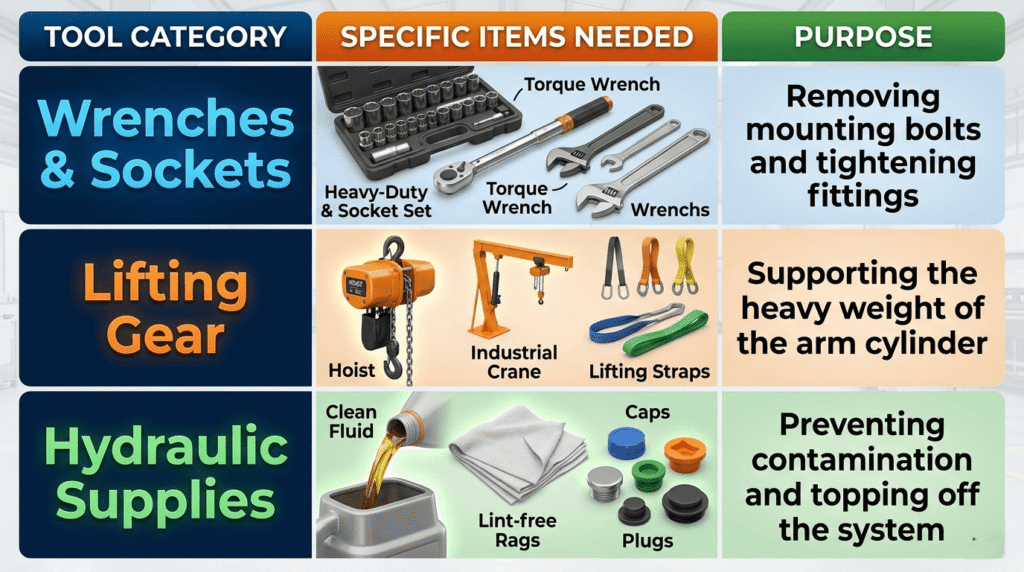
Table: Hydraulic Arm Cylinder Installation on Mini Excavators
| Tool Category | Specific Items Needed | Purpose |
| Wrenches & Sockets | Heavy-duty socket set, torque wrench, adjustable wrenches | Removing mounting bolts and tightening fittings |
| Lifting Gear | Hoist, crane, or lifting straps | Supporting the heavy weight of the arm cylinder |
| Hydraulic Supplies | Clean hydraulic fluid, lint-free rags, caps, and plugs | Preventing contamination and topping off the system |
- Lifting Support: If you really want to avoid injury, then the cylinder should never be lifted manually, but rather use rated lifting straps around the cylinder barrel (not the rod) to maintain balance.
- Contamination Control: Immediately seal open lines upon disconnecting by using specialized hydraulic caps and plugs so as to prevent dirt from entering sensitive hydraulic valve bank.
- Lubrication: Have a quality grease gun handy for lubricating new pins and bushings at the assembly stage.
3. How to Remove the Old Cylinder
For Hydraulic Arm Cylinder Installation on Mini Excavators, you need to be very slow and careful. Disconnecting the fluid lines and taking out the heavy pivot pins is what you need to do. These pins are the ones that link the cylinder to the boom and arm. Photos here are very helpful! Take pics of the hoses, so you know how to put them back later.
- Label the Hoses: In order not to cross the hoses when installing the new unit, label the “extend” and “retract” hoses before disconnecting.
- Drain Fluid Safely: Place a drip pan under the connections before loosening the fittings to catch escaping hydraulic oil, then immediately plug the ports.
- Pin Extraction: Use a pin driver or a brass drift and a hammer to gently remove the mounting pins; if the pins are seized, apply a penetrating lubricant and allow it to sit before attempting removal again.
4. Checking and Getting the New Arm Cylinder Ready
After you have taken out the old piece, it is time to check the new Hydraulic Arm Cylinder on Mini Excavators to make sure it perfectly suit your machine. Even brand-new parts sometimes get defects during the manufacturing or shipping that if left undiscovered, they will cause you problems like leaks right away.
- Verify Specs: Measure the retracted and extended lengths, as well as the pin hole diameters, of the new cylinder to those of the old one to make sure they are compatible.
- Check for Damages: Examine the chrome spa rod for scratches while also check port threads for cleanliness and undamaged.
- Pre-Greasing: Lastly, put some grease on the internal bushings and the mounting pins so that it is easier to insert the parts and avoid friction between the surfaces during the initial operation of the cylinder.
5. The Actual Installation of a Hydraulic Arm Cylinder on Mini Excavators
It is always better to work with two people when Hydraulic Arm Cylinder Installation on Mini Excavators to be able to help each other in case of danger. One person operates the hoist to line up the cylinder eyes with the mounting brackets and the other carefully puts the pins in place. It is very important to avoid a situation where the seal might be damaged due to side-loading that can happen due to improper alignment.
- Ports Alignment: Make sure the hydraulic ports are aligned in the same direction as the original cylinder so that the hoses can move naturally without getting kinked.
- Pin Security: After driving the pins through, fastening them with retainers such as bolts or snap rings is very important as this will prevent cylinder from shifting or falling.
- Specifications Tightening: To properly tighten all mounting hardware to the manufacturer’s recommended specifications, use a torque wrench because over-tightening can cause bracket stress.
6. Hydraulic System Connection and Bleeding
When it comes to Hydraulic Arm Cylinder Installation on Mini Excavators, hooking up the fluid system last and then purging the air from the lines promise your success. Air getting into the hydraulic cylinder will cause operation to be spongy or at worst cavitation which will destroy the internal piston and barrel.
- Hose Connection: Assemble the hydraulic lines back by means of 2 wrenches – one to hold the fitting of cylinder and another for the hose nut turning – to prevent the twisting of internal ports.
- Bleeding Air: At first turn on the engine and gradually move the arm cylinder a few inches in and out, then if no problem increase the stroke until the motion is smooth and constant.
- Check Fluid Levels: After several cycles, the system will have pulled fluid from the reservoir; check the sight glass and add clean hydraulic oil if necessary.
7. Testing Post-Installation and Maintenance
Once you have completed Hydraulic Arm Cylinder Installation on Mini Excavators, it is better to test the machine thoroughly before putting it to work heavy-duty. This is your chance to discover small issues such as leaks or misalignment that may lead to major failures when the machine is fully loaded for digging.
- Visual Leak Check: When you pressurize the system, look over the fittings and rod seal for any signs of “sweating” or weeping oil.
- Full Range of Motion: Perform full range arm motion, checking if hoses are not coming into contact with structural components of the machine.
- Ongoing Monitoring: Tightness of the mounting pins and bolts can be checked after the initial 10 hours since new parts can undergo slight settling after use.
FAQ’s: Hydraulic Arm Cylinder Installation on Mini Excavators and Maintenance
How do I know if my mini excavator’s arm cylinder needs to be replaced?
Typical indications include: drips of oil leaking from the rod seal (drift), slow arm “creeping” or even falling when the control levers in neutral and during operation there is a fall-off in lifting power or jerky movements.
Can I replace just the seals instead of the whole arm cylinder?
Yes, if both the exterior of the cylinder barrel and the rod are free from severe scratches or excessive bends, then fitting the seal kit (repacking) is likely a much cheaper solution than buying a brand new one.
What is “hydraulic cylinder drift” and why does it happen?
The condition causing an arm to move without any operator input is called cylinder drift and usually results from internal fluid bypassing the piston seal or external leakage of fluid through the rod gland.
How do I bleed air out of a new hydraulic cylinder?
To bleed air from the system, operate the cylinder through its complete stroke during low engine speed several times. This will push trapped air back into reservoir from where it escapes through the breather.
Why is my new hydraulic cylinder making a whining or screeching noise?
This is typically due to cavitation i.e. the presence of air in the hydraulic fluid. Check that there is enough fluid and no leaks in suction lines as well.
Do I need special hydraulic fluid for my mini excavator?
Always take your service manual with you. Most mini excavators will have ISO 46 or ISO 32 rated hydraulic oils mentioned but using a wrong viscosity can cause either overheating or sluggish responsiveness.
How often should I grease the mounting pins on my arm cylinder?
If you are a heavy user then it is recommended to grease pivot pins daily (every 8 to 10 hrs). Appropriate lubrication is the key to prevent not only their seizing but also will reduce wear on the bushings.