
Understanding Specs: Pressure, Impact Rate & Chisel Size for Mini Break Hammers
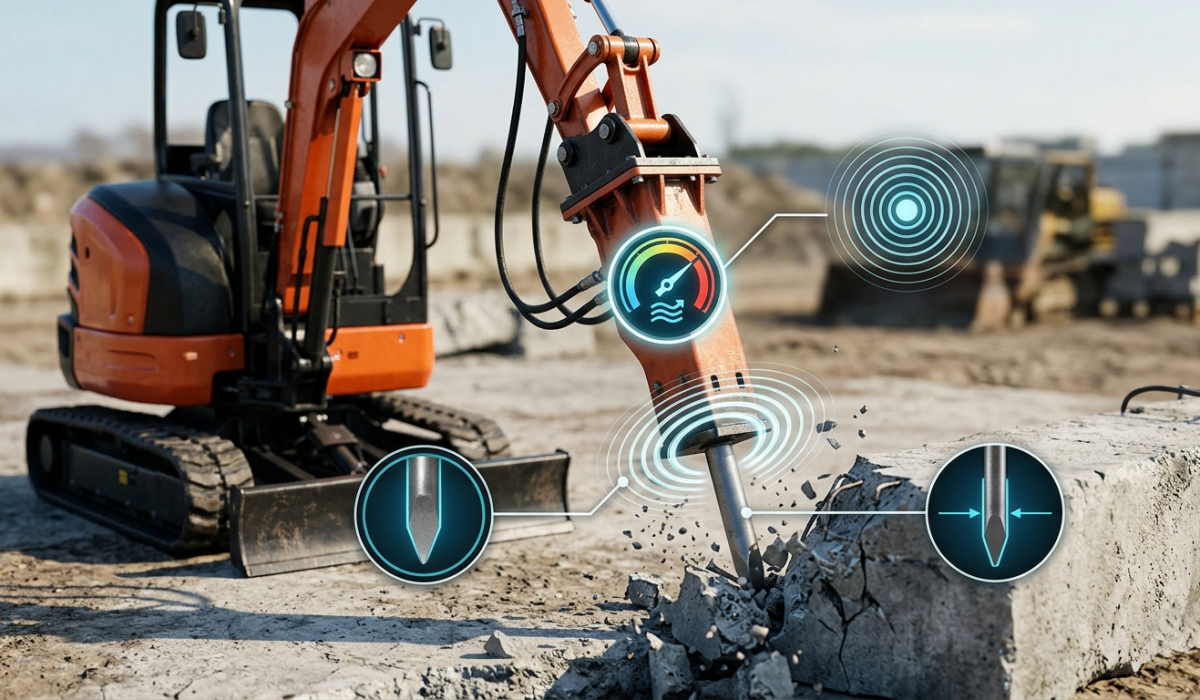
When working in tight spaces of a residential demolition or doing precise landscaping, an efficient equipment will depend on more than just “horsepower” alone. For mini excavator owners, the hydraulic breaker or the mini break hammers is the most important attachment to turn a digging machine into a demolition powerhouse.
However, looking at the specs could be a daunting task. To maximize your investment on americanexcavator.org, you need to understand the holy trinity of breaker performance of the Mini Break Hammers: Hydraulic Pressure, Impact Rate, and Chisel Size. These three specs will decide whether you will break the concrete easily or you will only cause vibrations to your machine that will lead to premature mechanical failure.
The Power of Precision: Understanding Hydraulic Working Pressure
Hydraulic pressure is actually the “power” behind each strike of your hammer. Mostly PSI (pounds per square inch) or MPa (megapascals) are the measuring units of this spec, which shows the force applied to the internal piston.
If the pressure is too low, the hammer will lack the power to break through hard rock; if it is too high, you can end up damaging the seals or the auxiliary circuit of your mini excavator.
- Optimal Pressure Ranges: Most mini breakers for 1–2 ton machines operate efficiently between 1,300 and 1,740 PSI. Matching this to your excavator’s output ensures the internal piston cycles with enough force to crack the material without overloading the carrier.
- Nitrogen Charge Correlation: The “back head” of the hammer is filled with nitrogen gas which acts as a spring. The hydraulic pressure works against this gas pressure; therefore, maintaining the correct nitrogen levels (often around 145–230 PSI depending on ambient temperature) is crucial for the hydraulic pressure to do its job.
- System Protection: Modern hammers often include relief valves to manage pressure spikes. This protects the “through-bolts” and the hammer housing from the violent energy of high-pressure cycles.
Speed vs. Force: Decoding the Impact Rate (BPM)
The Impact Rate, measured in Blows Per Minute (BPM), indicates how many times the chisel hits the surface in a minute. It is a mistake to assume that “the more, the better,” as the correct BPM actually depends on the material being broken. High-speed impacts are suitable for some surfaces, while slower, heavier hits are required for others.
- Frequency Ranges: Mini break hammers generally offer a BPM range from 500 to 1,200. A higher BPM works better for softer or thinner materials such as asphalt or thin concrete slabs where “shaking” the material makes it crumble.
- Impact Energy vs. Speed: Increasing the hit rate often means reducing the force per hit. A slower BPM with greater energy per hit (measured in Joules or ft-lbs) can bring about deep cracks in hard, solid rock.
- Heat Management: Operating the hammer at peak BPM continuously (more than 30 seconds at the same spot) produces a lot of heat due to friction. This not only softens the chisel tip but can also cause deterioration of the hydraulic oil. To prevent this, impact points should be changed regularly.
Choosing Your Edge: Chisel Size and Shape Selection
The hammer’s chisel is the only part that actually comes into contact with the material being worked. Its diameter—which is typically between 35mm and 45mm for mini excavators—and its form determine the way the huge hydraulic power is transferred to the ground. Bigger diameter chisels offer greater durability but also require more power to push them deep into the material.
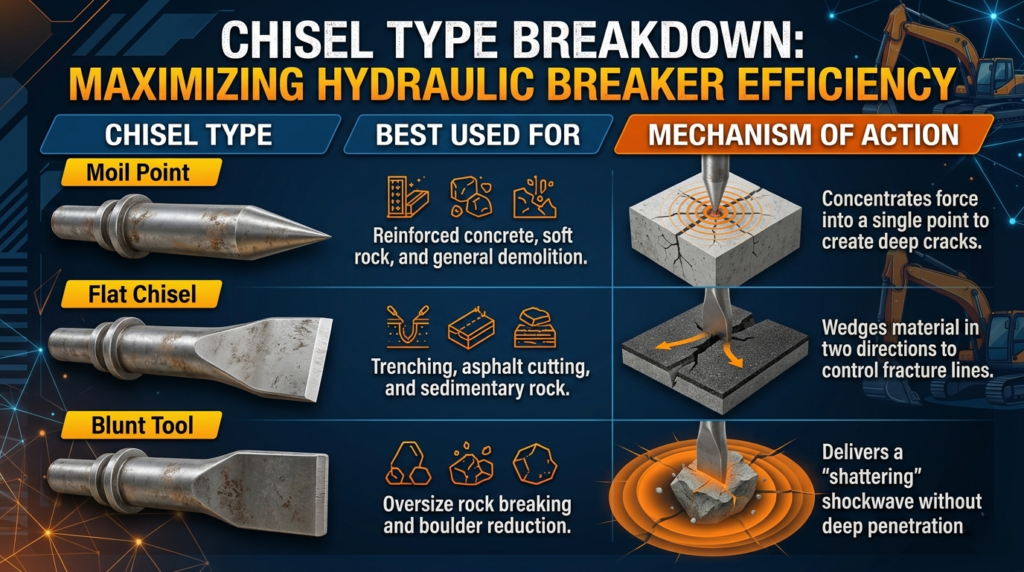
| Chisel Type | Best Used For | Mechanism of Action |
| Moil Point | Reinforced concrete, soft rock, and general demolition. | Concentrates force into a single point to create deep cracks. |
| Flat Chisel | Trenching, asphalt cutting, and sedimentary rock. | Wedges material in two directions to control fracture lines. |
| Blunt Tool | Oversize rock breaking and boulder reduction. | Delivers a “shattering” shockwave without deep penetration. |
- The 10% Rule: Ensure that the chisel diameter and hammer weight are suitable for your machine by sizing the total weight of the breaker to be approximately 10% of the mini excavator’s operating weight. For a 1-ton machine, a hammer of about 80-100kg is the optimal one.
- Material Compatibility: When working with limestone or asphalt, a wider chisel diameter (40mm-45mm) is beneficial as it helps to prevent the tool from “burying” itself too deep before the material breaks, which can lead to the hammer getting stuck.
- Bushing Wear: The chisel is retained by a tool bushing. If the chisel size is not correctly matched or is not lubricated every 2 hours, the friction will lead to “galling,” which is the welding of the chisel to the hammer body.
Maintenance and Longevity: Keeping the Hammer Hitting
Knowing specs is pointless if the hammer breaks down because of poor maintenance. Because mini break hammers release their power through rapid vibrations and high pressure, they need more frequent servicing than a normal digging bucket.
A mini break hammers that is well taken care of can last for thousands of hours, while one that is neglected can give up in one single season.
- Greasing Intervals: You need to manually grease the chisel shank after every 2 to 4 hours of continuous use. This helps the tool move freely within the bushing and prevents metal-on-metal friction, which produces destructive heat.
- Gas Pressure Checks: Nitrogen pressure varies with the weather. In summer, the gas expands which increases the pressure; in winter, it contracts. Check your charging kit every 100 hours to make sure the hammer “bounce” is consistent with manufacturer’s specs.
- Bolt Inspection: These “through-bolts” keep the entire hammer assembly together. Over time, due to the high impact rate, these bolts can stretch or loosen. Being thorough in inspecting them daily prevents internal parts from moving around which could lead to a big oil leak inside.
FAQs: Mini Break Hammers
What is the difference between a moil point and a chisel bit?
Molly point (conical) directs all the impact energy to a single point, so it is a great tool for accessing reinforced concrete and hard rock. A chisel bit (flat wedge) distributes force along a line and thus is better suited for cutting asphalt or trenching where a specific path is followed.
How much nitrogen pressure should be in a mini excavator breaker?
The typical nitrogen pressure for mini breakers is from 145 to 230 PSI (1.0 to 1.6 MPa). This is subject to ambient temperature, higher temperatures result in the gas expansion, therefore a small pressure adjustment is required in order to keep the performance.
Why is my hydraulic hammer hitting but not breaking?
One common problem is “blank firing” or low nitrogen pressure. Without adequate nitrogen, the piston fails to get the forceful “rebound” needed for a striking blow. Other reasons include the possibility that the hammer energy class is not sufficient for the material hardness, or that the chisel is worn out and needs a replacement.
Can I use a larger breaker on a smaller mini excavator?
No, oversized breakers can cause boom and hydraulic pump damages besides making the machine unstable and prone to tipping. So always adhere to the “10% rule,” matching breaker weight to 10% of the machine’s total operating weight.
How often should I grease my hydraulic breaker?
Tool bushing should be greased every 2 hours of actual hammering time. During greasing make sure that the hammer is standing vertically with pressure on the chisel in order for lubricant to properly flow around the shank.
What causes a hydraulic breaker chisel to break?
“Prying” is the most common reason. While the hammer is running, trying to move heavy rocks with the chisel leads to great lateral stresses on the steel. Also, overheating through hammering in one place for longer than 30 seconds may cause the metal to turn brittle and fracture.
How do I choose the right BPM for my job?
High BPM (1,000+) is recommended for “shattering” fragile materials such as concrete slabs and asphalt. Low BPM (500-800) is more suitable for “penetrating” dense, hard rock or thick foundations, where maximum kinetic energy per single blow is necessary.