
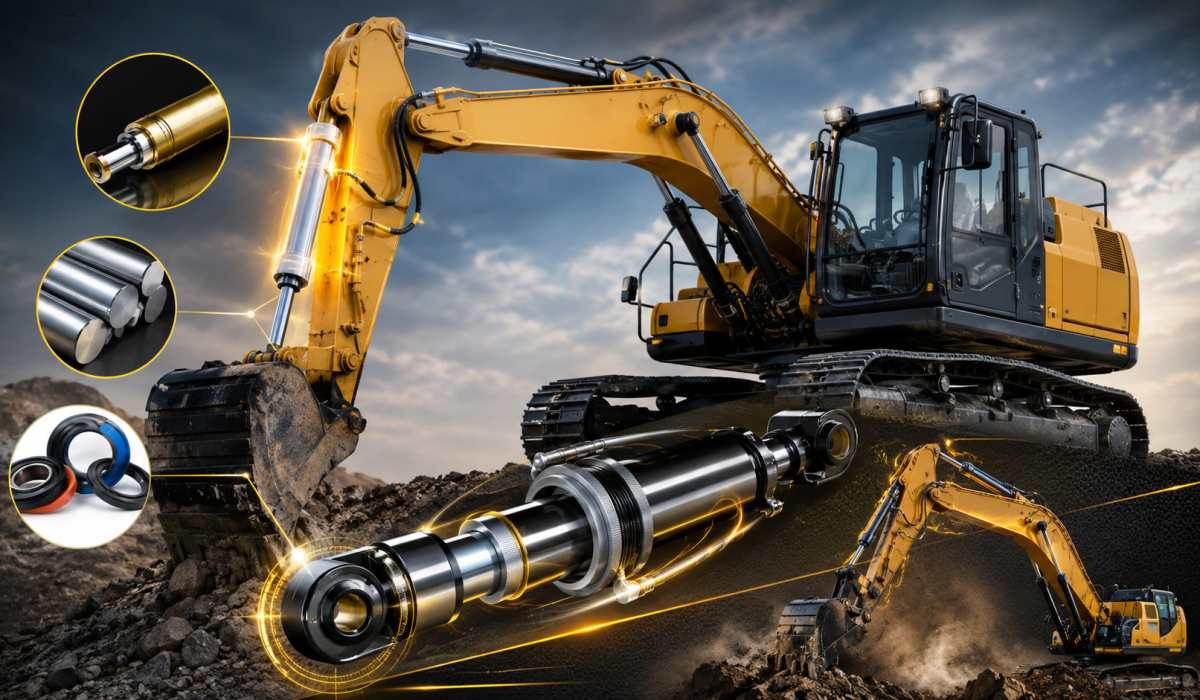
How to Improve Your Excavator’s Performance with a Quality Hydraulic Arm Cylinder
Modern construction equipment’s dynamic efficiency, digging force and precision control are provided by hydraulic pressure systems. In heavy-duty earthmoving, your equipment is only as strong as its structural components allow. If you’re looking to maximize your machinery outputs, then boosting your excavator’s performance with a premium hydraulic arm cylinder is one of the best mechanical modifications an owner can make.
The hydraulic arm cylinder (also called the dipper or stick cylinder) is the primary source of power for trenching, lifting and material handling. Maximum site productivity demands extreme loads, and standard factory parts often hit performance ceilings. That’s why operators turn to high-grade aftermarket components.
Top 5 Ways to Improve Your Excavator’s Performance with a Better Hydraulic Arm Cylinder
1. Core Engineering of High-Performance Hydraulic Cylinders
All heavy excavating equipment functions on physical principles to move earth, rock and construction debris. Premium manufacturing leverages precise design metrics to take standard mechanical metrics way beyond the limits of the factory.
- Pascal’s Law Compliance: Premium systems use the principle that a change in pressure applied to an enclosed fluid is transmitted undiminished to the entire fluid, in all directions, developing tremendous linear force by means of custom piston configurations.
- Double Acting Piston Design: Instead of depending on external springs or gravity like single acting designs do, double acting hydraulic cylinders have a fluid port at either end. This design allows great accuracy, fast speed and high force, both in extension and retraction.
- Enhanced Pressure Distribution: Better cylinders accommodate internal pressure fluctuations with a flawless fluid seal for smooth force application while breaking through high-resistance materials such as compacted clay or frozen ground.
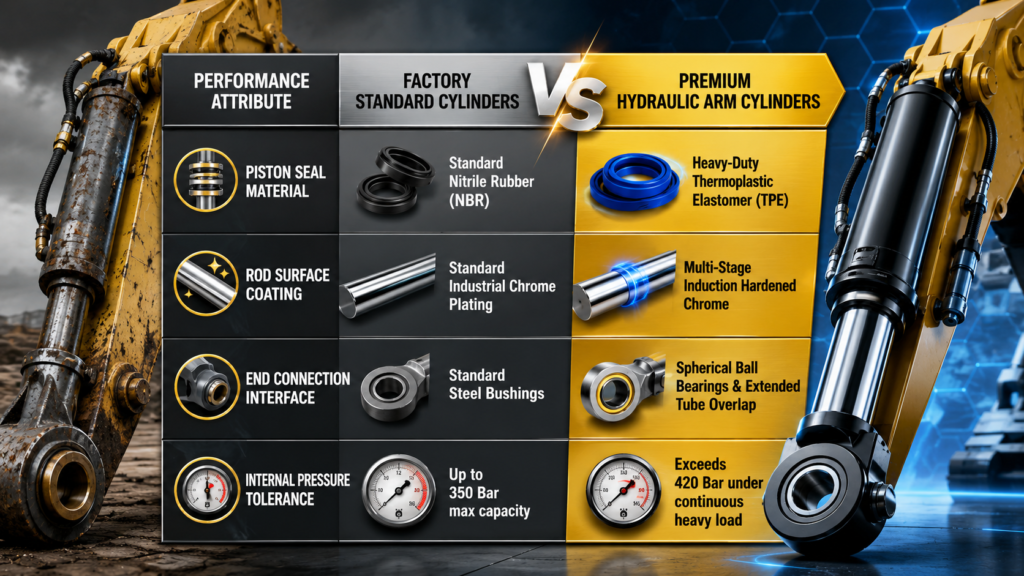
When we look at how these engineering decisions play out in the everyday field operations, there is a clear correlation between part quality and company profitability. Here is an average baseline of generic OEM cylinders vs high performance premium replacements.
| Performance Attribute | Factory Standard Cylinders | Premium Hydraulic Arm Cylinders |
| Piston Seal Material | Standard Nitrile Rubber (NBR) | Heavy-Duty Thermoplastic Elastomer (TPE) |
| Rod Surface Coating | Standard Industrial Chrome Plating | Multi-Stage Induction Hardened Chrome |
| End Connection Interface | Standard Steel Bushings | Spherical Ball Bearings & Extended Tube Overlap |
| Internal Pressure Tolerance | Up to 350 Bar max capacity | Exceeds 420 Bar under continuous heavy load |
2. Releasing faster cycle times and greater digging power
Time is the currency at a commercial job site. Upgrading your excavator’s performance with a premium hydraulic arm cylinder changes the fluid dynamics within the arm structure to shave off seconds off every single swing, dump and return motion.
- Internal Fluid Bypass Minimization: Premium piston seals prevent internal pressure leakage, so 100% of the directed hydraulic oil volume becomes instant mechanical motion.
- Fast Extension and Retraction: Innovative port designs such as SAE flushed ports minimize restrictive flow resistance to allow hydraulic oil to enter and exit the cylinder barrel quickly.
- Improved Compound Movement Control: High-efficiency cylinders guarantee uniform oil allocation to the dipper arm when an operator combines boom, arm and bucket movements simultaneously, avoiding lag.
[Hydraulic Pump Output] —> [SAE Flushed Ports] —> [Zero-Leak TPE Seals] —> [Instant Arm Extend/Retract]
If your excavator responds right away to joystick inputs, operators will feel less fatigue and can finish more cycles each hour. As the speed of delivery keeps increasing, project managers are able to meet tight timelines. And beat the clock.
3. Improving the Durability of Equipment with Higher Grade Materials
Heavy equipment operation subjects components to harsh outdoor elements, airborne abrasive particulate matter and intense friction. Protect your larger capital investment by investing in premium hydraulic hardware with wear-resistant material technologies.
- All-Stage Induction Chroming: The exterior piston rod surfaces are finished with multi-layered chrome which protects the underlying steel from abrasive scratching, rock impacts and pitting corrosion.
- Robust Protective Feeder Tubes: High-end arm cylinders include external steel shielding or integrated feeder tubes to protect critical hydraulic lines from falling rocks and severe environmental impact.
- Spherical Clevis Bushings. Improved connecting interfaces distribute loads of high radial forces and allow for minor angular misalignments, avoiding localized stress fractures at the boom-to-arm junction.
These material upgrades stop system contamination that destroys hydraulic pumps and control valves by preventing structural micro-damage before it escalates. A failure in a single factory arm cylinder can quickly become a system wide hydraulic failure if metallic debris is allowed to flake off into the oil lines.
4. Ensuring Site Safety and Managing Boom Drift
Uncontrolled movement of an excavator arm is a serious safety hazard to ground crews, utility lines and surrounding structures. Improve your excavator performance with a premium hydraulic arm cylinder for tighter structural control during critical holding phases.
- End-of-Stroke Cushioning: Advanced internal cushions absorb all severe deceleration shocks at full extension and retraction, reducing vibration of the structure over the entire machine.
- No Unwanted Boom Drift: Ultra-tight sealing profiles prevent fluid migration inside the barrel to keep the dipper arm locked in position when suspending max-capacity concrete vaults or steel pipes.
- Advanced Thermal Volume Expansion Handling: High-efficiency port relief valves can be combined with premium configurations to vent safe margins of pressure built up by solar heat or sudden external shocks.
When excavating contractors have absolute positioning control, they can safely perform sensitive operations like excavating alongside live gas mains or setting structural foundation piers. Security on site starts with the structural integrity of your primary hydraulic actuators.
5. Maintenance Procedures for Upgraded Cylinders
To protect your upgraded infrastructure and ensure maximum mechanical efficiency over thousands of operating hours, fleet managers must implement rigorous, data-driven preventative maintenance protocols.
1.Daily Visual Inspection to be done for every 10 operating hrs.
Clean the exposed piston rod and inspect the gland area for any oily residue, weepage, or deep scoring. Check the mounting pins for dried dirt that blocks the grease channels.
2.Keep Hydraulic Filtration High Level. Every 250 Operating Hours.
Make sure that your system is equipped with a filter with a rating of β10 ≥ 75 or higher. Removal of 99% of particulate matter > 10 micrometers to prevent internal abrasive seal degradation
3. Routine Seal Kit Replacement: Every 2,000 to 3,000 Operating Hours.
Proactive change of dynamic wiper seals and backup rings before structural failure. Beyond this window, ambient dust can pass into the high-pressure oil reserves.
4. Major Structural Overhauls Every 8000 Operating Hours
To conduct ultrasonic wall-thickness checks, to determine the roundness of the internal bore, and to test the rod for alignment deviations exceeding 0.05 millimeter, the cylinder must be completely disassembled.
FAQs – Excavator Hydraulic Arm Cylinder
How can I tell if my excavator hydraulic arm cylinder needs replacing?
The most common symptoms are visible oil weeping around the cylinder gland, structural drift where the arm will not hold position unpowered and slow or jerky responses to operator controls. Excessive heat on the cylinder barrel shell is often an indication of internal fluid bypassing the piston seals. If deep, bright, vertical scores are found on the chrome rod surface, immediate replacement or re-chroming is required to prevent catastrophic seal failure.
Can I just upgrade the cylinder seals or do I need a whole premium cylinder?
If your underlying cylinder barrel, piston head and rod are free from any structural distortion, ovaling or deep scratching, upgrading to a high-performance seal kit made of thermoplastic elastomers can be a real performance booster. If you want to increase raw pressure capacities, or need physical protections such as a protective feeder tube, or advanced end-of-stroke cushioning, you will have to replace the entire assembly with a premium after-market unit.
How does a premium hydraulic arm cylinder upgrade on your excavator improve performance and reduce fuel costs?
With a premium cylinder with zero internal bypass leakage and low-restriction fluid paths, an excavator doesn’t need the main hydraulic pump to work as hard or run at max RPM to get the desired digging force. This reduces energy losses caused by fluid friction and pressure leaks, providing more mechanical work from every gallon of diesel consumed and reducing your overall operational overhead.
What is the difference between single-acting and double-acting hydraulic cylinders in excavators?
The single acting cylinders use hydraulic pressure to move the piston in one direction and then a spring inside or the weight of the external load moves the rod back to its original position. Double-acting cylinders have fluid ports on both the rod end and the base, so hydraulic force can be applied directly to extend and retract the cylinder. The arm , boom , and bucket cylinders on all modern excavators are double acting , to give rigid control in both directions .
What cleanliness level of hydraulic fluid is required for premium cylinders?
Standard cleanliness limits must be met for high-performance hydraulic components, usually with an ISO 4406 level of 18/16/13 or better. This means maintaining precise oil filtration levels with absolute rated elements (typically 5 to 10 microns) to prevent fine silt from polishing down the sharp sealing lips of high-grade polyurethane or TPE seals.
Why are the rods of the hydraulic arm cylinder chrome plated?
Industrial hard chrome plating creates an ultra-smooth, hard exterior barrier that resists scratching from flying stones, dirt and debris during deep excavation work. This highly polished chrome surface also helps to control the microscopic fluid film that lubricates the primary rod seals, preventing rust and keeping the dynamic rubber elements from burning up due to dry friction.
Which mounting style do I select for an aftermarket arm cylinder?
For your excavator stick design, you will need to replicate the OEM geometry exactly with pivot mountings utilizing high-strength pin eyes and spherical bearings. Improper mounting alignments or forcing mismatched dimensions create devastating eccentric forces that will quickly bend the cylinder rod, crack structural welds or oval out the boom connecting pins.