
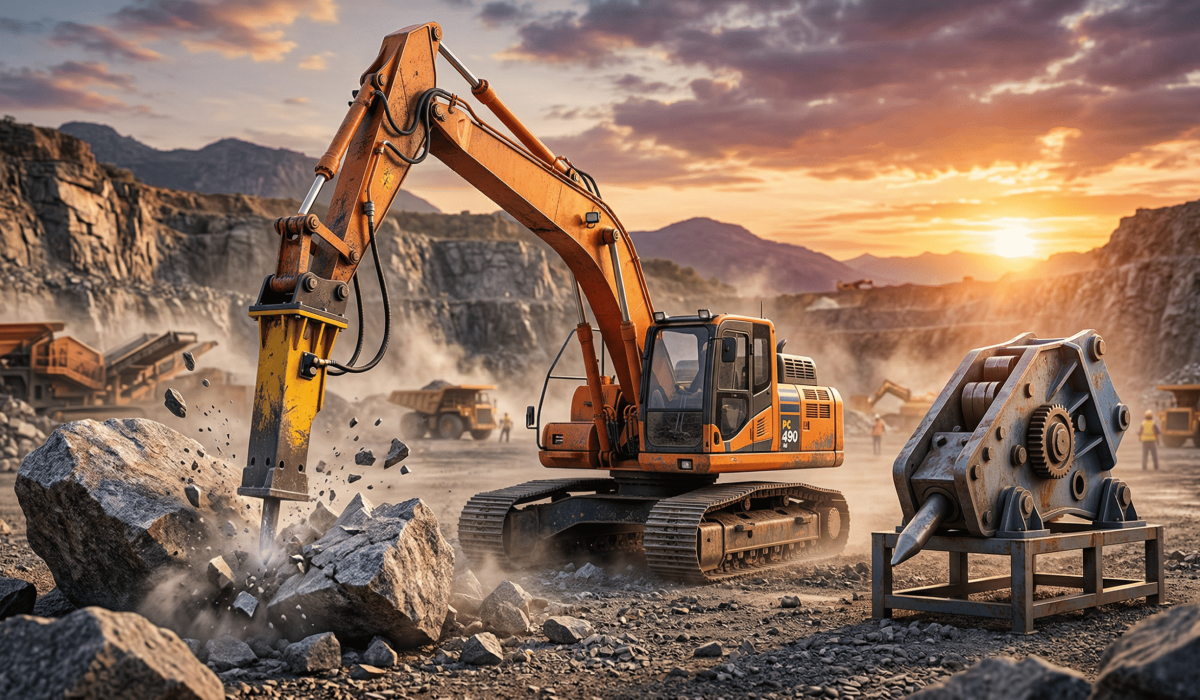
What is the best type of breaker for your excavator: hydraulic Breaker or Mechanical Breaker?
It can feel like a high-stakes game of “Power vs. Practicality” to pick the right attachment for your excavator. The tool at the end of your boom determines how much work you can get done each day, whether you’re breaking up a reinforced concrete slab in downtown Chicago or climbing a rock face in a remote quarry. Hydraulic Hammer (also known as hydraulic breaker) and Mechanical Breaker are two of the most talked-about choices.
Even though people in the industry often use these words interchangeably, there are big differences in how they work, how much it costs to keep them up, and which one will keep your machine running longer.
We at AmericanExcavator.org think that operators should have the information they need to make the best choice for their fleet in terms of cost. This guide tells you everything you need to know about these two powerhouses so you can choose the best one for your excavator.
The Percussive Powerhouse: Learning About Hydraulic Breakers
A hydraulic hammer, also called a hydraulic breaker, is a complex attachment that connects to your excavator’s auxiliary hydraulic system. It uses a mix of hydraulic oil pressure and usually a nitrogen gas chamber to push a piston against a tool bit (like a chisel or moil) at very high speeds. This makes the concentrated impact energy that is needed to break the hardest materials.
- Precision Impact: With a hydraulic hammer, the operator can hit the exact spot they want to, which lowers the chance of breaking nearby structures too much.
- Variable Power Settings: Many modern units in 2026 have auto-adaptive technology that changes the frequency and force of the strike depending on how hard the material is.
- System Integration: It doesn’t need any outside compressors or power units on the job site because it uses the excavator’s own “bloodstream” (hydraulic oil).
Mechanical Breakers: Simple and Long-Lasting
Mechanical Breakers (and their cousins, mechanical rippers) work on a different principle. They don’t have internal pistons and gas charges; instead, they use the power of the excavator’s arm and bucket cylinders.
These tools are “passive” because they don’t have a firing mechanism inside. Instead, they use the weight of the machine and hydraulic leverage to pry, rip, or crush things.
- Very Strong: Mechanical breakers are almost impossible to break in harsh, dusty environments because they don’t have any internal seals, valves, or nitrogen chambers that can break.
- Low Operating Costs: Because there are no moving parts inside, the maintenance schedule is almost non-existent compared to its hydraulic counterpart.
- Versatile Prying: When you need to pry or “rake” through broken material instead of just pounding it straight down, mechanical tools are better.
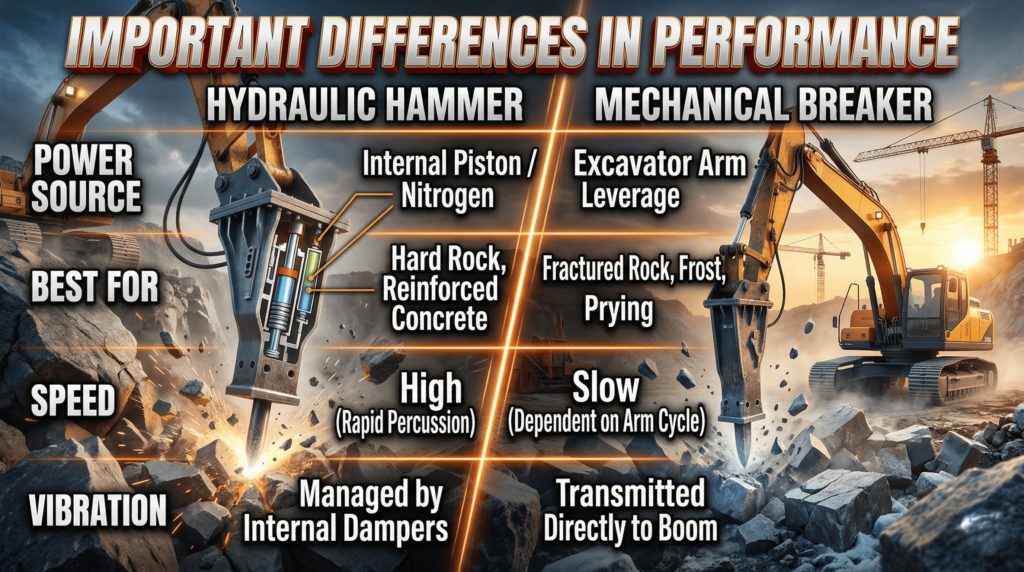
Comparing performance: impact force vs. versatility
When choosing between a hydraulic hammer and a mechanical one, the “Blow Energy” needed is usually the deciding factor. Hydraulic hammers are made for high-volume demolition work that needs 400 to 800 blows per minute. Even though mechanical tools are tough, they can’t break things as quickly or as well as a hammer made just for that purpose.
Table: Important Differences in Performance
| Feature | Hydraulic Hammer | Mechanical Breaker |
| Power Source | Internal Piston / Nitrogen | Excavator Arm Leverage |
| Best For | Hard Rock, Reinforced Concrete | Fractured Rock, Frost, Prying |
| Speed | High (Rapid Percussion) | Slow (Dependent on Arm Cycle) |
| Vibration | Managed by Internal Dampers | Transmitted Directly to Boom |
- Energy Transfer: Hydraulic hammers turn oil flow into kinetic energy quickly and easily, while mechanical breakers need the operator to “muscle” the machine.
- Operator Fatigue: The hydraulic hammer does the work, so there is a lot less vibration that gets sent back to the cabin.
- Material Suitability: If you are working with solid granite or concrete that is 5,000 PSI, you need a hydraulic hammer to get the job done quickly.
Long-Term Reliability and Maintenance
The Total Cost of Ownership (TCO) is one of the most important things for any fleet manager. Predictive maintenance has changed the game for hydraulic hammers in 2026.
Now, sensors can tell you exactly when your seal kit is going to break. But even with smart technology, hydraulic tools need more care than mechanical ones.
- Lubrication is Life: To keep the tool and bushings from seizing, a hydraulic hammer needs to be greased every two hours of use.
- Seal Management: The internal seals are the “heart” of the breaker; if they leak, the tool loses power and can pollute the main hydraulic system of the excavator.
- Component Longevity: You only need to look at the shank and the mounting pins of mechanical breakers, so they are the “set it and forget it” choice for remote sites.
Picking the Right Size for Your Excavator
People often make the mistake of putting a big hydraulic hammer on a small carrier. This not only makes the machine unstable, but it also puts a lot of stress on the boom and pins. The attachment should usually weigh between 10% and 15% of the carrier’s operating weight.
- Flow and Pressure: Your excavator needs to be able to give the hammer the right amount of GPM (Gallons Per Minute) and PSI. If you don’t give enough oil, the engine will run slowly. If you give too much oil, the engine could get very hot and break down.
- Stability Check: Make sure your excavator can lift the hammer’s weight at full reach, especially if you’re working on slopes.
- Check Auxiliary Plumbing: Check to see if your machine is “hammer-ready” with auxiliary plumbing. If not, you might have to add extra lines, which will cost more to set up in the first place.
Cost Analysis: Initial Investment vs. Return on Investment
There’s no denying that a good hydraulic hammer costs a lot of money. But in the construction business, “time is money.” The return on investment (ROI) is clear if a hydraulic tool can finish a demolition job in two days instead of a week with a mechanical ripper.
- Fuel Use: New hydraulic hammers have energy recovery valves that recycle oil, which can cut the amount of fuel the excavator uses by up to 15%.
- Saving Money on Labor: Faster breaking means fewer hours worked and quicker moves to the next step of the project.
- Resale Value: Hydraulic hammers from well-known brands that are well taken care of keep their value very well on the secondary market.
FAQs – Hydraulic Breaker Vs. Mechanical Breaker
What’s the difference between a hydraulic hammer and a hydraulic breaker?
They are the same tool in a technical sense. When talking about heavy-duty rock excavation, “hammer” usually means the pounding action. “Breaker” is more often used when talking about demolition and removing concrete. Both of them depend on the excavator’s hydraulic system.
Can I use my hydraulic hammer in the water?
Standard hydraulic hammers can’t go underwater because water can get into the percussion chamber and cause a “hydro-lock” that breaks the internal parts. But a lot of models can be fitted with an underwater kit that keeps water out by using compressed air.
How often do I need to oil my hydraulic breaker?
You should grease the tool every two hours of actual “running” time to make it last as long as possible. To keep the bushings safe while working with a lot of friction, use a high-quality, high-temperature molybdenum grease (chisel paste).
Why is my hammer losing power?
Low nitrogen gas pressure in the accumulator, worn internal seals, or an incorrect hydraulic flow setting on the excavator are all common causes. You can stop this drop in performance by checking the pressure regularly.
Are mechanical breakers better for ground that is frozen?
Yes, a mechanical frost ripper or breaker is often better at “peeling” layers of frozen ground. Because frozen ground isn’t as “brittle” as concrete, a mechanical tool that pries things apart often works better than a hammer that hits things.
Will hitting my excavator’s boom with a hammer hurt it?
No, if you use it right. But “blank firing” (pulling the hammer back when the tool isn’t touching a surface) or prying with the hammer can cause stress fractures in the boom and arm of the excavator.
How big of a hammer do I need for an excavator that weighs 20 tons?
A hammer that weighs between 3,000 and 4,500 pounds is usually needed for a 20-ton excavator. Always check the manufacturer’s specification sheet to make sure that the hydraulic flow (which is usually 30 to 45 GPM for this size) matches the output of your machine.
The Decision: Which One Should You Pick – Hydraulic Breaker Vs. Mechanical Breaker?
The Hydraulic Hammer is the best tool for heavy demolition, breaking up primary rock, or digging through solid stone every day. It will pay for itself in increased productivity because of how fast and accurate it is.
But if you work in a rental fleet where maintenance might not be done, or if your job mostly involves prying and light ripping in soft materials, the Mechanical Breaker is a cheap, foolproof option.
We suggest that you look at the most common conditions on your job sites at AmericanExcavator.org. Don’t just buy what you need for today; buy what you’ll need for the next three years.