

Best Practices for Operating Trailer Attachments on TYPHON Mini Excavators
Making the most of your fleet can require a change of the usual thinking about digging. Contractors, landscapers, and farmers who have TYPHON Mini Excavators can get big benefits by incorporating towing and trailer options as they can make one or two tons machine into an all-in-one logistics powerhouse with the best trailer attachments.
Even though these small but mighty machines are primarily designed for high-torque digging, grading and breaking, with the assistance of utility or dumping trailers, the material-handling cycle time can be greatly reduced. But the very operation of trailer attachments requires a good comprehension of the mechanical limitations, weight distribution and hydraulic control in order to avoid premature structural wear or dangerous tipping incidents.
The operator of a tow-behind or coupler-mounted system on a small tracked machine is asked to show a higher level of discipline in operation. Since mini excavators are designed with a short, heavy wheelbase for optimum stability in stationary positions, the introduction of a dynamic, rolling load alters the response of the machine to changing grades and sudden stops.
By adopting the connection methods recommended by the manufacturer, weighing the loads, and changing your track steering behavior, you will be able to keep your excavator’s undercarriage safe and at the same time achieve peak operational throughput.
Best Practices for Operating Trailer Attachments on TYPHON Mini Excavators
1. Verifying Compatibility and Weight Thresholds
It’s a good idea not to hook any trailing loads to your machine without considering first its mechanical limits usig the best trailer attachments. TYPHON has a wide range of models including the light gasoline-operated 1.1 ton models to the 2.5 ton heavy-duty Kubota powered units but all are equipped with specified drawbar pull ratings and structural limits and these should never be ignored. Overload of these limits will result in deformation of the track frames, overheating of the hydraulic drive motors or severe structural cracking near the tie-down or coupling points.
- Check the Gross Weight: Always calculate the combined mass of the trailer frame and its maximum payload to ensure it stays well within the machine’s safe towing capacity.
- Monitor Hydraulic Temps: Pulling heavy rolling loads over long distances increases system pressure, requiring operators to watch for signs of hydraulic fluid overheating.
- Assess the Ground Grade: Towing thresholds drop significantly when operating on inclines; never attempt to haul maximum weight up or down slopes greater than 10 degrees.
2. Secure Attachment Methods via Quick Hitch Systems
How a utility cart or site trailer is connected to your excavator can make or break your safety and efficiency. If you use a manual quick hitch coupler, for example, the standard 90 mm span, 25 mm pin configurations that are built for TYPHON models, you will get a rigid and safe interface that removes both slack and excessive play during movement.
Be careful not to use makeshift chains wrapped around bucket teeth because such pieces of equipment are not fixed at a single point and so a violent swinging of the trailer into the excavator’s tail is likely.
- Engage Locking Fasteners: Always confirm that the safety clips, pins, or locking bolts on your manual quick hitch are fully seated and torqued before moving.
- Clear the Interface Zone: Remove all dirt, packed mud, and gravel from the coupler slots to ensure a perfect metal-to-metal connection that won’t loosen under load.
- Align the Center Wheelbase: Match the attachment’s pull-bar perfectly with the excavator’s boom line to maintain linear tracking and prevent offset twisting forces.
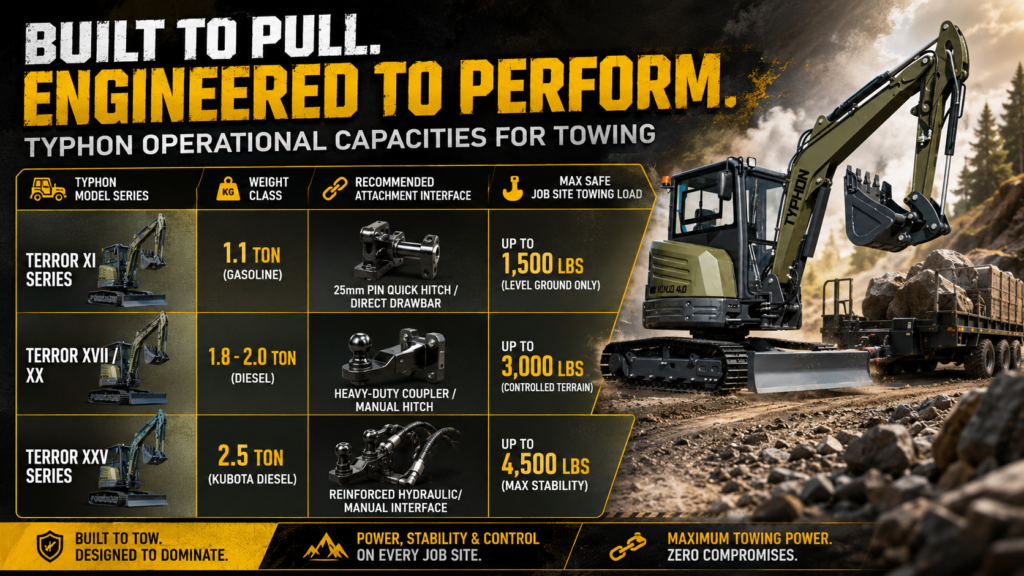
Table: Typhon Operational Capacities for Towing
| TYPHON Model Series | Weight Class | Recommended Attachment Interface | Max Safe Job Site Towing Load |
| TERROR XI Series | 1.1 Ton (Gasoline) | 25mm Pin Quick Hitch / Direct Drawbar | Up to 1,500 lbs (Level Ground Only) |
| TERROR XVII / XX | 1.8 – 2.0 Ton (Diesel) | Heavy-Duty Coupler / Manual Hitch | Up to 3,000 lbs (Controlled Terrain) |
| TERROR XXV Series | 2.5 Ton (Kubota Diesel) | Reinforced Hydraulic/Manual Interface | Up to 4,500 lbs (Max Stability) |
3. Safe Ground Navigation and Track Management
Navigation of the ground with a tracked machine and wheeled trailer attached is very different from simple tracked navigation. Since tracks do not reduce the friction of turning in the way that rubber tyres do, skidding or making a sharp counter-rotation turn when under load results in the extreme lateral stress of track guides, rollers and sprockets.
- Utilize Wide Turning Arcs: Avoid sharp, on-a-dime pivot turns; instead, plan broad paths that allow the trailing wheels to follow the tracks naturally.
- Travel with Drive Sprockets in Rear: Keep your travel motors and drive sprockets at the back of the machine while pulling to maximize traction and pull dynamics.
- Minimize High-Speed Travel: Keep the machine in its low-range turtle mode whenever a trailer is connected to maintain maximum torque and prevent brake slippage.
4. Balancing Payload and Managing Boom Placement
Weight distribution is the key factor in preventing the machine from tipping rear or forward as materials are transported across unstable ground. Tow vehicles and loaded dump trailers need to have their boom lifting and positioning very carefully controlled and should always be supported to the ground by stabilizers.
When the trailer is toyed about heavily, the operator will be throwing off their own controls one way or the other not to mention risking outer injury to the excavator. The excavator operators with trailer attachments need to be very fully aware of the weight distribution and mechanics of the trailer to avoid this type of error.
This is the point where the excavator’s operator pulling skills and the user of the trailer need to sync and balance down to the inch. If the trailer is loaded heavily toward its tongue, it will pull down on the rear or front of the excavator, destabilizing your track footprint and reducing your steering control.
- Distribute Cargo Uniformly: Load trailers with 60% of the weight in the front half to maintain stable tongue weight without lifting the excavator’s tracks.
- Secure the Excavator Boom: Position the arm close to the cab and just high enough to clear ground obstacles, lowering your overall center of gravity.
- Prevent Tail-Swing Impacts: Be acutely aware of your house rotation; never swing the upper cab structures while traveling with a long trailer attachment attached.
FAQs: Trailer Attachments Operational Capacity
Can you tow a trailer with a mini excavator?
Yes, you can tow a trailer with a mini excavator on a job site, provided you use an engineered attachment point and stay within the machine’s towing capacity. It is critical to use a secure connection like a quick hitch coupler rather than improvising with chains or straps around the bucket.
What is the towing capacity of a TYPHON mini excavator?
The towing capacity depends directly on the model’s operating weight and engine output. For instance, smaller 1.1-ton models are rated for light utility carts up to 1,500 lbs, while the robust 2.5-ton TERROR XXV can safely pull up to 4,500 lbs on level, stable terrain.
How do you attach a trailer to a mini excavator safely?
When a trailer is going to be attached, it has to be on level ground. Then the engine has to be turned off and a manual quick hitch coupler or drawbar attachment utilized. To prevent the trailer from accidentally disconnecting during transit, make sure all the 25 mm pins and safety clips are properly engaged and locked at the same time.
Can a mini excavator pull a dump trailer on a job site?
On a job site, mini excavators can be used to maneuver dump trailers in order to transport dirt, gravel, or debris. Nevertheless, you have to make sure that the total weight of the dump trailer, when fully loaded, is within the pulling capacity of the track motor and does not exert excessive down-force on the hitch.
What safety precautions should be taken when using mini excavator trailer attachments?
Amongst the most important safety precautions are: always operate at low speeds; do not go over steep inclines that are greater than 10 degrees; make wide sweeping turns and keep the boom low to the ground. It is dangerous to allow passengers to be inside or on the trailing attachments during operation.
Do TYPHON mini excavators require a quick hitch for trailer attachments?
It is not absolutely necessary to use a quick hitch for directly-mounting attachments. But, a good quality manual quick hitch coupler with a 90 mm span should almost always be used. This is a great time saver, it results in a rigid and slop-free connection and it also helps to prevent wear on the primary arm holes of the excavator.
How do you safely transport a TYPHON mini excavator and its attachments?
When it comes to transport of the excavator itself on a commercial trailer, driving the machine onto the trailer bed, lowering the blade and bucket to the deck, turning off the engine and securing it through four tiedown points with heavy-duty transport chains rated for the machine’s weight class are the things you should do. The chains can then be tightened and locked to ensure complete safety during transport.