
How to Make Excavator Site Preparation Faster and Safer for your project!
The site preparation lays the groundwork for any construction, engineering, or forestry project. It involves a lot of power and accuracy for activities such as the clearing of thick vegetation, leveling the terrain, excavating precise trenches, and making the ground stable. Besides delays, inefficient site prep can cause huge labor costs and safety problems. Excavators offer a range of solutions for these issues with the proper plan of excavator site preparation.
The hydraulic excavators of today have made a big impact on the civil engineering and land management industries. These machines can change weeks of manual land clearing and risky digging into short, controlled operations. Thanks to the structural technology and the multifunctional hydraulic systems, the modern excavator site preparation for both commercial and residential sites in the fastest and safest way possible.
Best Excavator Site Preparation Strategies for Enhancing Speed and Safety:
1. Land clearing with excavators and debris removal at an accelerated rate
The first step of any earthmoving project is removal of natural and man-made obstructions. Before structural foundations can be laid or underground utilities can be planned, the job site must be entirely cleared of vegetation, heavy rocks, old concrete slabs, and subterranean tree stumps.
| THE MECHANICAL ADVANTAGE |
| Manual Labor & Small Tools ——–> Weeks of manual clearing / High Risk |
| Modern Heavy Excavator ———> Rapid, automated site readiness |
Excavators make this tough activity more efficient by directly applying the raw mechanical force to wherever it is needed. Instead of dispatching separate teams for cutting, lifting, and hauling, one person can methodically clear even the most complex terrains. This centralized way of working helps keep the construction schedules.
- Operators can quickly change the standard earthmoving buckets with various heavy-duty attachments such as hydraulic grapples, brush cutters, and stump grinders to handle different types of debris without moving to another machine.
- The extended reach and large bucket sizes of the medium-to-large excavators enable them to fill dump trucks directly with large amounts of organic material in a single cycle.
- Heavy root systems buried underground and boulders that stop less powerful utility tractors can be easily uprooted by the powerful breakout force of an excavator arm.
2. Precision Grading, Trenching, and Leveling Beyond Compare
After all surface obstructions have been removed, shaping a site to a given architectural design is a major task. Precision grading and trenching are most important for efficient drainage networks, reducing soil erosion, and uniform trenches for utility installations.
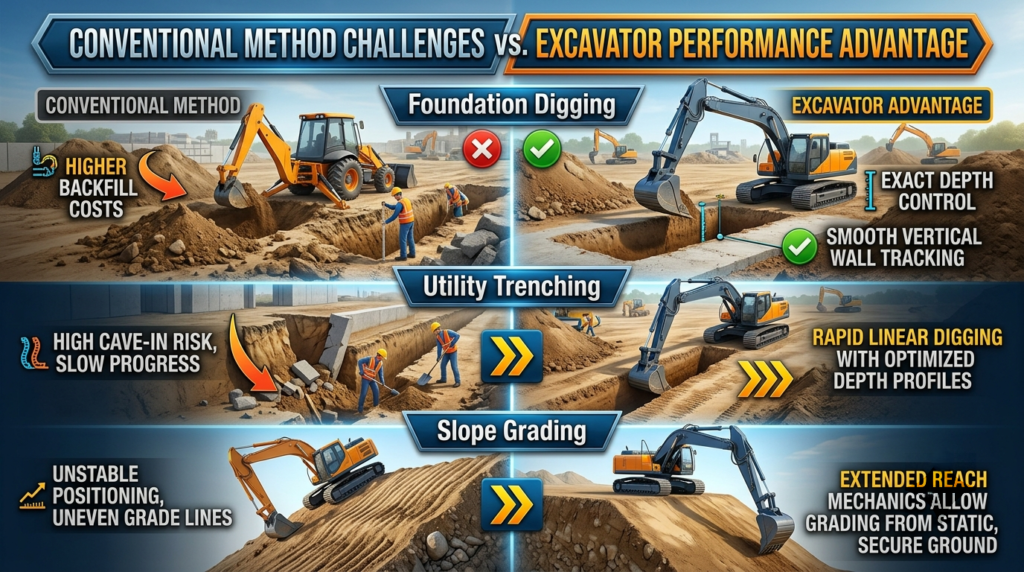
| Earthmoving Task | Conventional Method Challenges | Excavator Performance Advantage |
| Foundation Digging | Excess over-digging, high structural backfill costs | Exact depth control and smooth vertical wall tracking |
| Utility Trenching | High risk of cave-ins, slow hand-shoveling progress | Rapid linear digging with optimized depth profiles |
| Slope Grading | Unstable machine positioning, uneven grade lines | Extended reach mechanics allow grading from static, secure ground |
Getting the desired soil profile entails correct depth measurements and working according to a specific plan with the excavator site preparation. Excavators make it possible to get exact movements even in cramped places, something manual crews or large bulldozers cannot do. Such precision safeguards the foundations of buildings over time.
- Advanced Depth and Alignment Controls: Operators use in-cab monitoring to make sure trenches for sewer lines, water mains, and electrical cables are built according to the specifications to the last centimeter.
- Minimizing Unnecessary Ground Disruption: This feature enables the excavator to dig narrow and neat lines that save soil compaction and avoid excess backfilling costs.
- Simultaneous Leveling and Shaping: Leveling and shaping can be done at the same time. A grading bucket is a double edged tool that can be used to cut high spots, fill low spots to prepare the subgrade equally well.
3. Construction Safety and the Prevention of Ground Collapse
Excavation is risky work because of shifting pressures of earth, unstable types of soil, and weather changes. The most dangerous hazard on a construction site is trench collapse or slope failure, which can trap workers underground.
Key Safety Factor: Dirt walls without protection can cave in within seconds. Keeping the operator’s compartment and the machine’s tracks at a safe distance using the long reach of the machine is the best way to stay out of danger zones.
Excavators significantly mitigate these potential risks to life by enabling earthmoving operations to be performed from a distance. The design of the machine also serves as a safety feature that isolates the open excavations from the operators.
- Using a long boom and arm means that the operator can dig deep trenches and the heavy tracks can be placed far away from the side of the excavation which is fragile.
- Making slopes due to soil stability using a bucket is also a common action that can be taken. In fact, using the operator’s bucket means that shelves and safety slopes can be formed naturally.
- Excavators have not only the power but also the force to lift, lower, and move heavy steel trench shields, shoring boxes even before the crews get to the trench.
4. Avoiding Utility Strikes and Other Subterranean Dangers
Underground utilities are a hidden threat to excavator site preparation. Accidental hits on power lines, natural gas mains, or primary fiber cables can lead to explosions, flash fires, community blackouts, and heavy fines.
Excavators enable the operator to exercise precise control to safely avoid these sensitive utility corridors. Machines used with on-site safety protocols and spotters greatly reduce the number of line strikes.
- Highly responsive hydraulics: Joysticks are so finely tuned that operators can precisely maneuver buckets to gently loosen soil layers near marked utility zones without damage.
- Clear visibility by the operator and enhancing the line of sight: The elevated panoramic cabs combined with the wide-angle side mirrors and high-definition exterior cameras help operators consistently maintain a clear view of ground spotters and warning markers.
- Strategically deploying specialty attachments: When using specialized toothless buckets or vacuum excavation attachments, crews can carefully remove the soil surrounding critical lines without damaging them.
5. Crew Safety Maxing With Heavy Attachment Versatility
Old fashioned hand tools and manual demolition and land clearing expose field personnel to vibration, debris, physical fatigue, falling structural elements among other dangers. Manually moving of heavy materials can result in injuries.
An excavator can be engineered to do away with these hazards. It becomes a closed, protected working station for the utility while the operator stays safe inside the armored and climate-controlled cabin while performing excavator site preparation.
- Operator cabs armor protection: These are respectively the certified Roll-Over Protective Structures (ROPS) and Falling Object Protective Structures (FOPS) that protect operators from accidental tipping, falling debris, and building collapses.
- Demolition mechanization of existing structures: Old concrete walls can be demolished from a secure spot by an excavator equipped with a hydraulic breaker, concrete pulverizer, or primary shear, completely eliminating the need for manual sledgehammers or use of high-risk hand tools.
- Safe Handling of Unwieldy Infrastructure Materials: Heavy stormwater pipes, concrete culverts, and structural steel beams can be securely chained or grappled and moved smoothly across uneven ground without risking manual lifting injuries.
FAQs: Excavator Site Preparation
How much faster an excavator is as compared to manual site preparation?
An excavator can complete earthmoving, land clearing, and trenching tasks up to 20 to 30 times faster than a traditional manual labor crew using hand tools. While a crew of laborers might spend several weeks handling manual clearing operations, an operator with a good level of experience can finish the job in days only. This huge increase in speed also results in major savings on labor costs and makes it possible to meet the strict construction schedule without any disruptions.
What are the top safety procedures for working with an excavator on site preparation?
A few of the basic safety measures that must be adhered to when operating an excavator include checking the machine every day before it is operated (for hydraulic hoses, tension on tracks, and pins on buckets), making sure a 360-degree safety perimeter is strictly maintained at all times around the machine’s tail swing radius, and when moving, keeping the bucket close to the ground. In addition, seat belts must be worn by the operators, underground utilities have to be identified by using “Call Before You Dig” local services, and a ground worker who has received proper training should be used to assist when working near utility corridors or areas that are congested.
Can a mini excavator be used effectively for a large site preparation job?
Mini excavators are perfect for confined spaces, residential backyards, and utility trenching with great precision. They generally lack the raw horsepower, breakout force, and bucket capacity needed for large-scale commercial site preparation. Large commercial developments require deep foundation digging, heavy structural clearing, and the movement of massive earth volumes, making mid-size or full-size heavy excavators the ideal choice for optimal efficiency.
How excavators prevent soil erosion and ground collapse on slopes?
Slope failure and soil erosion are two major effects of improper slope management when excavating. Engineering safe slopes by either battering (cutting the soil at a stable angle) or benching (creating a series of flat terraces along a slope) with the help of an excavator prevent soil from sliding down and also help in controlling water runoff. Plus, the long reach of these machines lets them carry out grading operations from stable ground, thereby preventing the addition of extra weight by heavy equipment to the fragile, unconsolidated slopes.
Which excavator attachment is a must-have for land clearing?
Effective land-clearing attachments are a heavy-duty hydraulic grapple for grabbing and lifting fallen trees and rocks, a root rake that can remove hidden roots while leaving the topsoil intact, and a hydraulic breaker which could be used to break up concrete slabs or old foundations. In case of thick brush and dense vegetation, a specialized flail mower or mulching head attachment can quickly reduce the heavy overgrowth into eco-friendly organic mulch.
How does ground conditions affect excavator stability and safety?
Soft, muddy, and sandy ground conditions pose a serious challenge to the stability and safety of an excavator. There is a significant lowering of traction and the risk of the excavator tipping over or sinking into the ground increases.
What are the key indicators that an excavator needs a thorough maintenance check?
The primary reasons behind bringing a machine to the workshop include: deepest hydraulic fluid leaks visible along the boom or arm hoses; controls joysticks respond in a slow and jerky manner; undercarriage produces a strange squealing or grinding sound; active diagnostic warning indicators light up on the cabin dashboard. Ignoring these issues can lead to machine breakdown, costly repairs, and poor safety on the worksite.