
Hydraulic Hammer Magic: 7 Features Every Mini Excavator Needs One!
The rise of modern construction techniques has been mainly about time-saving, accurate work, and the use of a mighty power of a small machine. In the middle of this change is the mini excavator—a small-sized machine that has been made a giant in the field by specialized attachments. Among these, the hydraulic break hammer attachment (which is also called a rock breaker or a hydraulic hammer) gathers most of the attention as an absolute revolution.
The accessory that makes the host machine’s hydraulic hammer energy into a high-impact mechanical one thus giving the machine the power of the demolition unit can be used to aerially pulverize concrete, rock, and asphalt, as well as for the precise cutting or separating of the materials.
Contractors and project managers that want to get the best out of their fleet should not miss the point of the combined use of a mini excavator and a hydraulic breaker. This piece of writing shows how one single hydraulic hammer attachment realigns the site working capabilities, safety levels and profitability.
Top 7 Features of of Hydraulic Hammer Attachment in Mini Excavators:
1. Maximizing Demolition Efficiency in Confined Spaces
Mini excavators have been able to put the small places such as backyards, narrow alleyways, and indoor demolition sites, where do bigger machines not fit, in their pockets. When a hydraulic break hammer is mounted on these small machines, they are transformed into the main instrument of heavy-duty demolition in drastically limited areas.
- Access-Oriented Power: With the help of a hydraulic hammer, a mini excavator can demolish structurally the inside of the buildings or can enter standard 36-inch gates to operate.
- Surgical Precision: The hammer attachment used locally can cause less damage than big-scale demolition equipment which may result in the weakening of the surrounding foundations.
- Reduced Manual Labor: What used to be a task for 2–4 manual workers equipped with jackhammers, is now done in a very short period by one machine.
Table: Hydraulic Hammer Features:
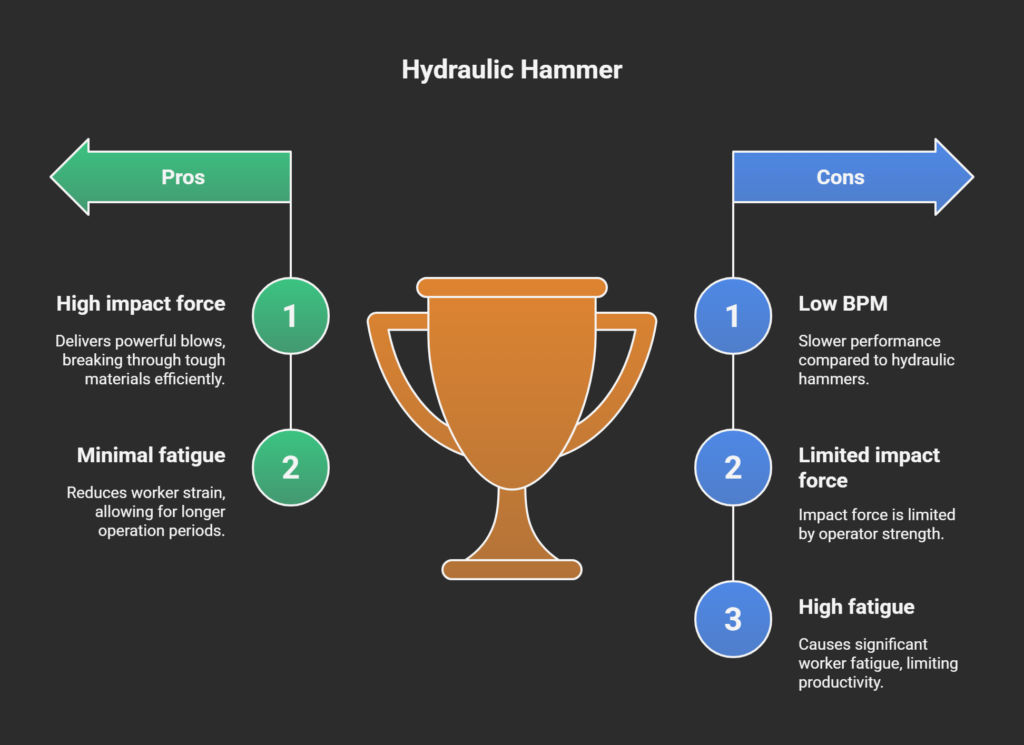
| Feature | Manual Jackhammer | Mini Excavator w/ Hammer |
| BPM (Blows Per Minute) | Low (Manual/Air) | 500 – 1,200 BPM |
| Impact Force | Limited by Operator | High (up to 1200+ Joules) |
| Worker Fatigue | High | Minimal (Cab-Controlled) |
2. Superior Productivity through Advanced Mechanics
The change of the mini excavator to the so-called “rock breaker” is the result of the machine’s auxiliary hydraulic system. The device uses a high-pressure nitrogen gas chamber along with hydraulic fluid to propel a piston that hits a chisel or moil point. This operation is the reason why the device can exert a continuous and, eventually, a very strong force to materials that it has to cut which, in result, gives no room for the capability of traditional digging buckets to challenge the method.
- Continuous Operation: The limitation regarding the duration of work is non-existent for hydraulic hammers, unlike for the pneumatic tools where the compressor should be stopped regularly for cooling, and the operators should be rotated.
- Material Versatility: The use of removable tips such as moil points for concrete and blunt points for rocks gives the flexibility to the hand to tackle the geological and structural challenges of different types of materials.
- High Power-to-Weight Ratio: The aim of the engineers when they got to the design of modern hammers was to keep the power of the impacting high but at the same time without the increase in the weight or the tipping limit of the mini excavator.
3. Enhancing Job Site Safety and Operator Health
Construction safety is the main priority that cannot be compromised. Among hand-held jackhammers which are a typical cause of various health diseases in the long run, the most frequent are likely to be Hand-Arm Vibration Syndrome (HAVS) and chronic back pain. Moving those operations to a hydraulic attachment mounted on a mini excavator will lead to lesser exposure to the source of the problem, i.e. vibration and debris.
- Vibration Isolation: The operator can do it in the cab which is far from and therefore isolated from the high-frequency vibration caused by the hammer.
- Debris Protection: Cab windows and ROPS/FOPS structures which should be made of impact-resistant material protect the operator from the pieces of broken concrete and dust, which are the main reasons for the site injuries.
- Noise Reduction: Modern silenced hydraulic breakers operate at 85–95 decibels, which is significantly quieter than the 110–120 decibel range of pneumatic tools, thus allowing the work to be done in noise-sensitive urban areas.
4. Cost-Effectiveness and Fleet Versatility
Practicing the use of a hydraulic hammer attachment device is usually more economical than a non-stop one resulting in a direct demolition machine purchasing. Any small to mid-sized contractor can benefit significantly from the fact that he can use one mini excavator for both bucket tasks with trenching and the hammer to rock breaking, thus his one machine has the function of multiple ones.
- Lower Fuel Consumption: Hydraulic hammers are very efficient and they use less fuel (40–50%) than that which is needed for a separate tow-behind air compressor for pneumatic tools.
- Rapid ROI: Numerous contractors see a hydraulic breaker’s self-pay within 200 to 300 hours of active use, resulting from the reduction of labor costs and the increase of project speed.
- Seasonal Revenue: Moreover, having the possibility of breaking through ice-covered ground with the hammer, contractors can extend their working hours through the cold season and therefore have stable cash inflow.
5. Essential Maintenance for Long-Term Performance
In order for the hydraulic break hammer to keep on turning your mini excavator into a powerful machine, a demanding maintenance program is required. Such tools are exposed to extreme pressure and vibration, therefore, the ignoring of daily check-ups can result in costly downtimes and damage to the excavator’s hydraulic pump.
- Consistent Greasing: The chisel and the bushings have to be greased every 2 working hours to prevent the friction and heat to be produced from the metal in contact with metal.
- Visual Inspections: Before each working shift, the operator is advised to look for loose fasteners, leaking hydraulic hoses, and cracks in the hammer housing.
- Nitrogen Charging: It is very important to regularly check and, if necessary, recharge the nitrogen gas pressure in the back that is responsible for the hammer’s impact energy in order to keep it at this level.
6. Choosing the Right Hammer for Your Machine
Different hydraulic hammers have different specifications and capabilities. The key point in pairing the attachment with your mini excavator is matching it with the specific flow rate (GPM) and operating pressure (PSI) of the machine. When these are out of match, there can be power deficiency or the additional force generated on the host machine’s hydraulic seals and relief valves may cause its damage.
- Weight Compatibility: As a general guideline, the weight of the hammer should be around 10–15% of the total weight of the excavator in order for the latter to remain stable.
- Flow Rate Matching: The auxiliary hydraulic flow (GPM) of the excavator should be within the range required by the hammer to avoid piston over-speeding or under-performing.
- Mounting Styles: Depending on the primary type of work you do, you can decide to mount the top (for better force transfer and visibility) or the side (for a lower profile in tight-clearance areas).
7. Transforming Future Project Potential
The mini excavator with a hydraulic breaker will be an asset the longer the urban areas get packed, and the environmental protection standards become stricter. Its mixture of low noise, high precision, and small size is what will make it the perfect tool for the coming “green” demolition and renovation projects.
- Recycling Integration: By breaking the concrete right there at the site into smaller pieces, sorting and recycling such materials as rebar and aggregate become much easier.
- Utility Infrastructure: The only way to get through rock that is hard or old pavement is this equipment, making it an absolute must for the installation of fiber optic and municipal water lines.
- Foundation Preparation: It provides the means for the accurate removal of the old foundations and at the same time, soil density for the new ones remains undisturbed.
FAQs: Hydraulic Hammer Attachments:
Can a mini excavator handle a hydraulic hammer attachment?
Most mini excavators come with an auxiliary hydraulic line that is capable of powering attachments like a hammer. Even so, it is of utmost importance to ensure that the weight of the hammer and its hydraulic requirements are compatible with your machine’s specifications (generally 1–6 tons for most compact hammers) to avoid tipping or hydraulic failure.
How much does a hydraulic breaker for a mini excavator cost?
The price varies between $2,500 and $8,000 approximately depending on the size, brand, and impact energy (Joules) of the device. While it is quite a big investment, the saving of labor costs and the speeding of the projects is usually a source of return on the investment within the first several months of usage.
What is the best grease for a hydraulic hammer?
It should be a high-temperature, extreme-pressure (EP) moly-grease (molybdenum disulfide). Regular chassis grease will be decomposed very fast under the intense heat and friction generated at the hammer’s point of impact, therefore, the tool and bushings will wear out prematurely.
What does “blank firing” mean and why is it bad?
Blank firing is the situation when the hammer is in operation but there is no firm contact between the chisel and the material. The impact energy is, thus, returned to the internal elements of the hammer, which results in enormous stress being generated on the tie rods, tool retainers, and the piston.
How often should I service my hydraulic rock breaker?
Besides greasing every 2 hours, putting a daily visual inspection of hydraulic hoses and pins into practice is also a must. A professional service including nitrogen pressure checks and seal inspections should be done every 500 working hours or once a year.
Is a moil point or a chisel point better for concrete?
Mofil point is usually better for the concussive breaking of the thickest, non-reinforced concrete and hard rock because it focuses the impact on the single point rapidly making the cracks. A chisel point can be used for trenching, cutting straight lines, and shaping materials where the “splitting” action is necessary.
Can I use my hydraulic hammer underwater?
No, a regular hydraulic hammer is not allowed to work under the water. In this case, the water is drawn into the striking chamber and therefore it leads to “water hammer” which in turn causes severe internal failure. Only specially designed underwater kits and air compressors are suitable for these kinds of tasks.