What Is a Mini Tracked Dumper and Do You Really Need One?
Anyone who has spent a long afternoon pushing a heavy wheelbarrow full of wet dirt across a muddy yard knows exactly how fast that gets old. It eats up your time, wrecks your back, and slows the whole job down. Let’s understand the prominence of mini tracked dumper and why it really required for your business.
When you are running a business, construction and landscaping projects demand absolute efficiency. That is exactly where a mini tracked dumper steps up to the plate. These compact, aggressive little machines are completely changing how contractors, landscapers, and farmers move heavy materials around tight spaces.
Whether you are trying to squeeze through a narrow residential side gate or haul gravel across a saturated, soft lawn, understanding what these machines can do is a game changer. Here at American Excavator, our goal is to help you match the exact right piece of iron to your daily grind so you can maximize your profitability.
We are going to break down everything you need to know about these machines:
- The nuts and bolts of how a mini tracked dumper actually works on a daily basis.
- The real-world differences between running tracks versus standard wheels.
- A no-nonsense look at whether buying one actually makes financial sense for your specific jobs.
What Exactly is a Mini Tracked Dumper?
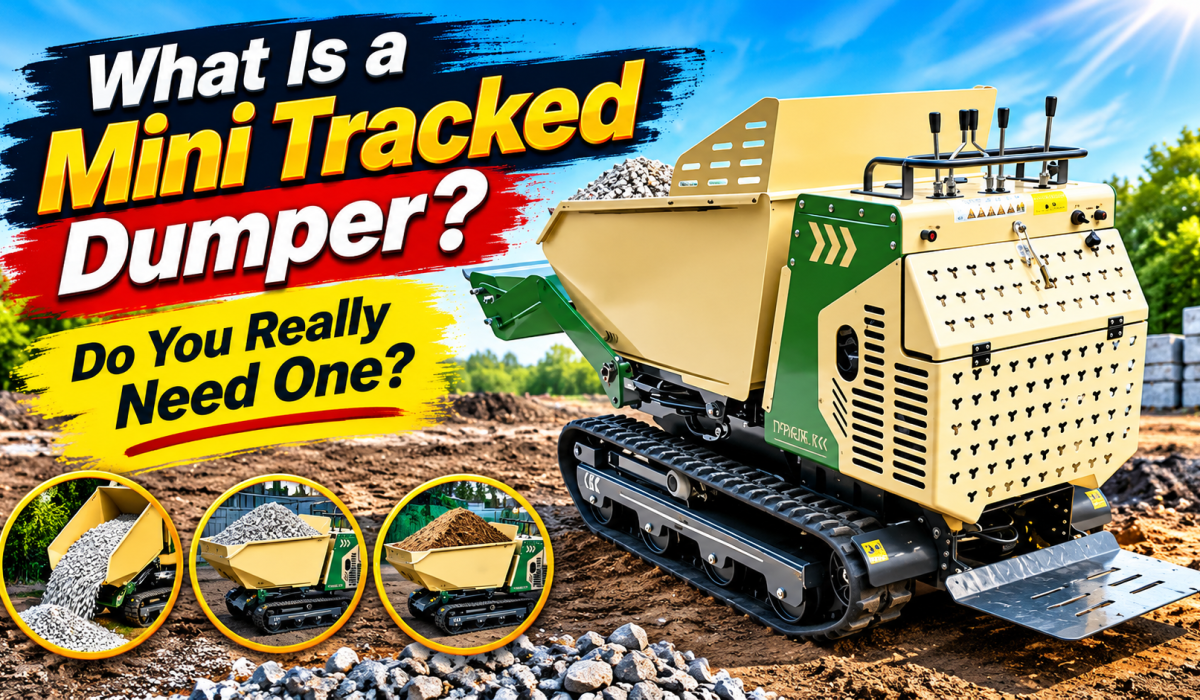
At its core, a mini tracked dumper is a motorized, ultra-compact hauling machine built to transport heavy payloads like soil, concrete, broken asphalt, and rubble over terrible ground conditions.
Instead of relying on manual labor or trying to force a full-sized dump truck into a tiny urban lot, operators use these machines to easily move anywhere from 500 kg to over 1,000 kg of material. They take the hardest part of material transport and make it look effortless.
Looking at the way these machines are put together explains why they punch so far above their weight class on the job site. The anatomy of a mini tracked dumper relies on a few major structural components:
- Continuous Rubber Tracks: Instead of sinking into the mud like tires do, tracks spread the weight of the machine and its load over a much wider area. This drastically lowers the ground pressure, meaning you will not tear up a client’s expensive lawn or get bogged down in deep mud.
- Hydraulic Tipping Skip: Nobody wants to manually shovel dirt back out of a hopper. These machines use a powerful hydraulic cylinder to lift and dump the entire payload in just a few seconds. Some higher-end models even feature a high-tip function, letting you dump material straight into a dumpster or the back of a truck.
- High-Torque Powerplants: Usually driven by compact but gutsy gas or diesel engines in the 6.5 to 13.5 horsepower range, they generate a massive amount of low-end torque. This lets them crawl up steep, 20-degree muddy hills while carrying a maximum payload without stalling out.
Top Uses and Applications Across Industries
The sheer versatility of a mini tracked dumper is what makes it such a popular rental and purchase item across wildly different industries. Because the standard models usually measure less than a meter across, you can drive them right through standard backyard gates or narrow alleyways. They bring serious, heavy-duty hauling power into spots where a skid steer or a compact track loader simply cannot fit.
If you are thinking about upgrading your equipment fleet, here are the main industries where a mini tracked dumper really earns its keep:
- Urban Construction and Tight Demolition: City jobs are notorious for having zero staging room. Crews use these machines to ferry broken drywall, chunks of concrete, and scrap materials out of tight basement dig-outs or narrow property lines where larger diesel equipment is too wide to enter.
- High-End Landscaping and Hardscaping: Building a custom patio requires moving tons of pavers, base gravel, and decorative sand. Landscapers rely on the rubber tracks to carry this heavy weight across finished turf without leaving those deep, expensive-to-repair tire ruts.
- Farming, Agriculture, and Forestry: Out in the country, the ground is rarely flat or dry. Farmers use them to haul feed, move organic fertilizer, or transport heavy rounds of cut firewood through deeply rutted timber trails and wet pastures where wheeled carts get hopelessly stuck.
Key Benefits of Using a Mini Tracked Dumper
Adding another engine to your fleet means maintenance and overhead, so the financial math needs to make sense. Making the jump from shovels and wheelbarrows to a mechanized mini tracked dumper brings immediate, noticeable changes to how your crew operates every single day.
Contractors who pull the trigger and put a mini tracked dumper on their job sites generally report these exact operational benefits:
- Absolute Terrain Dominance: Rain delays cost money. The aggressive rubber tracks give you enough traction to keep moving dirt and stone even when the site turns into a slippery, muddy mess, keeping your project timeline completely intact.
- Massive Reductions in Physical Labor: One guy running a 500 kg capacity dumper can move the exact same amount of material as ten guys pushing manual wheelbarrows, and he will do it in half the time without blowing out his lower back.
- Perfect Workflow Synergy: They are the ultimate companion piece to a mini excavator. The excavator digs the trench, immediately loads the dirt into the dumper, and the dumper whisks it away. You never have a pile of loose dirt blocking your work area, creating a smooth, non-stop workflow.
Essential Features to Look For Before Buying
Walking onto an equipment lot can be overwhelming because not every dumper is built for the same type of work. You can find everything from bare-bones, walk-behind units all the way up to enclosed, ride-on models with digital displays. Picking out the perfect mini tracked dumper means getting honest about what you actually do on a daily basis.
Before you sign any paperwork or put down a deposit, you need to zero in on these specific features:
- Realistic Payload and Skip Capacity: Do the math on what you actually move. A 500 kg hopper is usually plenty for residential yard jobs and mulch, but if you are constantly hauling wet concrete or demolition debris, you absolutely need to look at the 800 kg to 1,000 kg heavy-duty models.
- Integrated Self-Loading Scoops: Some models feature a hydraulic bucket on the front. The operator just drives into the pile of gravel, scoops it backward into the skip, and drives away. This entirely eliminates the need to have a second machine or a guy with a shovel loading the hopper.
- Operator Ride Platforms and Controls: If your crew is going to be running this thing for eight hours straight, ergonomics matter. Look for models with fold-down stand-on platforms, vibration-isolated handles, and simple dual-lever steering so your operator isn’t totally exhausted by lunchtime.
Equipment Comparison: Making the Right Choice
Sometimes it helps to see the numbers side by side to realize exactly what you are paying for. If you are on the fence about whether you need tracks, wheels, or just a bigger wheelbarrow, this breakdown will help clear things up.
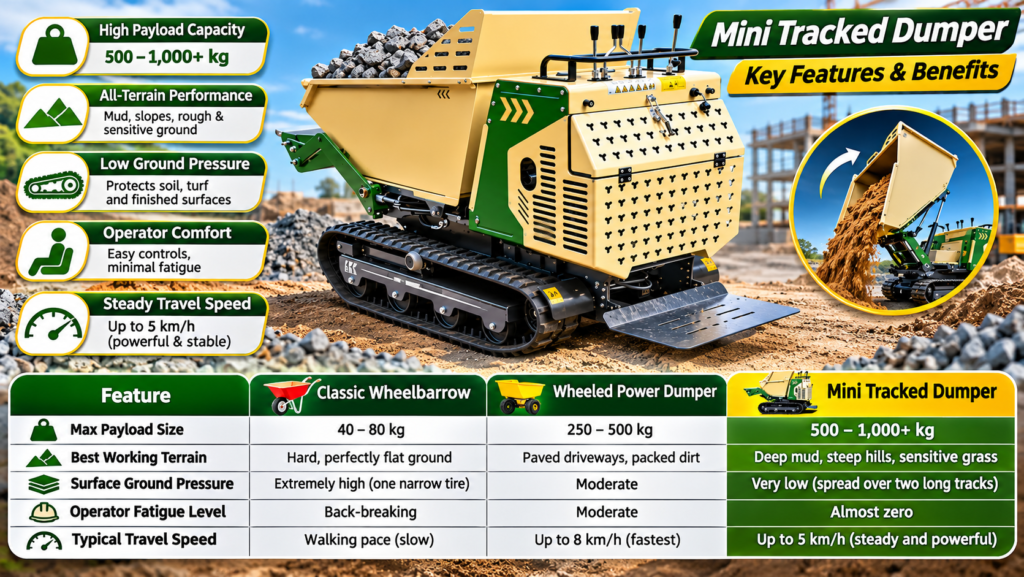
Table: Mini Tracked Dumper Features
| Feature | The Classic Wheelbarrow | Wheeled Power Dumper | Mini Tracked Dumper |
| Max Payload Size | 40 – 80 kg | 250 – 500 kg | 500 – 1,000+ kg |
| Best Working Terrain | Hard, perfectly flat ground | Paved driveways, packed dirt | Deep mud, steep hills, sensitive grass |
| Surface Ground Pressure | Extremely high (one narrow tire) | Moderate | Very low (spread over two long tracks) |
| Operator Fatigue Level | Back-breaking | Moderate | Almost zero |
| Typical Travel Speed | Walking pace (slow) | Up to 8 km/h (fastest) | Up to 5 km/h (steady and powerful) |
Looking at how these machines stack up, a few things become incredibly obvious:
- Keep the manual wheelbarrow in the shed for mixing small batches of cement or moving a few bags of potting soil around the house.
- A wheeled dumper is a great, speedy choice if you work strictly in warehouses, on asphalt, or on bone-dry, hard-packed earth.
- A mini tracked dumper is the undisputed king anytime the weather turns bad, the ground gets soft, or the property has steep inclines.
Do You Really Need a Mini Tracked Dumper?
At the end of the day, you have to decide if this machine is a want or a need. A mini tracked dumper is a serious piece of commercial equipment with a price tag to match. You have to look at your payroll and see if the time you save offsets the monthly payment.
You should seriously consider buying a mini tracked dumper right now if you deal with any of these situations:
- Your Excavators Keep Waiting Around: If your heavy equipment operators are constantly sitting idle while the ground crew scrambles to clear away the dirt they just dug up, a dumper will instantly fix that expensive bottleneck.
- You Work in Terrible Weather Conditions: If you live in an area that gets heavy spring rains or early snow, you can’t afford to shut down jobs just because the yard is slick. Tracks keep you working when wheels get hopelessly stuck.
- You Deal With Strict Homeowners: If you work in upscale neighborhoods where leaving tire ruts in the manicured lawn will get you sued or fired, the low-impact footprint of a track system is the ultimate insurance policy.
Frequently Asked Questions (FAQs) – Mini Tracked Dumper
How does a mini tracked dumper actually steer and maneuver?
They steer exactly like a skid steer or a tank. The engine powers a hydrostatic or mechanical transmission that runs both tracks. The operator pulls steering levers that brake one track while the other keeps moving, allowing the machine to spin completely around in its own footprint for zero-turn maneuvering.
Can a mini tracked dumper safely drive up steep hills?
Absolutely, that is one of their biggest selling points. Most quality models can easily tackle grades up to 20 degrees. Just remember that if you are carrying a full, heavy load of rock up a steep incline, you should reduce the payload a bit to keep the center of gravity low and prevent tipping backward.
What is the real difference between a tracked dumper and a wheeled dumper?
It all comes down to where you are driving it. Tracked dumpers use thick rubber belts that float over mud and grip uneven ground without sinking. Wheeled dumpers roll on tires, which makes them faster on flat asphalt but highly likely to sink, spin out, and get stuck the second they hit soft mud.
How much weight can a standard mini tracked dumper haul?
It depends entirely on the size of the unit you buy. Your standard residential machines will easily haul 500 kg (about 1,100 lbs). If you jump up to the commercial-grade models used on heavy construction sites, they can comfortably carry 800 kg to well over 1,000 kg per trip.
Is the maintenance on a mini tracked dumper complicated?
Not at all. It is very similar to maintaining a heavy-duty lawnmower. You need to check the engine oil and hydraulic fluid daily, blow out the air filters if you work in dusty conditions, and keep an eye on the track tension. Greasing the moving pivot points every 15 to 20 hours is the best way to prevent early wear.
Should I pay extra for a self-loading mini tracked dumper?
If you work solo or don’t always have a mini excavator on-site to load the hopper for you, a self-loading model is worth every single penny. It uses a hydraulic shovel on the front to scoop up dirt and dump it into its own hopper, which saves your back and cuts your loading time in half.
How many hours will a mini tracked dumper last before it dies?
If you stay on top of the maintenance schedule, a premium diesel-powered mini tracked dumper can easily give you 8,000 to 10,000 hours of life. You will just need to replace wear parts like the rubber tracks every 2,000 hours and occasionally rebuild the hydraulic cylinders as the seals age.