Mini Excavator Compactor Plate: Get the Right Soil Density on Small Sites
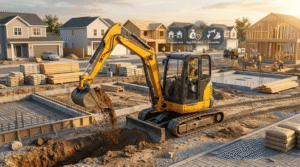
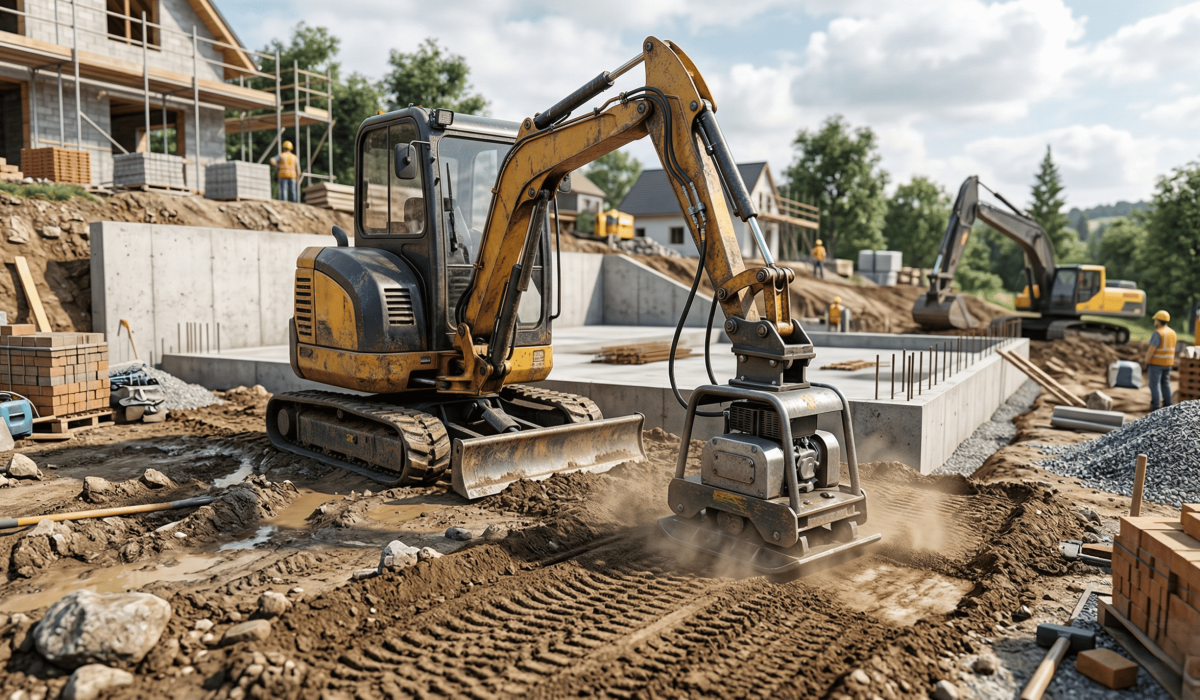
No matter how big or small the construction project is, the foundation starts below the surface. Contractors who work on residential landscapes, utility trenches, or tight urban developments have always had trouble getting industrial-grade soil stability without being able to move heavy rollers around. In this case, the Mini Excavator Compactor Plate makes a big difference.
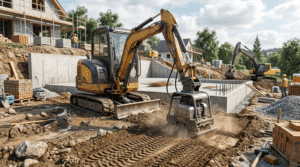
This attachment turns a regular mini excavator into a high-frequency vibrating powerhouse. It makes sure that every inch of backfill is dense, stable, and ready to hold up structural loads.
In modern excavation, “good enough” is no longer the standard for how dense the soil is. Poor compaction can cause foundations to shift, pavement to crack, and expensive repairs. With a Mini Excavator Compactor Plate, operators can apply thousands of pounds of centrifugal force exactly where it is needed, even in deep trenches or on steep embankments where walk-behind units are either too dangerous or impossible to use.
The Science Behind the Mini Excavator Compactor Plate
To get the most out of a Mini Excavator Compactor Plate on the job site, you need to know how it works. These attachments don’t just use weight like static rollers do; they also use high-speed vibrations, which are often measured in Vibrations Per Minute (VPM), to move soil particles around. This method gets rid of air pockets and pushes moisture to the surface, making a tightly woven soil matrix.
- Hydraulic Power Integration: The unit connects directly to the mini excavator’s auxiliary hydraulic circuit, using the machine’s existing power to move the internal eccentric weights.
- High-Frequency Vibration: These plates usually work at speeds between 2000 and 2500 RPM, which is perfect for settling granular materials like sand and gravel.
- Construction that resists wear: Quality plates, like the ones on americanexcavator.org, are made from high-tensile steel so they can handle rocky soil and constant impact.
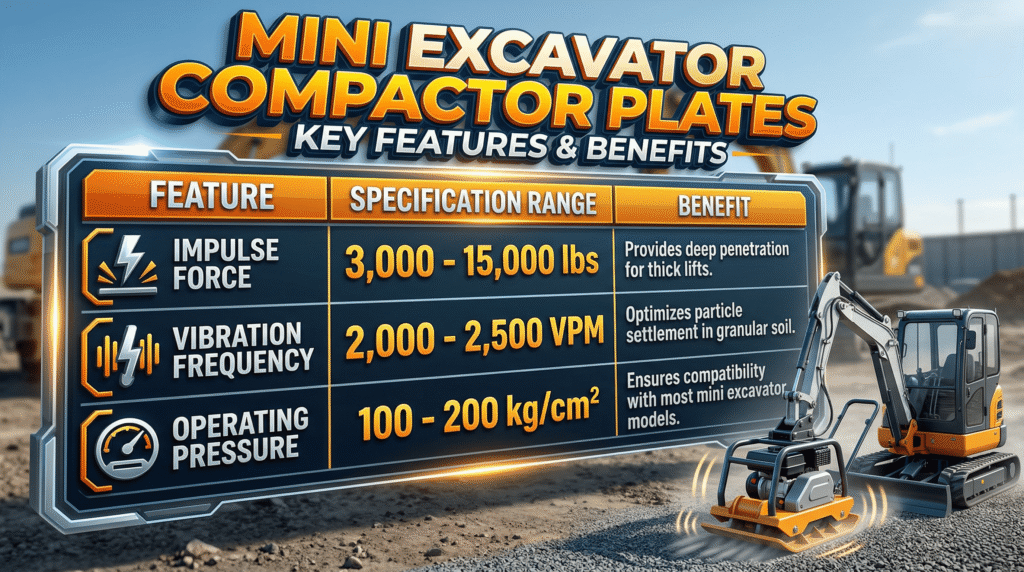
Table: Mini Excavator Compactor Plate Features
| Feature | Specification Range | Benefit |
| Impulse Force | 3,000 – 15,000 lbs | Provides deep penetration for thick lifts. |
| Vibration Frequency | 2,000 – 2,500 VPM | Optimizes particle settlement in granular soil. |
| Operating Pressure | 100 – 200 kg/cm² | Ensures compatibility with most mini excavator models |
Why the density of soil is important on small job sites
There isn’t much room for mistakes on small sites. A driveway that settles or a patio that sinks can cause structural failure right away and legal problems. The best way to avoid the “settlement trap” is to use a Mini Excavator Compactor Plate to get the soil density just right.
When soil is compacted correctly, it can hold a lot more weight. This means it can hold heavy pavers, concrete slabs, or building footings without moving in the future.
- Avoiding Damage to Structures: Using a Mini Excavator Compactor Plate correctly stops voids from forming, which would cause the ground to sink over time.
- Better Water Resistance: Soil that is very dense has lower permeability, which means that water can’t easily get in and cause “frost heave” or erosion during heavy rains.
- Consistency Across the Site: An excavator-mounted plate’s mechanical consistency makes sure that the whole area has the same density, getting rid of soft spots.
Key Advantages of Using Excavator-Mounted Plates vs. Walk-Behind Units
The main benefits of using plates that are attached to excavators instead of walk-behind units. There is a place for traditional walk-behind plate compactors, but the Mini Excavator Compactor Plate is more efficient and safer.
For one thing, the operator stays safely inside the climate-controlled cab of the excavator, far away from the noise, vibration, and possible dangers of a deep trench. Also, the excavator arm can reach places that a person can’t get to, which makes it easier to compact.
- Better Safety: Workers don’t have to stand in deep trenches, which greatly lowers the risk of injuries from cave-ins.
- More work done: The Mini Excavator Compactor Plate covers more ground in less time and can handle thicker “lifts” (layers of soil) than manual units.
- Flexible movement: The excavator’s boom lets the plate work on slopes, around corners, and over obstacles with surgical precision.
The best ways to get the right soil density
Operator technique is just as important as the Mini Excavator Compactor Plate itself if you want to get the best results. You can’t just put the plate on the ground; you need to know how moisture, soil type, and down-pressure all work together.
Compacting too much can be just as bad as not compacting enough because it can crush the aggregate and make the soil less stable.
- Control the Thickness of the Lift: Don’t try to compact three feet of soil all at once. For the best density, work in “lifts” that are 6 to 12 inches high, and make sure to compact each layer well before adding more.
- Keep the Right Amount of Moisture: If the soil is too dry, it won’t stick; if it’s too wet, it will turn to mud. The “hand test,” which involves squeezing the soil to see if it keeps its shape, is a quick way to check for the right amount of moisture.
- Keep the Pressure Even: Use the excavator’s down-pressure to keep the plate flat against the ground. This will make sure that the vibrations go straight into the ground instead of bouncing off the top.
Important Care for Your Compactor Attachment
A Mini Excavator Compactor Plate is a tool that can handle a lot of stress and wear. A regular maintenance schedule is needed to make sure it keeps giving the right amount of force for the right soil density. If you don’t do simple things like grease or check bolts, the job could fail in the middle of it.
- Check the hydraulic hoses: Always look for leaks or damage, since the high-frequency vibration can make the hoses rub against the excavator arm.
- Check the rubber isolators: These mounts keep the vibrations from the plate from getting to your excavator. If they break or wear out, the vibrations will go back into the boom of your machine, which can cause damage.
- Tighten the mounting bolts: Over time, the weight of a Mini Excavator Compactor Plate can loosen even the strongest bolts. Check them every day before you start working.
FAQs About Mini Excavator Compactor Plates
Is it possible to use a mini excavator compactor plate to drive posts?
Yes, a lot of high-quality plates can also be used as post drivers. The Mini Excavator Compactor Plate can drive fence posts or piles into the ground much faster than doing it by hand by putting the vibrating force on the top of the post or pile.
How big of a mini excavator do I need to use with a compactor plate?
The weight of the carrier determines the type of compactor plate. Most of the time, there are models made for micro excavators that weigh 1 ton and midi machines that weigh 10 tons. Always make sure that the hydraulic flow (GPM) of your machine is right for the plate.
Is a vibrating plate better than a wheel for compacting?
For flat surfaces and granular soils (like sand and gravel), a Mini Excavator Compactor Plate is usually better. A compaction wheel is often better for narrow trenches with cohesive soils (like clay) where a kneading action is needed.
How many passes do you need to get to 95% Proctor density?
Most operators agree that 3 to 5 slow passes with a Mini Excavator Compactor Plate on a 10-inch lift will get the soil to the right density for residential construction. However, this depends on the type of soil.
Do I need a special hydraulic kit to use a compactor plate?
Most new mini excavators come with “auxiliary hydraulics” as a standard feature. Depending on the model of the Mini Excavator Compactor Plate, you will need either a two-way (bi-directional) or a one-way (hammer) circuit.
Is it okay to use the compactor plate on slopes?
One of the best things about a Mini Excavator Compactor Plate is that it can work on slopes. The boom on the excavator gives it stability and reach so it can compact soil on slopes where a walk-behind unit would roll over.
What can I do to keep the plate from sticking to the asphalt?
If you’re using the plate to fix small holes in asphalt, make sure it stays cool or is lightly misted with water. Some industrial models come with built-in water sprinklers just for this purpose.