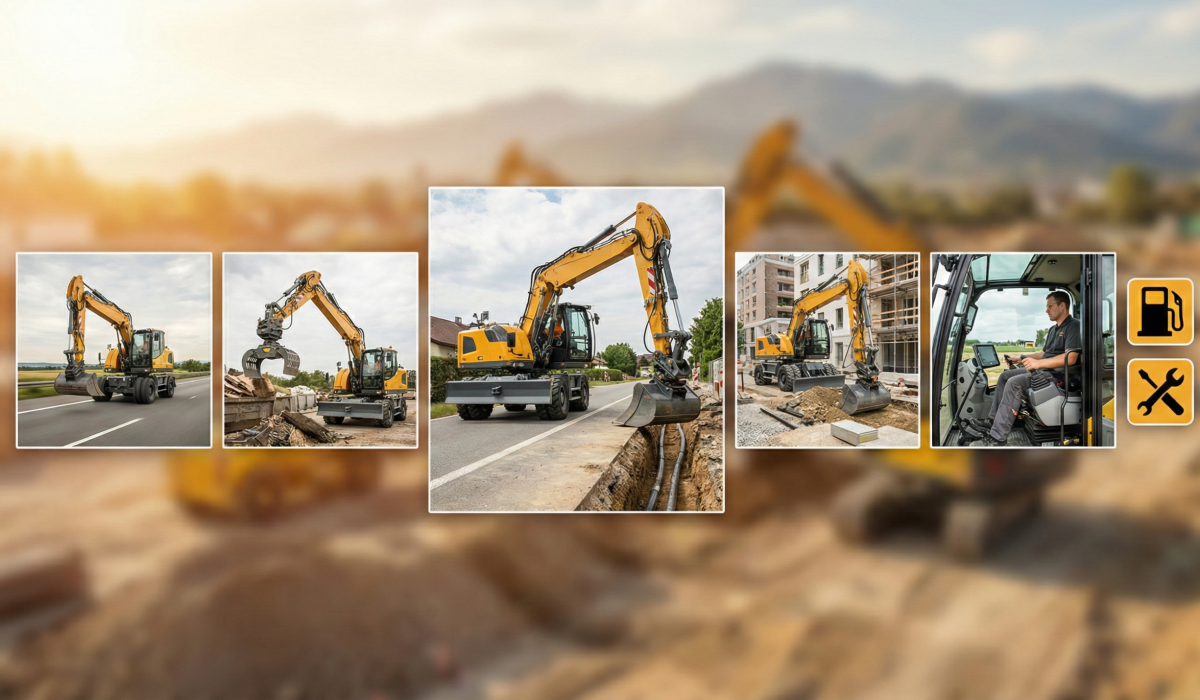
Top 5 Reasons to Consider Wheeled Excavator
Who would decide the ideal piece of equipment in the rapidly changing construction and earthmoving arena? It’s the one that effectively differentiates between a finished project under budget and a project skyrocketing out of control. For such a long time, a typical wheeled excavator has been the industry standard for heavy-duty diggings.
But, there is a considerable trend change on American jobsites. Contractors, city officials, and fleet managers are continually shifting their attention to wheeled excavator. Generally, in the United States, these machines are less praised compared to their European market domination.
However, they are gaining popularity very fast due to the urbanization and more necessity for flexible equipment. If you have been reluctant to exchange your tracks for tires, maybe it is time to reconsider your fleet decision.
Understanding The Top 5 Reasons to Consider Wheeled Excavators
A wheeled excavator proposes a very uncommon combination of power, precision, and mobility that tracked machines will never be able to provide in certain situations. Due to the increasing densification of cities and restriction of job sites, the capability to move around without damaging the infrastructures is becoming very essential.
When you are working on road improvement, utility installation, or urban landscaping, these machines provide a competitive edge that can streamline your operations and make you more profitable.
We analyze five main reasons below to help you understand why you need to consider seriously getting a wheeled excavator in your arsenal. These reasons are supported by industry trends and benefits that are practical.
The Top 5 Reasons to Consider Wheeled Excavators
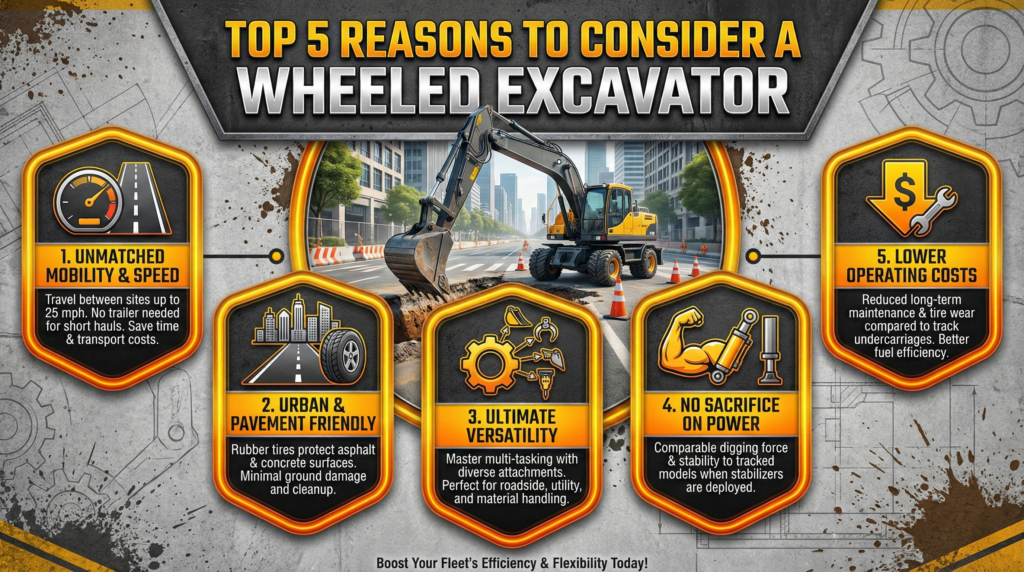
1. Unmatched Mobility and Speed on the Jobsite
The and most visible advantage of a wheeled excavator is its capability to move under its own power at quite good speeds. Tracked excavators do not have this feature, so they move at really low speeds (usually 2-4 mph) and they definitely require a lowboy trailer and a semi-truck to be transported from one site to another.
In contrast, wheeled models can travel with a speed of 22 mph on paved roads. This “roading” ability completely changes your perception towards logistics. The time is saved massively for contractors who handle multiple smaller projects across a city—such as utility repairs or municipal maintenance.
- Say goodbye to transport costs: greatly minimizes the need for lowboy trailer and support trucks in moving locally.
- Speedy repositioning: Without wasting valuable work hours, you can rapidly move from one side to the other of a giant jobsite.
- Urban, Efficient: Navigate city traffic and tight streets with ease and comfort where a truck and trailer might find it hard to turn.
2. Superior Versatility in Urban Environments
Urbanization is a major push in today’s construction market and wheeled excavators are the ones that are built specifically for working in a concrete jungle. One headache with tracked machines is the damage they cause to finished surfaces.
Steel tracks can ruin asphalt, crack concrete, and kill the lawn, which means that the job has to be followed up with expensive cleanup and repair. On the other hand, wheeled machines, fitted with sturdy rubber tires, only exert a fraction of the pressure that steel tracks do on the ground and they keep the pavements safe. This makes them the first option for working on roads, parking spaces, and driveways that are all been.
Besides that, these machines normally come in “compact radius” or “short swing” models. This basically means that they can easily do a job even if only one lane is blocked without the risk of the counterweight hitting moving vehicles.—Safety and traffic management have always been key for road maintenance.
- Surface Protection: The use of rubber tires is beneficial not only for asphalt and concrete but also for curbs and it totally gets rid of restoration cost.
- Compact Footprint: Thanks to the short-swing radius the operator can work in the lane that is single-lane and the rest neighbors will be act with minimum disruption
- Reduced disruption: Being neighbor-friendly in residential characteristics area resulting from less noise operation and vibration as compared to steel tracks
3. Stability Without Sacrifice (Myth Busting)
Many operators have a wrong idea that wheeled excavators are not stable compared to their tracked counterparts. Is it fair to say that the tracked crawler has a lower center of gravity and a wider natural footprint? This is a fact.
However, wheeled excavators of today can and do boast excellent stability although they may not have quite the lower center of gravity of crawlers and their natural footprint is narrower.
The fact of the matter is, these wheeled machines have super strong stabilizer systems which are normally a combination of outriggers (stabilizer legs) and the dozer blade. When the stabilizing system is on, the machine is lifted slightly off its tires and then, with the wide, solid platform that is created it can match a tracked machine in terms of stability and).
The truth is, sometimes the use of outriggers allows the vehicle to be more stable than a crawler that just has to conform to the pitch and roll of the ground it sits on. Some brands have also come up with clever weight redistribution so that you are not forced to compromise on the depth of the dig or the lifting method. The same range of heavy lifting, trenching, and material handling is at your fingertips as is the crawler.
- Adjustable stabilization: Where there will be four outriggers, or a blade and two outriggers, each combination can be used in different terrains.
- Leveling capability: Outrigger that are operated individually allows for level of the machine even when on uneven ground.
- Heavy lifting power: Machines with the same tonnage as that of the tracked are capable of the heavy lifting operations when stabilized.
4. Lower Operating and Maintenance Costs
If you are managing a fleet and are thinking about the expenses of the bottom line, the cost of the possession over the life cycle will be a serious question for you. The tracked excavator’s undercarriage is the most expensive wearable part to a vehicle.
Pins, bushings, sprockets, rollers, and the tracks themselves are the parts that always wear out, especially if the machine is operating in abrasive soil or is moving for long distances. The repair/replacement of a whole tracked undercarriage may cost you several thousands of dollars and that means downtime. wheeled excavator e.g.
On the other hand, a wheeled excavator runs on rugged industrial tires. Of course, tires wear out, but their replacement is generally less costly than the complete steel undercarriage system, and on hard surfaces, their life is significantly longer. Besides, since the unit is self-propelled, you also get to save on fuel and maintenance costs of the haul truck and trailer which otherwise you would have had to use for moving the rig.
- Less expensive wear parts: Tires are cheaper to replace and less complicated than tracks, chains, and sprockets.
- Lower fuel consumption: The fuel burn of a transport truck for local moves is eliminated.
- More durable on hard surfaces: Because of the tires, tracks wear rapidly on Asphalt/Concrete.
5. The Ultimate Tool Carrier (Attachment Diversity)
All excavators can use attachments, but the wheeled ones are usually considered multi-tool carriers or simply, a Swiss Army Knife rather than just a digging machine. Utility and municipal works are where, most of the time, these excavators are found.
But they should be teamed up with an advanced attachment system, e.g., a tiltrotator, to be most effective. A tiltrotator offers 360-degree rotation and 45-degree tilting of a bucket or tool that allows for a great advantage of precision to the operator at minimal machine repositioning.
Such partnership turns the excavator into an adaptable unit that is capable of grabbing, lifting, grading, compacting, and sweeping. It is very common to find a wheeled excavator in the morning digging a trench, at lunch time, it is putting concrete barriers in place, and in the afternoon, it is sweeping the road with a broom attachment. In terms of versatility, you may be able to substitute 2 to 3 different machines such as a backhoe or a crane by just one wheeled unit.
- Tiltrotator synergy: Best fit with tiltrotators in terms of giving more precision in compact working spaces.
- Multi-tasking: Can easily switch from one fork to another, from sweeper to breaker, and also bucket.
- Hydraulic flexibility: Mostly equipped with an auxiliary hydraulics system of the high-flow type to power the tools that consume high energy.
Wheeled Excavators vs. Tracked Excavators: A Quick Comparison
If you have a hard time picturing the differences, here is a visualization of the key operational areas of these two types of machines in a comparative manner.
| Feature | Wheeled Excavator | Tracked (Crawler) Excavator |
| Primary Terrain | Asphalt, Concrete, Hard-packed dirt | Mud, Swamps, Loose Soil, Steep Hills |
| Mobility | High (Up to 22 mph on roads) | Low (Creates damage, needs trailer) |
| Surface Impact | Minimal (Safe for paved roads) | High (Damages paved surfaces) |
| Stability | Excellent (When stabilizers are deployed) | Excellent (Natural low center of gravity) |
| Maintenance Cost | Lower (Tires are cheaper than tracks) | Higher (Undercarriage is expensive) |
FAQs: Wheeled Excavator
What are the main benefits of a wheeled excavator?
The main ones being: mobility, quickness, and versatility. They are capable of driving on public roads which results in less transport costs. Besides, they do not damage the road surfaces which makes them suitable for urban construction and street maintenance.
Are wheeled excavators as stable as tracked excavators?
Definitely! But only when outriggers and dozer blades are in use. Tracked machines have a naturally lower center of gravity. However, the stabilizer system of wheeled excavators will quite similarly create a wide, solid platform that enables safe digging and heavy lifting.
Can wheeled excavators work off-road?
Yup! These machines, while being the ride of choice for hard and smooth surfaces, are still very capable of navigating rough and uneven terrain as they have 4WD, high ground clearance and oscillating axles. On very deep mud, however, they may be less efficient as compared to tracks.
Do wheeled excavators require a special license to drive on the road?
Depending on the location, yes. These machines being driven on public highways may require operators to have either a valid driver’s license or a specific commercial endorsement depending on the weight of the machine and traffic laws. Be sure that you check with your local authorities.
Why are wheeled excavators more popular in Europe than the US?
Higher population density, narrower streets, and construction of more urbanized zones favor mobility of wheeled units in Europe. American cities are becoming denser and contractors are looking for more efficient transportation solutions, so the U.S. market is starting to move in the same direction.
What is the difference in maintenance between wheeled and tracked excavators?
Vehicles with rubber tires have the advantage of undercarriage maintenance costs being generally lower compared to those of steel tracks, rollers, and sprockets because tires are cheaper and last longer. They nevertheless have extra axles and transmission parts that require routine maintenance.
Can I use the same attachments on wheeled and tracked excavators?
In the majority of cases, yes. Provided that the machines are of the same weight class and utilize identical coupler types, buckets and hydraulic attachments can be interchanged.
Choose The Best Wheeled Excavator
Don’t let your fleet be stagnant while the construction industry keeps changing. Although the tracked excavator will still be suitable for heavy earthmoving and soft-ground work, the wheeled excavator is answering the call of present-day job sites with its modern solution.
They bring to a job site their self-deployment capability, infrastructure protection and multi-tasking. Forward-looking contractors who make smart investments will consider these machines. In case you are trying to identify ways to increase your productivity and cut down on your logistics costs, you should start thinking of what a wheeled machine can do for you.