
Unleash the Beast: Why Your Excavator Isn’t Working as Well as It Should Without the Right Excavator Attachments
In the high-stakes fields of construction, demolition, and earthmoving, your excavator is often the most valuable piece of equipment you own. But a lot of fleet owners and operators are missing out on money. If you only use your machine with a standard bucket, you are not only limiting what you can do, but you are also hurting your return on investment in multitudinous excavator attachments.
To really let the beast out, you need to go beyond the basic boom and arm. The right attachments for an excavator can turn it into a multi-purpose powerhouse that can handle any job site.
We at American Excavator know that performance isn’t just about how much horsepower a machine has; it’s also about how that power is used. Your excavator isn’t working as well as it could be without the right specialized tools. It’s using more fuel to do less work and putting more stress on its main parts.
The Secret Cost of Using the Wrong Tools
If an excavator and its attachment don’t fit together properly, the whole job goes wrong. It’s like trying to cut a steak with a spoon: you might get it done, but it will be messy, take a long time, and be very tiring. Equipment that doesn’t work well causes missed deadlines and higher labor costs.
Why standard buckets don’t always work
- Shorter Cycle Times: Using a general-purpose bucket for tasks like grading or trenching that need a lot of passes makes the cycle times longer.
- Too Much Fuel Use: When a machine has trouble getting through hard ground with the wrong edge, it uses more hydraulic power, which quickly burns through fuel.
- More wear and tear on parts: Forcing a machine to do work it isn’t “dressed” for puts too much stress on the pins, bushings, and hydraulic seals.
Transforming Versatility with Specialized Excavator Attachments
The key to getting the most out of your machine is to make it flexible. With the right attachments for your excavator, you can go from clearing land to precise demolition in just a few minutes. This ability to adapt is what makes some contractors more successful than others.
Attachments That Are Necessary for High-Performance Sites
- Hydraulic Breakers (Hammers): These are very important for tearing down buildings and mining. These tools make your excavator into a concrete-crushing monster that works much better than drop balls or manual labor.
- Auger Drives: Great for utility poles, fencing, and foundation piers. An auger makes sure that holes are perfectly vertical with as little soil disturbance as possible.
- Grapples and Thumbs: Change your machine into a material handler. A grapple gives your excavator the “hand” it needs to grip and rip logs, scrap metal, or boulders.
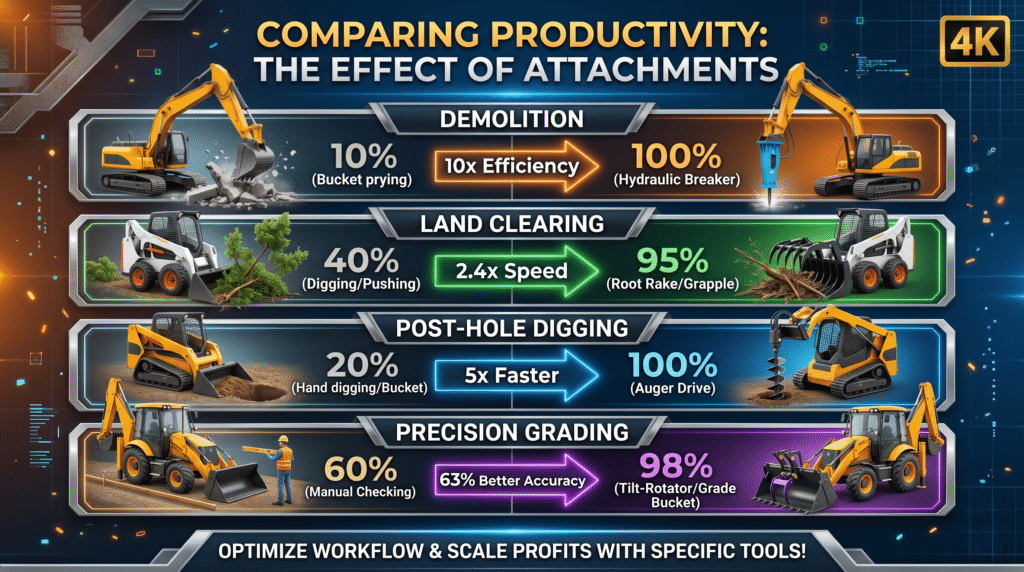
Comparing productivity: the effect of attachments
| Task Type | Standard Equipment Performance | With Specialized Attachment | Productivity Boost |
| Demolition | 10% (Bucket prying) | 100% (Hydraulic Breaker) | 10x Efficiency |
| Land Clearing | 40% (Digging/Pushing) | 95% (Root Rake/Grapple) | 2.4x Speed |
| Post-Hole Digging | 20% (Hand digging/Bucket) | 100% (Auger Drive) | 5x Faster |
| Precision Grading | 60% (Manual Checking) | 98% (Tilt-Rotator/Grade Bucket) | 63% Better Accuracy |
Tiltrotators and couplers: how they help with accuracy and power
You need to think about the machine’s “wrists” if you really want to let it loose. Tiltrotators have changed the industry by letting attachments rotate all the way around and tilt up to 45 degrees. This means that the tool moves to the work while the excavator stays still, which greatly cuts down on track wear and fuel use.
What Modern Coupling Systems Do
- Quick Couplers: These let you change attachments in seconds instead of hours, so the operator always has the right tool for the job at hand.
- 360-Degree Rotation: This feature lets you do complicated grading and trenching in tight urban spaces where the machine can’t move around easily.
- Safety First: Operators can switch tools from the safety of the cab with modern hydraulic couplers. This lowers the risk of accidents on the ground.
How attachments pay for themselves and get the most out of your money
The first cost of high-quality excavator attachments may seem scary, but the math is on the side of the brave. You can make more money by adding new services to your machine. A machine that can dig, break, and sort is three times more useful than one that can only dig.
Financial Advantages of a Flexible Fleet
- No Rental Fees: If you own your own breakers or augers, you don’t have to wait for them to be available or pay daily fees.
- Lower Labor Costs: Specialized tools help you get jobs done faster, so you can move your crew to the next one sooner.
- Higher Resale Value: A well-maintained excavator that comes with a set of working attachments usually sells for a lot more on the market.
FAQs – Excavator Attachments
What are the most popular excavator attachments?
Digging buckets, hydraulic breakers (hammers), augers, grapples, thumbs, and rippers are some of the most common attachments. Each one is made to work well with certain materials, like soil, rock, or trash.
What size attachment should I get for my excavator?
You need to make sure that the weight and hydraulic needs (flow and pressure) of the attachment match those of your machine. If you use an attachment that is too heavy, the machine may tip over. If you use one that is too small, the machine won’t use all of its power.
Are attachments for excavators the same for all of them?
A lot of modern machines use “Universal Quick Couplers,” but there are still differences between brands like CAT, John Deere, and Komatsu. Before you buy, always check the sizes of the ears and pins.
Can I tear down something with a mini-excavator?
Yes, mini-excavators are great for tearing down things inside and removing small amounts of concrete when they have a small hydraulic breaker or a special thumb.
What is a tiltrotator, and do I need one?
A tiltrotator is a type of coupler that lets an attachment tilt and turn at the same time. It is not necessary for basic digging, but it is highly recommended for more complicated landscaping, grading, and utility work.
How does an attachment change how much gas I use?
Using the right attachment for the job can actually help save gas. A specialized tool speeds up the work, which means the engine runs for fewer hours to do the same thing.
How often do I need to take care of my hydraulic attachments?
You need to grease hydraulic attachments like breakers and augers every day and check the hoses and seals every now and then. Regular maintenance keeps the hydraulic system from getting dirty, which saves money.
Last Thoughts: Don’t Let Your Machine Work Less Well
Your excavator is a monster that is ready to go. At American Excavator, we think that every job needs the right tools to get the job done right. Stop thinking of your machine as a one-trick pony and start using it as the flexible platform it was meant to be. Improve your workflow, add to your arsenal, and see your productivity skyrocket.
Open up your potential today. Let the beast out.