
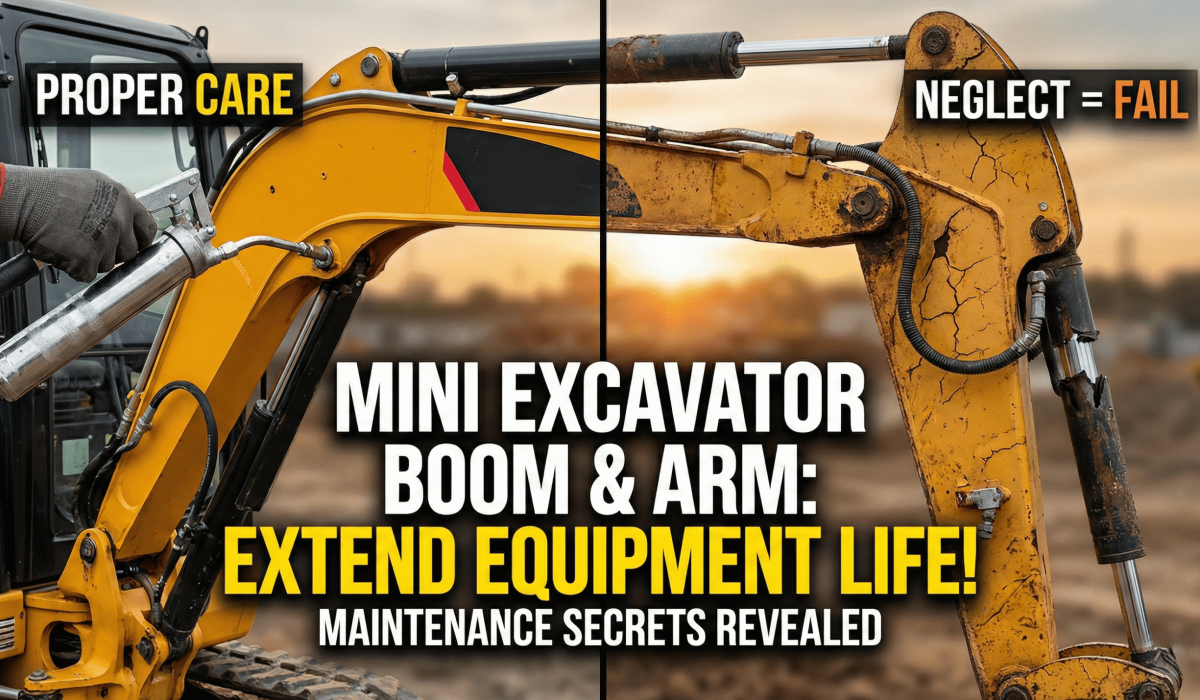
Mini Excavator Boom and Arm Parts: How Properly Caring for Them Can Mean Longer Equipment
The main strength of a mini excavator is the front-end assembly. The boom and arm (the latter also called stick or dipper) are the major elements that are responsible for digging, lifting, and material handling. Since these parts are the most mechanically and hydraulically stressed, keeping the Mini Excavator Boom and Arm Parts in good condition is a must for any contractor or owner-operator wanting the best financial return from their equipment.
Ignoring those parts not only affects the speed of work but can put the entire structure at great risk with a catastrophic breakdown. This in-depth article highlights the major parts of the boom and arm and gives a maintenance program to help your unit stay top-performing even after years of use.
Understanding the basic components of the boom and arm
It’s necessary first to understand what makes use of the “working hand” of your equipment before you do any maintenance. The perfect functioning of these pieces together defines the digging capacity, working depth, and the machine’s breakout power.
- The Boom: It is the main piece of the structure and is the one that is fixed onto the machine’s house (the main frame). It is the component that gives the workgroup their main lift and allows them to reach up high.
- The Arm (Stick/Dipper): The arm is fixed on the boom’s end and the two together give the bucket the right angles for pivoting and getting into the soil during digging.
- Hydraulic Cylinders: It is the actuators (especially the boom cylinder and the arm cylinder) which by changing the hydraulic power into mechanical force are capable of moving such heavy steel structures.
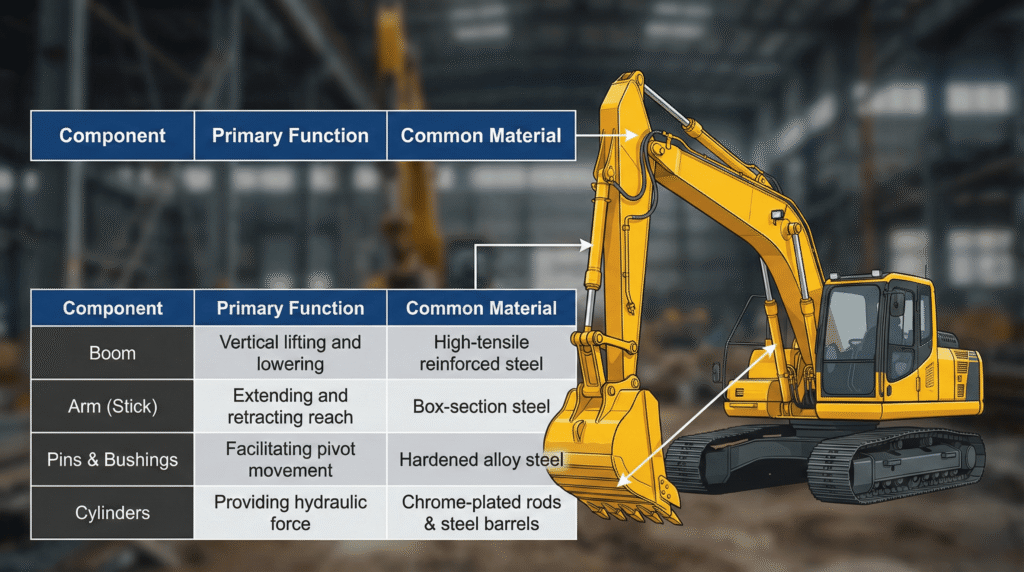
Functionality Table:
| Component | Primary Function | Common Material |
| Boom | Vertical lifting and lowering | High-tensile reinforced steel |
| Arm (Stick) | Extending and retracting reach | Box-section steel |
| Pins & Bushings | Facilitating pivot movement | Hardened alloy steel |
| Cylinders | Providing hydraulic force | Chrome-plated rods & steel barrels |
Top 7 Mini Excavator Boom and Arm Parts Tips
1. The Essential Role of Daily Lubrication
Out of all the features that can be used to prolong the life of Mini Excavator Boom and Arm Parts, lubrication is perhaps the most crucial one. Once there is no smooth layer of grease, the rubbing of pins on bushings will very quickly cause “play” or looseness in the joints.
- Locate All Grease Points: Grease should be applied to every moving point in boom foot, boom-to-arm as well as arm-to-bucket joints daily.
- Choose Good Quality Grease: A lithium-based grease with molybdenum disulfide (moly) will be the best choice as such a product is specially made to sustain extra tough pressure loads which are typical of excavation operations.
- Remove Contaminants First: It is very important that the grease nipples are thoroughly cleaned before putting the grease gun otherwise dirt and grit will be directly pumped into the bushings.
2. Identifying Potential Problems with Cylinders and Hoses Unseen
Your boom and arm can only deliver power if the hydraulic system driving them is working efficiently. Hoses are the components most vulnerable to damage because they are the closest to the debris and weather.
- Search for Rod Scoring: You should look over the chrome surface of hydraulic rods carefully for any damage including “pitting” as some scratches can be so small that they go unnoticed. Even such small imperfections might cause the seals to tear which then leads to internal or external leakage.
- Manage Hose Routing: It is very important to check that there should not be any interaction between the edges of the boom or the arm and the hydraulic hoses in any form such as rubbing, for instance. A possible “hose burst” failure can be the result when such friction continues long enough as it occurs during the movement.
- What to Do if Your Boom or Arm Is “Drifting” on Its Own: When your boom or arm unintentionally starts to come down slowly while the controls are in the neutral position, this may signify an internal seal leakage or a defective control valve.
3. Structural Integrity and Crack Detection
Mini excavators are made to work in difficult environments – the machinery might have to be used while moving over stones or in a demolition site. The areas where welding has been done on the boom and arm parts undergo a lot of stress cycles and if a huge crack does not develop, the metal will at least have fatigue cracks.
- Examine Welds: It is also a good idea to closely inspect the boom mounting plate area and the “crotch” of the arm, going up to the boom.
- Follow the Sound: If you are hearing a rhythmic clicking or popping sound when the machine is being operated, it probably is telling you at least one of the pins is loose or that a structural weld is partially separated.
- Painting Issues: Usually, the initial hairline crack is visually detected by a thin line of rust or “chipped paint” along a weld seam, the metal movement is revealed in this case.
4. How to Handle Pins, Bushings Replacements
Even if the lubrication is flawless, the pins and bushings will still be wear items. Preventing major damage to the huge parts of the boom and the arm that can be very costly to replace or repair by timely changing of these smaller components is what keeping them at the right size is actually all about.
- Check the Amount of “Play”: When the bucket or the arm moves from side to side, it is an indication that the bushings are worn and have to be checked. As the bushings become loose, the pins will wear the holes in the boom or the arm into an “egg” shape.
- Change on a Schedule: The cost of simply getting a new bushing can be really low compared to keeping the old one and later having to spend thousands of dollars on welding and line boring a boom that has been damaged.
- If necessary, Use Shims: Placing shims at the pivot points will be of assistance in making the connection tighter and at the same time, it reduces the lateral movement which is one of the causes of accelerated wear.
Table:
| Maintenance Interval | Task Description | Target Component |
| Daily (8 Hours) | Grease all pivot points and check for leaks | Pins, Bushings, Cylinders |
| Weekly (50 Hours) | Inspect for structural cracks and hose wear | Boom and Arm Welds |
| Monthly (250 Hours) | Check pin securement bolts and torque | Main Pivot Pins |
| Yearly (1000 Hours) | Professional hydraulic pressure test | Total Workgroup System |
5. Proper Operation to Prevent Premature Wear
What the operator does with his machine reflects directly on how long Mini Excavator Boom and Arm Parts are going to last. Overusing the equipment by making sudden moves or using the wrong digging methods can shorten the life of these components.
- Refrain from Hard Impact: Do not let the boom or arm be hammered by something or dragged to the sides with heavy debris being in contact as this causes enormous lateral stress on the boom pivot.
- Load Should Always be at the Center: The working surface must be level. If the digging is done at an angle, the boom comes under a torsion force which may result in structural warping over time.
- Keep the Boom and Arm Close to the Machine when Traveling: If the machine has to be moved a long distance with the boom and the arm hanging, it stresses the frame a lot and the center of gravity goes up thus increasing the risk of tipping over.
6. Environmental Protection and Cleaning
One should keep in mind that dirt, mud, and other corrosive elements severely hasten the degradation of seals and metal surfaces. Regularly cleaning your equipment will also make it much easier to spot problems and perform repairs.
- Maintenance of the Workgroup: One should make it a habit to remove dried mud from the cylinders frequently. Because every time the cylinder retracts, the rod sandpaper effect on the seals that can be caused by the hardened mud can be avoided.
- Anti-rust: If the equipment will be out of use for quite some time, a thin layer of grease should be applied on any exposed hydraulic rods in order to prevent rust and corrosion.
- Debris Removal: Do not allow the “well” where the boom foot rests to get clogged with stones or any other kind of debris as it may cause the mechanism to become jammed or wear the metal surfaces.
7. Quality Replacement Parts Selection
It is very important to make the right choice when selecting a replacement part after the original one is worn out completely. Different brands and qualities of aftermarket parts are available and using less competitive components may lead to a situation where the whole machine is compromised.
- Double Check the Material Specs: Replacement pins should have a similar durability as the original ones and for this, they need to be made from induction-hardened alloy steel.
- OEM vs. Quality Aftermarket: Although OEM parts are trustworthy, a high-quality aftermarket product coming from a specialized provider like American Excavator might be more affordable, yet just as durable.
- Ensure Proper Fit: Before buying the parts, always confirm the specific model number and serial number of your mini excavator so that the boom and arm parts can fit perfectly without requiring any modification.
FAQs: Mini Excavator Boom and Arm Care
How frequently should I grease pins on my mini excavator boom?
The best thing would be to grease all the pivot points every 8 to 10 hours of working. If you are working in water, mud, or dusty conditions, you should grease the machine twice a day in order to wash out the dirt and other contaminants.
What makes a boom drop or “drift” by itself?
Usually, the worn hydraulic cylinder seals (internal leaking) or a control valve that has gone bad are the reasons for boom drift. If the cylinder is internally leaking, it loses the ability to maintain the pressure that is needed to support the boom’s weight.
I found a crack on the mini excavator boom; can I weld it?
You can weld it, but only a welder certified in heavy equipment and with a welding experience in this type of equipment should do it. The boom is subjected to a great tensile force and, therefore, if the weld is not properly done, it can fail under load and cause serious accident or further machine damage.
At what point should I change bushings in the arm?
If you notice a lot of “slop” or play in the joints, then it is time to change the bushings. Specifically, if you can see more than 1/8th of an inch at the pivot point, this means that the bushings are worn out and need to be replaced.
Why are the hydraulic hoses I have on the boom getting cracked?
Hoses getting cracked is a result of UV exposure, temperature going up and down very quickly, and frequent bending. The outer rubber casing cracking or “bubbling” is a warning that you should change the hose immediately to avoid a failure that involves high pressure.
Does having a longer excavator arm shorten its lifespan?
Yes, if the arm is lengthened (long reach stick), more leverage is used and resulting that the boom and the center of gravity of the machine experience more stress. From this perspective, machines with long reach arms usually undergo inspections of the pivot pins and the welds more often.
How do I know if my hydraulic cylinder rod is bent?
If it is bent it will, most likely, make the cylinder hermetic when it leaks fluid at the seal, and you may also find “shiny spots” or one side of the rod will have wear that is not even. Another way would be to do a straightness check using a precision straight-edge tool.