
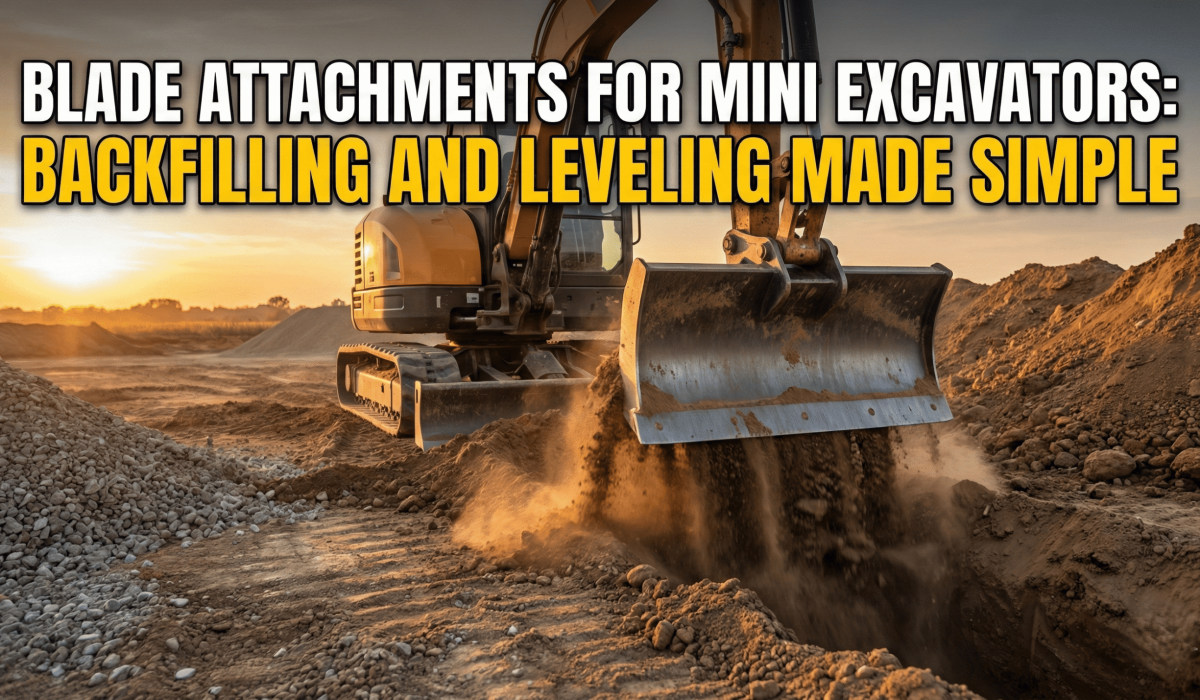
Blade Attachments for Mini Excavators: Backfilling and Leveling Made Simple
Mini excavators are famously versatile and could aptly be compared to a “Swiss Army Knife” in the world of construction machinery. Nevertheless, their genuine ability frequently stays hidden behind the regular bucket. Digging is undoubtedly the main function of these machines, but the effectiveness of a job can very well depend on the subsequent operations after excavating the hole. Blade attachments for mini excavators are really the tools that bring a revolution in this respect.
Why Blade Attachments for Mini Excavators is Necessary?
By simply adding a very efficient blade, operators are able to turn a mere digging machine into an accurate grading and re-filling powerhouse. No matter, if you are a technician carrying out professional landscaping or a homeowner planning backyard revamping, these attachments will understand how they can make preparatory works very easy thus increasing your ROI.
The incredible feature of a mini excavator is that it is very small, which allows it to be used in narrow residential corridor areas or be easily moved around a commercial site that is full of people and materials. However, without a blade, it is almost impossible to backfill a trench except by using the “scoop and drop” method with a bucket, the ground thus resulting uneven and loosely compacted.
A backfill or grading blade makes it possible for the mini to push the material in a continuous manner thereby resembling a bulldozer in terms of pushing style but doing it with the delicate touch required for projects on the smaller scale. What this new use for the machine has resulted in is that not only do the surfaces get “filled” but they are also leveled professionally and are ready for the next stage of the construction.
Understanding Different Types of Blade Attachments
Choosing the appropriate tool is always going to be halfway through doing the work efficiently. There are so many different types of blades that you can choose from and they all cannot be handled the same way. Blades differ in how wide they can open, the amount of hydraulic power they can handle, and also the type of ground to which they are best suited. Your attachment choice will determine the amount of manual work you can eliminate from your work.
- Standard Straight Blades: Also referred to as S-blades, these blades only take vertical movement by going up and down to provide machine stability and basic leveling.
- Angle Blades: With these the operator becomes able to pivot the blade left or right, therefore it is possible to windrow material to the side when going forward.
- 6-Way Dozer Blades: These are the most versatile as they can tilt, angle, and lift simultaneously thus giving you the accuracy that you need for the contour of drainage swales and the crowning of the road.
| Blade Type | Movement Range | Best Use Case |
| Standard | Vertical (Up/Down) | Basic stability and rough backfilling |
| Angle | Vertical + Horizontal Pivot | Trench backfilling and side-casting |
| 6-Way | Vertical + Angle + Tilt | Finish grading and complex contouring |

Streamlining the Backfilling Process
Backfilling is not only about returning the excavated soil back into the hole, but the ground’s strength has to be re-established. First of all, blade attachments for mini excavators make returning soil to the hole very easy by letting the material be power-tucked into the trenches.
This method is generally good for the soil to be distributed well so that no sinkholes will occur later and the problem of settling that happens when manual filling or bucket-going leaves air pockets trapped will be solved as well.
- Continuous Flow: In contrast to a bucket, a blade stays in constant contact with the pile, thus it can push a large volume of earth in just one go.
- Side-Casting Efficiency: You can run next to a trench with an angled blade and “plow” the spoil pile back in without the need to turn the tracks.
- Improved Compaction: You can use the weight and the flat surface of the blade for “tracking” or packing the soil into a harder base.
Precision Leveling and Finish Grading
Obtaining a totally level surface for a patio, driveway, or foundation is extremely challenging when done with a conventional digging bucket. Grading blades, on the contrary, come with a very sharp and smooth cutting edge which is precisely meant for shaving the surface, raising the lower areas, and thereby keeping the earth intact. This capability is what turns a “rough” construction site into a “finished” one.
- Float Mode Compatibility: There is no doubt that many new mini excavators are equipped with a float setting that makes it possible for the blade to be free to follow the ground contours resulting in a very even finish.
- Wide Surface Area: Because the grading blade is wider in comparison, a larger area is covered in a single pass which really times the whole site preparation process brings down drastically.
- Versatile Material Handling: Not only with soil these blades are also very good at spreading gravel, crushed stone, topsoil, etc. with surgical precision.
Enhancing Stability of the Machine and Safety
Besides earthmoving, blade attachments for mini excavators have been found to perform an equally important function: when lowered into the earth the blade attachments acts as an outrigger, changes the center of gravity of the machine and offers a wider base of support. This is a crucial factor when one is digging over the side or working on very soft, uneven ground where the risk of tipping is quite high.
- Increased Lift Capacity: A blade that is firmly planted on the ground enables the excavator to go for heavier loads with the boom without the tracks being lifted off the ground.
- Anchor Point: The blade can be dug into the uphill side on slopes so as to act as an anchor and the machine will not slide during operation.
- Protection for Undercarriage: The blade functions as a shield and no large stones or debris will be able to roll underneath the tracks and cause any damages to the hydraulic lines.
How to Choose an Appropriate Blade for Your Project
The only way to fully utilize your equipment is to ensure that the attachment goes well with the machine’s hydraulic flow as well as with the requirements of the job site. On americanexcavator.org, the point is made that a too-large blade will overwork your engine while a small one will hinder your output.
- Check Hydraulic Specs: If what you want out of your blade is an angle or 6-way one, make sure the machine is equipped with the necessary auxiliary hydraulics.
- Material Matters: Are you dealing with very rocky or abrasive soils? In that case, you want blades that will have replaceable, high-carbon steel cutting edges.
- Weight Balance: The attachment should be sufficiently heavy to enable a good grip on the soil but not so heavy that it compromises the machine’s mobility.
Simple Tasks You Can Do to Ensure Longer Service Life
A blade attachment is a tough piece of equipment but that does not mean that it cannot be broken. For one reason, it is constantly exposed to abrasive materials and only best practice maintenance can guarantee it will be a reliable partner for a long time. In fact, failing to maintain the cutting edge or hydraulic seals will make a tool that is very efficient one that is liable to breakdowns and the like.
- Daily inspections: See if any bolts fastening the cutting edge are loose or if there is any sign of a hydraulic leak at the pivots.
- Grease pivot pins: Areas that rub against one another such as the angling cylinders need to be lubricated frequently so that they do not seize up.
- Edge Rotation: You can turn the blade over so it will last longer; normally, the cutting edges of blades are reversible.
FAQs – Blade Attachments for Mini Excavators!
Is it possible to equip a mini excavator with a 6-way blade?
Not actually. Mini excavators may be able to take a basic blade but in the case of a 6-way blade, there is the need for special auxiliary hydraulic circuits and controls (usually a 4-button joystick) to be able to operate the lift, angle, and tilt functions at the same time.
Is a grading blade superior to a grading bucket?
Generally, a grading blade will be used when you require pushing of significantly high volumes of material and leveling over a long distance. On the other hand, a grading bucket will perform better when it comes to “shaving” small to precise quantities of soil and transporting the material to another location.
Can you explain how “float mode” operates on an excavator blade?
Float mode is a situation when the hydraulic pressure on the cylinders that are used to lift up the blade is released and thus the blade is able to stay on the ground because of its own weight. The blade “floats” over the terrain following its shape and the operator doesn’t have to keep on changing the blade height.
Will a blade attachments be useful for snow removal?
Absolutely! Specifically, angle blades are really very good when it comes to snow clearing of such places as driveways and parking lots. Due to their excellent maneuverability, they can be used to push the snow to the side just like a typical plow truck but more effectively.
What can distinguish a backfill blade from a dozer blade?
As mini excavators are concerned, the terms are often interpreted as meaning the same thing. Nevertheless, sometimes “a backfill blade” is just a little narrower and a bit taller and it is meant to be used for trench work, whereas “a dozer blade” is a wider one and is used for general site leveling purposes.
Is a quick coupler necessary for these blade attachments for mini excavators?
It is true that some blades are “pin-on” however, most modern operators are in favor of using a quick coupler which is an advantage if you can switch from a digging bucket to a leveling blade in a flash without exiting the cab.
What kind of price range do blade attachments for mini excavators fall into?
Depending on size and complexity, there can be wide variations in prices. You may expect a standard manual-angle blade to be somewhere between $1,500 and $3,000 while a fully hydraulic 6-way blade for a larger mini excavator could be above $5,000.