
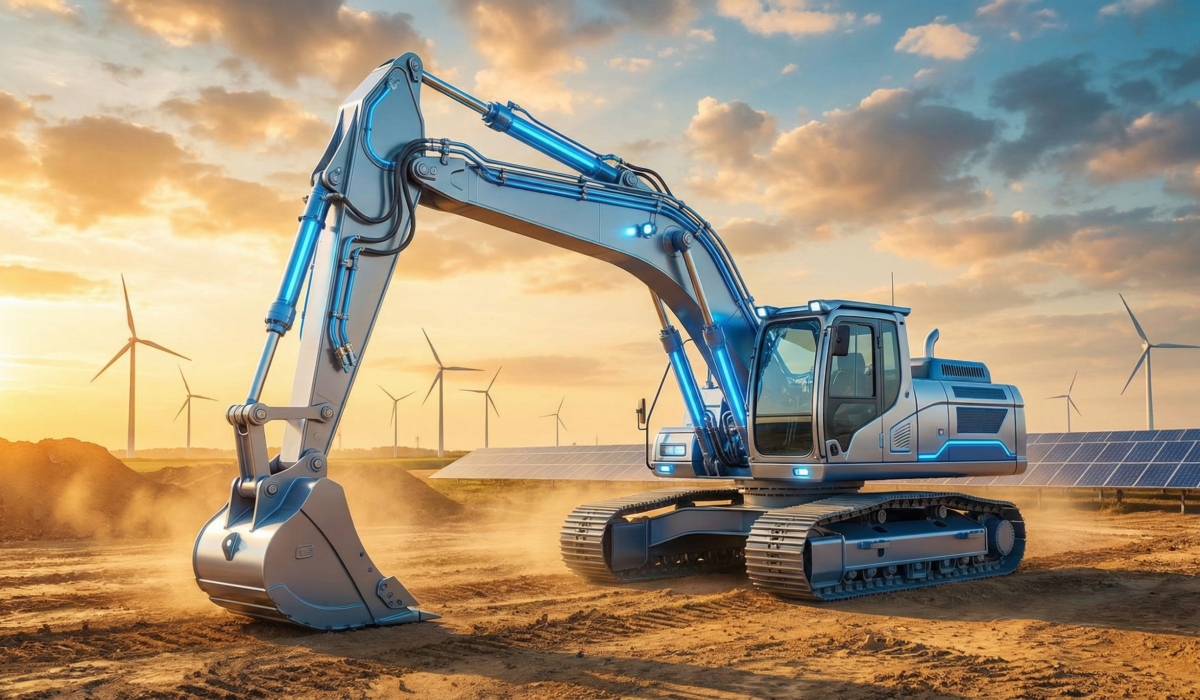
Electro-Hydraulic Excavators Could Be the Turning Point in Excavator Designs
The construction and heavy equipment industries are experiencing a major transformation into Electro-hydraulic excavators that is almost on par with the historical shift from steam to diesel. For many generations, the excavator has revolved around the operator-machine mechanical link: a mere human action lifting a lever that physically moves a pilot valve, which in turn directs oil through a hose to operate the main spool.
Hence, it was a mechanism based solely on hydraulics and mechanical linkages. However, such a traditional configuration are fast becoming inadequate as far as efficiency and integration go. Digitization is the future and it has manifested itself in the form of electro-hydraulic excavators.
This method, which in the flying industry is generally known as ‘fly-by-wire’, is basically disintegrating and reconstructing the whole blueprint of excavator design. Instead of using a complicated network of hydraulic pilot lines, it uses electrical wires and digital sensors to make the machine a smart partner that helps the operator to perform better on the site.
The move toward electro-hydraulic excavators is mainly inspired by the demand for higher fuel efficiency, less pollution, and an increase in the ability to integrate automation solutions. More and more construction sites are being digitized, hence the use of purely mechanical hydraulic systems becomes a hindrance as far as data flow and responsiveness are concerned.
Electro-hydraulics come to the rescue by serving as an interface between the machine’s digital brain and its hydraulic muscles. Such a development opens the door to precision, customization, and energy management, which simply couldn’t have been achieved physically. Fleet owners and operators who frequent will certainly find it advantageous to comprehend this development deeply. This is not only a swap of parts but a change of potential that will set the tone for the next ten years of earthmoving competition.
The Technology Behind Electro-Hydraulic Excavators
Understanding such a colossal transition necessitates an awareness of the architecture differences. In the old fashioned hydraulic system, the joystick itself is a hydraulic pump. When you use it you are physically sending a low pressure oil (pilot oil) through lines that go through the cab floor and finally end up at the main control valve.
Electro-hydraulic excavators however get rid of such an archaic system. In these new high-tech machines, the joystick is regarded as an electronic input device, not very different from a high-end gaming controller but built with indestructible materials.
On movement, it sends a digital signal to an Electronic Control Unit (ECU). This computer then processes the command—taking into account engine speed, load sensors and whatever operator settings have been chosen—after which it sends an electrical current to solenoids on the main hydraulic valve thus releasing the oil flow.
Introducing a digital intermediary in the middle has made it possible for the machine to exhibit some level of “intelligence”. The ECU can, in literally milliseconds, read the operator’s intention and fine tune the hydraulic output accordingly.
Take for example an operator who suddenly pushes the joystick to the full speed. The mechanical system will respond with a jerk and thus the spillage and damage. The electro-hydraulic system will, however, take that input and gradually and rapidly accelerate the controlled speed, thereby protecting the machine and the payload. Besides, this design makes it possible for the use of Independent Metering Valves (IMV).
In the conventional systems, the inlet and outlet of a cylinder are mechanically linked on one spool. With the help of a computer, IMV is able to control the oil going in and the oil coming out separately, which essentially means that huge efficiency is being attained.
- Digital Signal Processing: The ECU filters and optimizes operator inputs to prevent shock loads and improve smoothness, thus providing a more refined operating experience.
- Pilot Hoses Removal: The replacement of hydraulic pilot lines by electric wires offers a quieter, cooler cab without the risk of pressurized oil leaks near the operator.
- Independent Metering Capability: The two cylinder flows (inlet and outlet) can be decoupled by the system to allow for advanced pressure management that conventional spools lack.
Efficiency Gains: The Economic Engine
The most compelling argument for adopting electro-hydraulic excavators comes down to money; in particular fuel efficiency. Conventional hydraulic systems are by nature wasteful; they will direct a large amount of oil even if only a small percentage is necessary which leads to heat being produced as well as the engine supporting a parasitic load.
The engine has to exert more power just to counteract the friction of the hydraulic fluid flowing through the circuit. Electro-hydraulic excavators throw in a “demand-based” brain.
The system understands how much pressure and flow is needed for the job of say, curling the bucket versus lifting the boom, and thus when the pump is signaled to deliver that exact amount, no further adjustments are necessary. This level of accuracy not only results in fuel being used sparingly but also yields savings of 15% to 25% compared to regular pilot-controlled machines.
Besides pump efficiency, electro-hydraulics enable energy regeneration. When an excavator lowers its heavy boom, gravity provides the force. In a standard machine, the hydraulic fluid exiting the cylinder is restricted to control the descent, turning that kinetic energy into waste heat that must be cooled. Advanced electro-hydraulic systems can capture this energy.
The pressurized fluid exiting the cylinder can be routed to an accumulator to be stored and used to assist the engine during the next lift cycle, or in hybrid models, converted into electricity. This “regenerative braking” for hydraulics transforms gravity from an enemy into a power source, further driving down operating costs.
- Optimized Pump Control: The engine and hydraulic pump communicate electronically to ensure the engine only burns fuel proportional to the actual work being done.
- Energy Recovery Systems: Capturing energy from gravity-assisted functions (boom down) and swing deceleration reduces the total horsepower required from the diesel engine.
- Reduced Heat Generation: By minimizing wasted flow and pressure drops, the hydraulic oil stays cooler, reducing the load on cooling fans and extending oil life.
Revolutionizing the Operator Experience
The advent of electro-hydraulic excavators marks a paradigm change in the operator-machine relationship. The machine no longer merely follows the commands of the operator but it can also read the user’s mind and anticipate the action.
Such a machine is infinitely more versatile and accommodating than a simple tool, liberating people from the constraints of technique, skill, and physical strength. Thus, it is possible for an operator to perform at a high level all the time without getting worn out.
The fact that the machine handles the mucky and grueling parts also means that the operator’s attention is free to be on making the work of excavation more efficient through applying strategy and ingenuity.
On a more practical and basic level, operators who will have to use these new machines will find that their muscles and joints don’t ache anymore by the time they are done with their work, something that is perceptible even to an amateur observer.
The more experienced and mature users of traditional hydraulic equipment will surely find in electro-hydraulics something totally new and disruptive and for sure a big step in the right direction.
- Personalized User Profiles: The unique user settings (joystick sensitivity, button mapping) can be stored via a USB or passcode and then instantly used in any machine.
- Active Safety Barriers: E-fence technology prevents the machine from swinging into traffic or lifting into overhead hazards, thus significantly reducing accidents on site.
- Fatigue Reduction: Electronic joysticks are easier to move as they do not require hydraulic pilot levers use physical force, thus making the operator’s wrist and arm fatigued less during long shifts.
Maintenance and Diagnostics in the Digital Age
More than anything else, this is the real maintenance revolution in diagnostics, which can greatly help the technicians. For with mechanical systems, figuring out whether a particular hydraulic function is sluggish would mean opening up various test ports and attaching pressure gauges.
Quite a bother and time-consuming. However, with electro-hydraulic excavators, the unit is self-monitoring. The ECU receives constant status reports from all the sensors and solenoids. If a valve is sticking or a sensor is drifting out of calibration, the machine can send the alert to the technician either via the cab monitor or a remote telematics app.
The error code will point the faulty component exactly so that the technician comes with the right spare part first thus saving time and drastically cutting down on the “mean time to repair.”
- Simplified Hydraulic Circuitry: Minimalization of hydraulic lines leads to lower volume of hydraulic fluid being used and also limits the chances of causing environmentally dangerous leaks.
- Remote Health Monitoring: Fleet managers can check hydraulic health, temperature, and pressure real-time from the office, thus making it possible to plan maintenance before the equipment breaks down.
- Rapid Troubleshooting: Electrical faults or sensor failures are instantly detected by onboard diagnostic software. Hence, there is no need for manual pressure testing, which involves a lot of guesswork.
Comparison: Traditional vs. Electro-Hydraulic Excavators
To visualize the upgrade, we can look at the direct operational differences.
| Feature | Traditional Hydraulic System | Electro-Hydraulic System |
| Control Input | Mechanical lever pushing pilot oil | Electronic joystick sending digital signal |
| Response Time | Limited by hydraulic fluid travel time | Near-instantaneous (speed of light signals) |
| Customization | Fixed hardware; hard to change | Fully programmable via software |
| Fuel Efficiency | Lower; high parasitic losses | High; demand-driven flow management |
| Automation | Difficult; requires aftermarket actuators | Native; ready for semi-auto/full-auto |
| Hose Count | High (Pilot + Main lines) | Low (Main lines only) |
| Feedback | Hydraulic resistance felt in hand | Haptic feedback or purely visual/auditory |

The Future: Automation and Remote Control
Electro-hydraulic excavators are seen as an essential next step/opportunity for autonomous construction. It makes no sense to program a robot to operate a machine controlled by human touch and mechanical valves. Besides, when systems become digital, an excavator qualifies as a robot.
Semi-autonomous machines are currently being deployed to do the tedious tasks with minimal human input such as loading a hopper or digging a trench to a specific location as per GPS. Electro-hydraulic system will carry out these Human commands with a precision level that even a human hand cannot replicate up to 8-hour shift consistently.
In addition, it facilitates true remote operation. Because there is no physical connection between the cab and the hydraulics, the operator doesn’t have to be in the cab at all. With 5G technology, the operator at the remote control center, even if it is hundreds of miles away, can operate the electro-hydraulic excavator as if on-site.
This is a game changer for safety in risky industries such as mining, demolition, and disaster recovery. The machine and the remote station communicate through a digital signal the machine at the remote station receives the digital signal and the ECU will make the hydraulic move immediately.
This also led to labor flexibility, and for example, an operator can remotely monitor and control three different machines on three different sites while only one console is used. It is in this way that the operator can switch between the machines as appropriately.
- Plug-and-Play Automation: These machines are “automation ready” from the factory, easily integrating with 3D GPS systems without invasive retrofitting.
- Tele-Operation Capabilities: Removes operator from cab thus enabling operation in hazardous environments like collapses, areas filled with toxic gases, etc.
- Consistent Accuracy: Hydraulic systems controlled by computers completely eradicate human errors that routinely occur in fine grading, thus the job is done right the first time without need for rework.
FAQ’s – Future of Excavation with Electro-Hydraulic Excavators:
What are the main advantages of electro-hydraulic excavators?
Highly improved fuel efficiency (usually 15-25% higher), the option to individually adjust control sensitivities in order to accommodate operators’ different levels of experience, reduced maintenance tasks due to a decreased number of hydraulic hoses, and further automation by 2D and 3D grade control systems integration leading to automated digging are the main benefits.
How do electro-hydraulic controls differ from pilot controls?
Pilot controls use low-pressure hydraulic fluid to physically push the main spool valves, thus requiring hoses to be run from the joystick to the valve. Electro-hydraulic controls use electronic sensors in the joystick to send a digital signal to a computer, which then electrically actuates the valves, thus the pilot hoses are not only eliminated but also software-based adjustments are allowed.
Are electro-hydraulic excavators reliable?
Modern electro-hydraulic systems are very reliable. While they have more electronics, they dispense with the most common failure points of traditional systems: the pilot hydraulic lines which are prone to leaks and rubbing. Besides, the electrical parts are closed, and tests have shown that they can resist the harsh construction surroundings (vibration, dust, moisture).
Can electro-hydraulic excavators save money on fuel?
Yes, definitely. Electro-hydraulic excavators take fuel saving up a notch with the use of independent metering valves and intelligent pump control whereby the machine creates only the exact flow and pressure that are needed for the task. They also reduce engine RPMs in low-load activities and even capture energy from boom-down movements and store it, which I believe leads to substantial diesel savings over the machine’s lifespan.
Is it hard to learn how to operate an electro-hydraulic excavator?
Actually, quite the opposite of what you suggested. Since the controls can be modified, a beginner operator can switch the machine to “slow and smooth” mode for safe learning. Grade assist, virtual boundaries (e-fences) features in addition to other features make it possible for new operators to perform like professionals faster than on traditional mechanical machines.
Do electro-hydraulic excavators have “lag”?
Some delay or lag was reported ten years ago with the first-generation machines as is the case even with most other types of machines and equipment but today it is almost impossible for such to be feasible as current electro-hydraulic excavators from known brands are equipped with top-notch processors and advanced valve technology that effectively have eliminated lag. Operator feedback points to instant response being the highlight of these machines, even more accurate when compared to traditional hydraulic pilot controls.
Can I retrofit an old excavator to be electro-hydraulic?
Technically it can be done but it is not economically viable. Replacing a mechanical pilot system with an electro-hydraulic involves changing the main control valve, adding an ECU, changing the joysticks, rewiring the machine as well as other alterations. To be sure, it is always better to acquire a factory-designed machine having such architecture so that safety and software integration are guaranteed.
Final Verdict – A Transition On Electro-Hydraulic Excavators
The construction sector is progressively unshackling itself from the mechanical and is gearing up for a digital transformation. Electro-hydraulic excavators, in particular, bring the best of technology, efficiency, power, and intelligence together – something the traditional machines cannot boost. Owners and operators of businesses picking up their tools at americanexcavator.org will have less advantage of increased productivity accompanied by lower operating costs; different aspects of the business will be more responsive, such as: the addition of interaction among machines, the remote monitoring of fleet operations, and the real-time monitoring of equipment health.
These new technologies can operationally be thought of as machines being ‘self-aware’. They can not only tell when a task is being performed by an operator but also the quality (performance) level. The built-in artificial intelligence (AI) can thus use the information it receives to come up with ideas on how to increase the efficiency and the overall productivity of the task at hand.