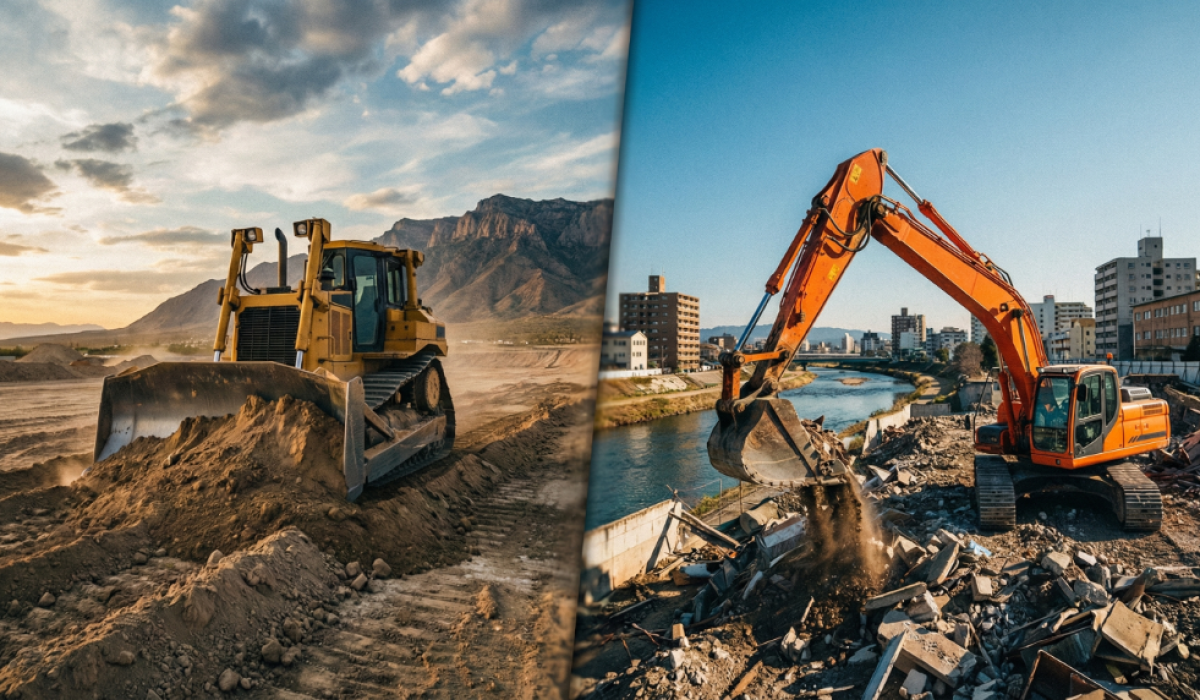
Bulldozer vs. Excavator: Which Mini Excavator is suitable for different projects?
There is a variety of earthmoving and heavy construction equipment that is designed to carry out different tasks. Hence, functionality and effectiveness depend largely on properly selecting equipment based on the needs of the project at hand. American Excavator recognizes your need to get the right equipment for the job no matter how complex the site is. Whether you are opening up a mine, reshaping a garden, or demolishing an old building, the question of Bulldozer vs Excavator usually comes up among project managers and contractors as well to choose the best mini excavator.
These two machines are the giants of the industry and each possesses more features and power than typical machines with some overlapping functions which might cause confusion to novices in the industry. Knowing how these two heavy equipment comparatively differ helps you make the most of your money by increasing performance, safety, and cost savings.
To a layman, they may look quite similar as they are both large tracked vehicles used to move earth and materials, but really, a bulldozer and an excavator are very different in terms of their main mechanisms and most suitable uses. The main function of a bulldozer is that of material pushing whereas the excavator can be said to be a specialist in digging and lifting hence it is capable of doing a great number of different things with precise control.
Understanding the Power of the Bulldozer
A bulldozer (also called a dozer) is a heavy machine on tracks with a big blade that can push large amounts of soil, sand, or debris during construction or land clearing work. In the world of construction equipment, the bulldozer is the strongest and most powerful machine. It is mainly used for clearing areas and generally preparing the ground.
The main idea is that by pushing power and traction, the dozer can move the objects that other machines cannot move. The tracks give it excellent ground hold and mobility through very rough terrain, preventing it from sinking in sandy or muddy ground.
Like with any other piece of equipment, it is important to know what a bulldozer can do and is intrinsically capable of before committing the money to it. Besides the fact that its weight can be used as an advantage to the extent that it can help in compacting the soil on which it moves, it is not suitable for making holes in the ground.
Some of the important functions of a bulldozer are:
- Land clearing: Bulldozers are great for clearing land by cutting down and removing trees, stumps, rocks and undergrowth.
- Surface grading and leveling: Bulldozers are often used for spreading material and leveling the ground to provide a flat surface for buildings, roads and runways.
- Pushing Material: The blade of a dozer is ideal for performing the lateral movement of materials, whether it be pushing scraps for disposal or shoving soil to backfill a shallow trench.
Unleashing the Versatility of the Excavator
Just like a bulldozer, an excavator is a heavy construction machine that has several parts including a boom, an arm, a bucket, and a cabin. These sit on a platform which can rotate and this is called the house. The house sits on the undercarriage which could have either wheels or tracks.
The bulldozer is a machine that is all about pushing and so the excavator is pretty much the total opposite. To put it simply, it can perform digging, lifting, and swinging operations. If you ask us, mini excavators are like the “Swiss Army Knife” of heavy machinery.” That is serious praise as a multi-tool capable of operating a whole range of heavy equipment simply by swapping over the attachments.
For example, using it for digging great trenches for laying pipe to carefully positioning heavy-weight pipe for assembly and even demolishing concrete structures.
The excavator operator has 360 degrees view of his surroundings since the cabin can rotate all around. Therefore, no need to move the machine’s tracks to get to any part of a worksite. This feature of staying stationary while rotating fully results in higher productivity when it comes to loading trucks or dumping material away from a trench.
Excavators come in many sizes starting from small mini ones that are perfect for indoor home jobs or anything that does not have great space all the way to very large hydraulic mining equipment.
Some key advantages of an excavator include:
- Capability for Deep Excavation: Its main function is the digging of trenches, openings, and foundations, with the ability to tunnel as far down as necessary.
- Ability to Handle Materials: An excavator equipped with a hydraulic arm and bucket can handle heavy lifting, such as pipes, timber and concrete, and then accurately placing them.
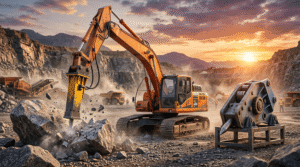
- Demolition and Attachments: Hydraulic hammers can be installed on excavators in place of the bucket, transforming the excavator into a powerful demolition machine capable of not only breaking, but also sorting and handling debris.
Bulldozer vs. Excavator: A Detailed Comparison
If you want to determine which equipment will be better for you, the most efficient way is to understand the differences between the two machines. On the surface, both are earthmovers, but they have different roles on a worksite.
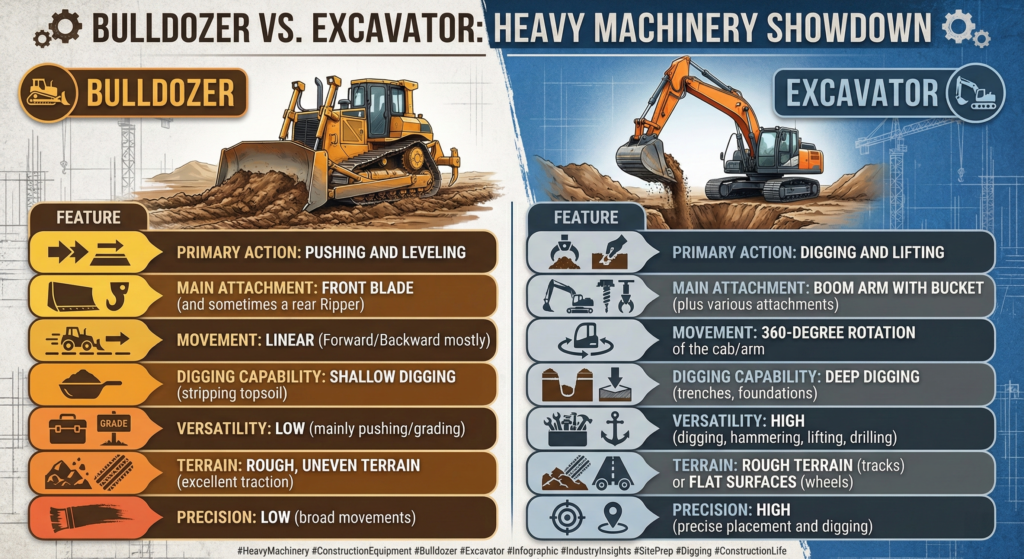
And the table below is a quick guide to help you understand the differences in each machine’s design, function, and usage.
| Feature | Bulldozer | Excavator |
| Primary Action | Pushing and Leveling | Digging and Lifting |
| Main Attachment | Front Blade (and sometimes a rear Ripper) | Boom Arm with Bucket (plus various attachments) |
| Movement | Linear (Forward/Backward mostly) | 360-degree rotation of the cab/arm |
| Digging Capability | Shallow digging (stripping topsoil) | Deep digging (trenches, foundations) |
| Versatility | Low (mainly pushing/grading) | High (digging, hammering, lifting, drilling) |
| Terrain | Rough, uneven terrain (excellent traction) | Rough terrain (tracks) or flat surfaces (wheels) |
| Precision | Low (broad movements) | High (precise placement and digging) |
Choosing the Right Mini Excavator for Your Project
If you are trying to decide on one, Bulldozer vs Excavator should be a decision based on the nature and objectives of your project only. Bulldozers are often the tool that will help you the most at the very beginning of a project when the mostly uninhabited land is full of wild overgrown areas and has an uneven surface and therefore you need to get rid of the vegetation and strip off the topsoil.
But, when it is a surface that has been prepared and you are involved with such tasks like digging below the surface, working with an excavator will be a great choice.
A typical example of a residential construction where these machines are used might be that with a bulldozer the site would be cleared and the driveway graded. Next, mini excavator would be called in to dig the basement foundation, trench for water and sewer lines, and maybe with the use of a grapple attachment, large landscaping rocks would be put in place.
Due to its capability of attaching a ladder or going vertical, the mini excavator can be used in situations where the bulldozer will not be able to maneuver without causing damage or be useless because it is too big.
Think about these:
- Depth Requirements: Excavators are a must if the work is about digging deep (pool, basement, trench, etc.)
- Surface Area: Bulldozers will do the leveling job far better if you have a large area that needs to be flattened out quickly.
- Material Transport: Excavators are the only ones that can load soil into a dump truck directly normally; bulldozers can only push soil into a pile but cannot lift it into the truck bed.
FAQs: Bulldozer vs. Excavator
Can a bulldozer dig as good as an excavator?
No, a bulldozer cannot dig as well as an excavator. Whilst a bulldozer can only clear the top layer of soil and make some very shallow ditches by tilting the blade, fundamentally, it is not a deep digger. Mini Excavators are mechanized forsaking human labor to digging a hole or cutting into the ground so they are the obvious winner for a trench, basement, or foundations.
Is it cheaper to rent a bulldozer or an excavator?
You will find that prices for rentals depend largely on size and locale, but on the whole, excavators and bulldozers of the same size class are going to be more or less equal in rental rate. Yet, since mini excavators can do more things (dig, load, lift), they tend to give you better bang for your buck if your needs are not just one dimensional. Mini excavators usually go for way cheaper as a rental than a full-sized bulldozer.
Which is better for clearing land: a bulldozer or an excavator?
If the land you want to clear is thick and overgrown and with heavy trees and rocks, a bulldozer will be a better choice because it can easily knock down the obstacles and clear wide spaces very quickly. On the contrary, if you just want to cut down the few trees selectively or get the deep stumps out without moving the soil around, then the mini excavator will come in handy because of the operator’s precision.
Can an excavator level ground similar to a bulldozer?
Yes, an excavator can do some ground leveling although generally it will be slower and harder for it to get a surface as flat as a bulldozer. By using the side of the bucket or a grading beam attachment, an excavator operator can get a good finish on the soil.
Are bulldozer and mini excavator operation licensed regulated?
It might be the case that a “license” is not legally required for many private construction situations, however, certification and training are definitely necessary (and are often insurance or OSHA requirements). When it comes to public roads and commercial work, a CDL or hoisting license may be necessary based on the state. Safety and certification of all operators is the top priority of American Excavator.
Which of the two is safer on a very steep slope?
Mini Excavators have more stability when going up steep slopes because the boom arm can serve as an anchor or stabilizer. Dozers have their center of gravity changed (and can get in a very unstable situation) when moving on steep slopes, and if the tracks lose grip the machine will slide. Nevertheless, both machines have their limit and an operator with experience should always be the one to run the machine on slopes.
Can excavator be used for dirt pushing job?
Yes it is possible to use an mini excavator for pushing dirt with a “dozer blade” attachment that is commonly available on mini excavators or pushing dirt by using the bucket. But, on the other hand, if you do it regularly then, this way of working will take a toll on the undercarriage and boom parts. If you want to push a lot of dirt for long distances, of course, the dozer is the one to go for.
Concluded Decision: Bulldozer vs Excavator
In this case, the factors make Bulldozer vs Excavator a moot debate as each has its ups and downs that make them the ideal partner for the other. The bulldozer is the leader when it comes to brute force, pushing capability, and wide-area grading, thus it is the undisputed king of site prep.
However, the mini excavator is the most versatile, deepest digger and has precision to boot, thus the most indispensable multi-tool on the construction site. American Excavator always sees that excellence is achieved when the machines are combined: the dozer to clear the path and the mini excavator to build the future.
Whether your backyard calls for a mini excavator to be rented or you have questions about the heavy equipment needed for a commercial construction, you can understand that these differences help you save not only time but money as well. Remember to always be safe and take care of your machines, and you will always be better served by the equipment that suits your terrain and project goals best.